FreeQAs
 Request Exam  Contact
  • Home
  • View All Exams
  • New QA's
  • Upload
PRACTICE EXAMS:
  • Oracle
  • Fortinet
  • Juniper
  • Microsoft
  • Cisco
  • Citrix
  • CompTIA
  • VMware
  • ISC
  • SAP
  • EMC
  • PMI
  • HP
  • Salesforce
  • Other
  • Oracle
    Oracle
  • Fortinet
    Fortinet
  • Juniper
    Juniper
  • Microsoft
    Microsoft
  • Cisco
    Cisco
  • Citrix
    Citrix
  • CompTIA
    CompTIA
  • VMware
    VMware
  • ISC
    ISC
  • SAP
    SAP
  • EMC
    EMC
  • PMI
    PMI
  • HP
    HP
  • Salesforce
    Salesforce
  1. Home
  2. Microsoft Certification
  3. AZ-304 Exam
  4. Microsoft.AZ-304.v2022-10-14.q303 Dumps
  • ««
  • «
  • …
  • 20
  • 21
  • 22
  • 23
  • 24
  • 25
  • 26
  • 27
  • 28
  • 29
  • …
  • »
  • »»
Download Now

Question 116

You are designing an Azure Cosmos DB solution that will host multiple writable replicas in multiple Azure regions.
You need to recommend the strongest database consistency level for the design. The solution must meet the following requirements:
* Provide a latency-based Service Level Agreement (SLA) for writes.
* Support multiple regions.
Which consistency level should you recommend?
Correct Answer: A
Explanation
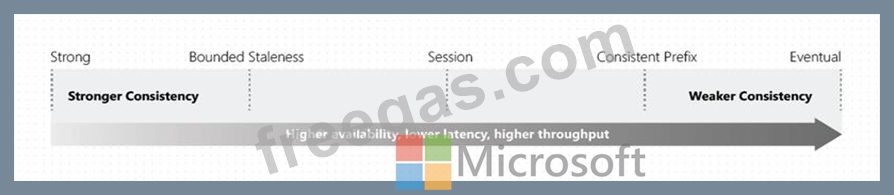
Each level provides availability and performance tradeoffs. The following image shows the different consistency levels as a spectrum.
Timeline Description automatically generated

Note: The service offers comprehensive 99.99% SLAs which covers the guarantees for throughput, consistency, availability and latency for the Azure Cosmos DB Database Accounts scoped to a single Azure region configured with any of the five Consistency Levels or Database Accounts spanning multiple Azure regions, configured with any of the four relaxed Consistency Levels.
Reference:
https://azure.microsoft.com/en-us/support/legal/sla/cosmos-db/v1_3/
https://docs.microsoft.com/en-us/azure/cosmos-db/consistency-levels#consistency-levels-and-latency
insert code

Question 117

Your company deploys several Linux and Windows virtual machines (VMs) to Azure. The VMs are deployed with the Microsoft Dependency Agent and the Log Analytics Agent installed by using Azure VM extensions. On-premises connectivity has been enabled by using Azure ExpressRoute.
You need to design a solution to monitor the VMs.
Which Azure monitoring services should you use? To answer, select the appropriate Azure monitoring services in the answer area.
NOTE: Each correct selection is worth one point.

Correct Answer:

Explanation:
Box 1: Azure Traffic Analytics
Traffic Analytics is a cloud-based solution that provides visibility into user and application activity in cloud networks. Traffic analytics analyzes Network Watcher network security group (NSG) flow logs to provide insights into traffic flow in your Azure cloud. With traffic analytics, you can:
* Identify security threats to, and secure your network, with information such as open-ports, applications attempting internet access, and virtual machines (VM) connecting to rogue networks.
* Visualize network activity across your Azure subscriptions and identify hot spots.
* Understand traffic flow patterns across Azure regions and the internet to optimize your network deployment for performance and capacity.
* Pinpoint network misconfigurations leading to failed connections in your network.
Box 2: Azure Service Map
Service Map automatically discovers application components on Windows and Linux systems and maps the communication between services. With Service Map, you can view your servers in the way that you think of them: as interconnected systems that deliver critical services. Service Map shows connections between servers, processes, inbound and outbound connection latency, and ports across any TCP-connected architecture, with no configuration required other than the installation of an agent.
References:
https://docs.microsoft.com/en-us/azure/network-watcher/traffic-analytics
https://docs.microsoft.com/en-us/azure/azure-monitor/insights/service-map
insert code

Question 118

You need to recommend a solution for data of the historical transaction query system.
What should you include in the recommendation? To answer, Select the appropriate or options in the answer area.
NOTE: Each correct selection is worth one point

Correct Answer:
insert code

Question 119

A company named Contoso, Ltd- has an Azure Active Directory {Azure AD) tenant that uses the Basic license.
You plan to deploy two applications to Azure. The applications have the requirements shown in the following table.

Which authentication strategy should you recommend for each application? To answer, drag the appropriate authentication strategies to the correct applications. Each authentication strategy may be used once, more than once, or not at all. You may need to drag the split bar between panes or scroll to view content.
NOTE: Each correct selection is worth one point.

Correct Answer:

Explanation

Box 1: Azure AD V2.0 endpoint
Microsoft identity platform is an evolution of the Azure Active Directory (Azure AD) developer platform. It allows developers to build applications that sign in all Microsoft identities and get tokens to call Microsoft APIs, such as Microsoft Graph, or APIs that developers have built. The Microsoft identity platform consists of:
OAuth 2.0 and OpenID Connect standard-compliant authentication service that enables developers to authenticate any Microsoft identity, including:
Work or school accounts (provisioned through Azure AD)
Personal Microsoft accounts (such as Skype, Xbox, and Outlook.com)
Social or local accounts (via Azure AD B2C)
Box 2: Azure AD B2C tenant
Azure Active Directory B2C provides business-to-customer identity as a service. Your customers use their preferred social, enterprise, or local account identities to get single sign-on access to your applications and APIs.
Azure Active Directory B2C (Azure AD B2C) integrates directly with Azure Multi-Factor Authentication so that you can add a second layer of security to sign-up and sign-in experiences in your applications.
Reference:
https://docs.microsoft.com/en-us/azure/active-directory-b2c/active-directory-b2c-reference-mfa
https://docs.microsoft.com/en-us/azure/active-directory/develop/v2-overview
insert code

Question 120

Your company has users who work remotely from laptops.
You plan to move some of the applications accessed by the remote users to Azure virtual machines. The users will access the applications in Azure by using a point-to-site VPN connection. You will use certificates generated from an on-premises-based certification authority (CA).
You need to recommend which certificates are required for the deployment.
What should you include in the recommendation? To answer, drag the appropriate certificates to the correct targets. Each certificate may be used once, more than once, or not at all. You may need to drag the split bar between panes or scroll to view content.
NOTE: Each correct selection is worth one point.

Correct Answer:

Explanation
insert code
  • ««
  • «
  • …
  • 20
  • 21
  • 22
  • 23
  • 24
  • 25
  • 26
  • 27
  • 28
  • 29
  • …
  • »
  • »»
[×]

Download PDF File

Enter your email address to download Microsoft.AZ-304.v2022-10-14.q303 Dumps

Email:

FreeQAs

Our website provides the Largest and the most Latest vendors Certification Exam materials around the world.

Using dumps we provide to Pass the Exam, we has the Valid Dumps with passing guranteed just which you need.

  • DMCA
  • About
  • Contact Us
  • Privacy Policy
  • Terms & Conditions
©2026 FreeQAs

www.freeqas.com materials do not contain actual questions and answers from Cisco's certification exams.
