FreeQAs
 Request Exam  Contact
  • Home
  • View All Exams
  • New QA's
  • Upload
PRACTICE EXAMS:
  • Oracle
  • Fortinet
  • Juniper
  • Microsoft
  • Cisco
  • Citrix
  • CompTIA
  • VMware
  • ISC
  • SAP
  • EMC
  • PMI
  • HP
  • Salesforce
  • Other
  • Oracle
    Oracle
  • Fortinet
    Fortinet
  • Juniper
    Juniper
  • Microsoft
    Microsoft
  • Cisco
    Cisco
  • Citrix
    Citrix
  • CompTIA
    CompTIA
  • VMware
    VMware
  • ISC
    ISC
  • SAP
    SAP
  • EMC
    EMC
  • PMI
    PMI
  • HP
    HP
  • Salesforce
    Salesforce
  1. Home
  2. Microsoft Certification
  3. AZ-400 Exam
  4. Microsoft.AZ-400.v2023-11-06.q439 Dumps
  • ««
  • «
  • …
  • 61
  • 62
  • 63
  • 64
  • 65
  • 66
  • 67
  • 68
  • 69
  • 70
  • …
  • »
  • »»
Download Now

Question 321

You have a project in Azure DevOps named Project1 that contains two Azure DevOps pipelines named Pipeline1 and Pipeline2.
You need to ensure that Pipeline1 can deploy code successfully to an Azure web app named webapp1. The solution must ensure that Pipeline2 does not have permission to webapp1.
Which three actions should you perform in sequence? To answer, move the appropriate actions from the list of actions to the answer area and arrange them in the correct order.

Correct Answer:
Graphical user interface, text, application, email Description automatically generated

Reference:
https://docs.microsoft.com/en-us/azure/devops/pipelines/library/connect-to-azure?view=azure-devops
insert code

Question 322

How should you configure the release retention policy for the investment planning applications suite? To answer, select the appropriate options in the answer area.
NOTE: Each correct selection is worth one point.

Correct Answer:

Explanation

Scenario: By default, all releases must remain available for 30 days, except for production releases, which must be kept for 60 days.
Box 1: Set the default retention policy to 30 days
The Global default retention policy sets the default retention values for all the build pipelines. Authors of build pipelines can override these values.
Box 2: Set the stage retention policy to 60 days
You may want to retain more releases that have been deployed to specific stages.
References: https://docs.microsoft.com/en-us/azure/devops/pipelines/policies/retention
insert code

Question 323

You are configuring a release pipeline in Azure DevOps as shown in the exhibit.

Use the drop-down menus to select the answer choice that answers each question based on the information presented in the graphic.
NOTE: Each correct selection is worth one point.

Correct Answer:
insert code

Question 324

You provision an Azure Kubernetes Service (AKS) cluster that has RBAC enabled. You have a Helm chart for a client application.
You need to configure Helm and Tiller on the cluster and install the chart.
Which three commands should you recommend be run in sequence? To answer, move the appropriate commands from the list of commands to the answer area and arrange them in the correct order.

Correct Answer:

Explanation

Step 1: Kubectl create
You can add a service account to Tiller using the --service-account <NAME> flag while you're configuring Helm (step 2 below). As a prerequisite, you'll have to create a role binding which specifies a role and a service account name that have been set up in advance.
Example: Service account with cluster-admin role
$ kubectl create -f rbac-config.yaml
serviceaccount "tiller" created
clusterrolebinding "tiller" created
$ helm init --service-account tiller
Step 2: helm init
To deploy a basic Tiller into an AKS cluster, use the helm init command.
Step 3: helm install
To install charts with Helm, use the helm install command and specify the name of the chart to install.
References:
https://docs.microsoft.com/en-us/azure/aks/kubernetes-helm
https://docs.helm.sh/using_helm/#tiller-namespaces-and-rbac
insert code

Question 325

You are creating a NuGet package.
You plan to distribute the package to your development team privately.
You need to share the package and test that the package can be consumed.
Which four actions should you perform in sequence? To answer, move the appropriate actions from the list of actions to the answer area and arrange them in the correct order.

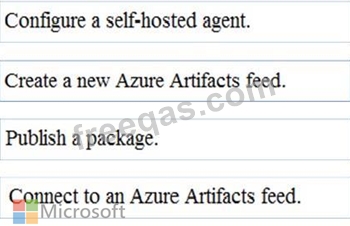
Correct Answer:

Explanation

Step 1: Configure a self-hosted agent.
The build will run on a Microsoft hosted agent.
Step 2: Create a new Azure Artifacts feed
Microsoft offers an official extension for publishing and managing your private NuGet feeds.
Step 3: Publish the package.
Publish, pack and push the built project to your NuGet feed.
Step 4: Connect to an Azure Artifacts feed.
With the package now available, you can point Visual Studio to the feed, and download the newly published package References:
https://medium.com/@dan.cokely/creating-nuget-packages-in-azure-devops-with-azure-pipelines-and-yaml-d6fa
insert code
  • ««
  • «
  • …
  • 61
  • 62
  • 63
  • 64
  • 65
  • 66
  • 67
  • 68
  • 69
  • 70
  • …
  • »
  • »»
[×]

Download PDF File

Enter your email address to download Microsoft.AZ-400.v2023-11-06.q439 Dumps

Email:

FreeQAs

Our website provides the Largest and the most Latest vendors Certification Exam materials around the world.

Using dumps we provide to Pass the Exam, we has the Valid Dumps with passing guranteed just which you need.

  • DMCA
  • About
  • Contact Us
  • Privacy Policy
  • Terms & Conditions
©2026 FreeQAs

www.freeqas.com materials do not contain actual questions and answers from Cisco's certification exams.
