FreeQAs
 Request Exam  Contact
  • Home
  • View All Exams
  • New QA's
  • Upload
PRACTICE EXAMS:
  • Oracle
  • Fortinet
  • Juniper
  • Microsoft
  • Cisco
  • Citrix
  • CompTIA
  • VMware
  • ISC
  • SAP
  • EMC
  • PMI
  • HP
  • Salesforce
  • Other
  • Oracle
    Oracle
  • Fortinet
    Fortinet
  • Juniper
    Juniper
  • Microsoft
    Microsoft
  • Cisco
    Cisco
  • Citrix
    Citrix
  • CompTIA
    CompTIA
  • VMware
    VMware
  • ISC
    ISC
  • SAP
    SAP
  • EMC
    EMC
  • PMI
    PMI
  • HP
    HP
  • Salesforce
    Salesforce
  1. Home
  2. Microsoft Certification
  3. AZ-400 Exam
  4. Microsoft.AZ-400.v2023-11-06.q439 Dumps
  • ««
  • «
  • …
  • 80
  • 81
  • 82
  • 83
  • 84
  • 85
  • 86
  • 87
  • 88
  • 89
  • »
Download Now

Question 416

You have an Azure Kubermets Service (AKS) implementation that is RBAC-enabled You plan to use Azure Container Instances as a hosted development environment to run containers in the AKS implementation.
You need to conjure Azure Container Instances as a hosted environment for running me containers in AKS.
Which three actions should you perform m sequence?
To answer, move the appropriate actions from the list of actions to the answer area and arrange them in the correct order.

Correct Answer:

Step 1: Create a YAML file.
If your AKS cluster is RBAC-enabled, you must create a service account and role binding for use with Tiller.
To create a service account and role binding, create a file named rbac-virtual-kubelet.yaml Step 2: Run kubectl apply.
Apply the service account and binding with kubectl apply and specify your rbac-virtual-kubelet.yaml file.
Step 3: Run helm init.
Configure Helm to use the tiller service account:
helm init --service-account tiller
You can now continue to installing the Virtual Kubelet into your AKS cluster.
References: https://docs.microsoft.com/en-us/azure/aks/virtual-kubelet
insert code

Question 417

You are configuring Azure Pipelines for three projects in Azure DevOps as shown in the following table.

Which version control system should you recommend for each project? To answer, drag the appropriate version control systems to the correct projects. Each version control system may be used once, more than once, or not at all. You may need to drag the split bar between panes or scroll to view content.
NOTE: Each correct selection is worth one point.

Correct Answer:

Explanation:
Project1:Git in Azure Repos
Project2: Github Enterprise
GitHub Enterprise is the on-premises version of GitHub.com. GitHub Enterprise includes the same great set of features as GitHub.com but packaged for running on your organization's local network. All repository data is stored on machines that you control, and access is integrated with your organization's authentication system (LDAP, SAML, or CAS).
Project3: Bitbucket cloud
One downside, however, is that Bitubucket does not include support for SVN but this can be easily amended migrating the SVN repos to Git with tools such as SVN Mirror for Bitbucket .
Note: SVN is a centralized version control system.
Incorrect Answers:
Bitbucket:
Bitbucket comes as a distributed version control system based on Git.
Note: A source control system, also called a version control system, allows developers to collaborate on code and track changes. Source control is an essential tool for multi-developer projects.
Our systems support two types of source control: Git (distributed) and Team Foundation Version Control (TFVC). TFVC is a centralized, client-server system. In both Git and TFVC, you can check in files and organize files in folders, branches, and repositories.
References:
https://www.azuredevopslabs.com/labs/azuredevops/yaml/
https://enterprise.github.com/faq
insert code

Question 418

You have a project in Azure DevOps named Project1 that has a release pipeline in Azure Pipeline named ReleaseP1.
you need to ensure that when a new release is generated for ReleaseP1, a new release note document is created. The release notes must contain new features and bug fixes.
Which three actions should you perform in sequence? To answer, move the appropriate actions from the Most of actions to the answer area and arrange them r the correct order.
NOTE: More than one order of answer choices is correct You will receive credit for any of the correct orders you select

Correct Answer:
insert code

Question 419

You need to increase the security of your team's development process.
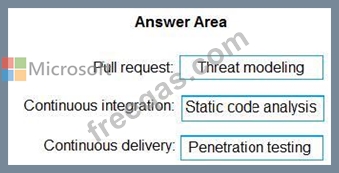
Which type of security tool should you recommend for each stage of the development process? To answer, drag the appropriate security toots to the correct stages. Each security tool may be used once, more than once, or not at all. You may need to drag the split bar between panes or scroll to view content NOTE: Each correct selection is worth one point.

Correct Answer:

Explanation

Box 1: Threat modeling
Threat modeling's motto should be, "The earlier the better, but not too late and never ignore." Box 2: Static code analysis Validation in the CI/CD begins before the developer commits his or her code. Static code analysis tools in the IDE provide the first line of defense to help ensure that security vulnerabilities are not introduced into the CI/CD process.
Box 3: Penetration testing
Once your code quality is verified, and the application is deployed to a lower environment like development or QA, the process should verify that there are not any security vulnerabilities in the running application. This can be accomplished by executing automated penetration test against the running application to scan it for vulnerabilities.
References:
https://docs.microsoft.com/en-us/azure/devops/articles/security-validation-cicd-pipeline?view=vsts
insert code

Question 420

You have a protect in Azure DevOps.
You need to associate an automated test to a test case.
Which three actions should you perform in sequence? To answer, move the appropriate actions from the list of actions to the answer area and arrange them in the correct order.

Correct Answer:

Explanation

The process to associate an automated test with a test case is:
* Create a test project containing your automated test. What types of tests are supported?
* Check your test project into an Azure DevOps or Team Foundation Server (TFS) repository.
* Create a build pipeline for your project, ensuring that it contains the automated test. What are the differences if I am still using a XAML build?
* Use Visual Studio Enterprise or Professional 2017 or a later version to associate the automated test with a test case as shown below. The test case must have been added to a test plan that uses the build you just defined.
Reference:
https://docs.microsoft.com/en-us/azure/devops/test/associate-automated-test-with-test-case
insert code
  • ««
  • «
  • …
  • 80
  • 81
  • 82
  • 83
  • 84
  • 85
  • 86
  • 87
  • 88
  • 89
  • »
[×]

Download PDF File

Enter your email address to download Microsoft.AZ-400.v2023-11-06.q439 Dumps

Email:

FreeQAs

Our website provides the Largest and the most Latest vendors Certification Exam materials around the world.

Using dumps we provide to Pass the Exam, we has the Valid Dumps with passing guranteed just which you need.

  • DMCA
  • About
  • Contact Us
  • Privacy Policy
  • Terms & Conditions
©2026 FreeQAs

www.freeqas.com materials do not contain actual questions and answers from Cisco's certification exams.
