FreeQAs
 Request Exam  Contact
  • Home
  • View All Exams
  • New QA's
  • Upload
PRACTICE EXAMS:
  • Oracle
  • Fortinet
  • IBM
  • Juniper
  • Microsoft
  • Cisco
  • Citrix
  • CompTIA
  • VMware
  • ISC
  • SAP
  • EMC
  • PMI
  • HP
  • Salesforce
  • Other
  • Oracle
    Oracle
  • Fortinet
    Fortinet
  • IBM
    IBM
  • Juniper
    Juniper
  • Microsoft
    Microsoft
  • Cisco
    Cisco
  • Citrix
    Citrix
  • CompTIA
    CompTIA
  • VMware
    VMware
  • ISC
    ISC
  • SAP
    SAP
  • EMC
    EMC
  • PMI
    PMI
  • HP
    HP
  • Salesforce
    Salesforce
  1. Home
  2. Microsoft Certification
  3. AZ-400 Exam
  4. Microsoft.AZ-400.v2024-04-28.q185 Dumps
  • ««
  • «
  • …
  • 14
  • 15
  • 16
  • 17
  • 18
  • 19
  • 20
  • 21
  • 22
  • 23
  • …
  • »
  • »»
Download Now

Question 86

You are developing a full Microsoft .NET Framework solution that includes unit tests.
You need to configure SonarQube to perform a code quality validation of the C# code as part of the build pipelines.
Which four tasks should you perform in sequence? To answer, move the appropriate tasks from the list of tasks to the answer area and arrange them in the correct order.

Correct Answer:

Step 1: Prepare Analysis Configuration
Prepare Analysis Configuration task, to configure all the required settings before executing the build.
This task is mandatory.
In case of .NET solutions or Java projects, it helps to integrate seamlessly with MSBuild, Maven and Gradle tasks.
Step 2: Visual Studio Build
Reorder the tasks to respect the following order:
Prepare Analysis Configuration task before any MSBuild or Visual Studio Build task.
Step 3: Visual Studio Test
Reorder the tasks to respect the following order:
Run Code Analysis task after the Visual Studio Test task.
Step 4: Run Code Analysis
Run Code Analysis task, to actually execute the analysis of the source code.
This task is not required for Maven or Gradle projects, because scanner will be run as part of the Maven/Gradle build.
Note:

References:
https://docs.sonarqube.org/display/SCAN/Analyzing+with+SonarQube+Extension+for+VSTS-TFS
insert code

Question 87

Which branching strategy should you recommend for the investment planning applications suite?

Correct Answer: D
Scenario: A branching strategy that supports developing new functionality in isolation must be used.
Feature isolation is a special derivation of the development isolation, allowing you to branch one or more feature branches from main, as shown, or from your dev branches.

When you need to work on a particular feature, it might be a good idea to create a feature branch.
Incorrect Answers:
A: Release isolation introduces one or more release branches from main. The strategy allows concurrent release management, multiple and parallel releases, and codebase snapshots at release time.
B: The Main Only strategy can be folder-based or with the main folder converted to a Branch, to enable additional visibility features. You commit your changes to the main branch and optionally indicate development and release milestones with labels.
C: Development isolation: When you need to maintain and protect a stable main branch, you can branch one or more dev branches from main. It enables isolation and concurrent development. Work can be isolated in development branches by feature, organization, or temporary collaboration.
Reference:
https://docs.microsoft.com/en-us/azure/devops/repos/tfvc/branching-strategies-with-tfvc?view=azure-devops
insert code

Question 88

You have an Azure subscription that contains the resources shown in the following table.

Project1 produces npm packages that are published to Feed 1. Feed1 is consumed by multiple projects.
You need to ensure that only tested packages are available for consumption. The solution must minimize development effort.
What should you do?

Correct Answer: C
insert code

Question 89

Your company is creating a suite of three mobile applications.
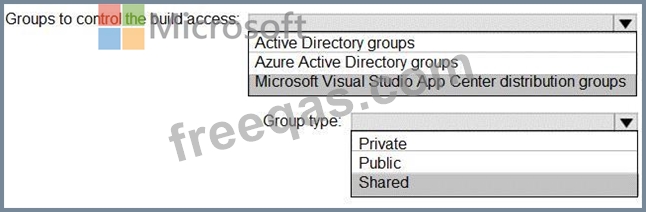
You need to control access to the application builds. The solution must be managed at the organization level What should you use? To answer, select the appropriate options m the answer area.
NOTE: Each correct selection is worth one point.

Correct Answer:

Explanation

Box 1: Microsoft Visual Studio App Center distribution Groups
Distribution Groups are used to control access to releases. A Distribution Group represents a set of users that can be managed jointly and can have common access to releases. Example of Distribution Groups can be teams of users, like the QA Team or External Beta Testers or can represent stages or rings of releases, such as Staging.
Box 2: Shared
Shared distribution groups are private or public distribution groups that are shared across multiple apps in a single organization. Shared distribution groups eliminate the need to replicate distribution groups across multiple apps.
Note: With the Deploy with App Center Task in Visual Studio Team Services, you can deploy your apps from Azure DevOps (formerly known as VSTS) to App Center. By deploying to App Center, you will be able to distribute your builds to your users.
References: https://docs.microsoft.com/en-us/appcenter/distribution/groups
insert code

Question 90

You have the Azure DevOps pipeline shown in the following exhibit.
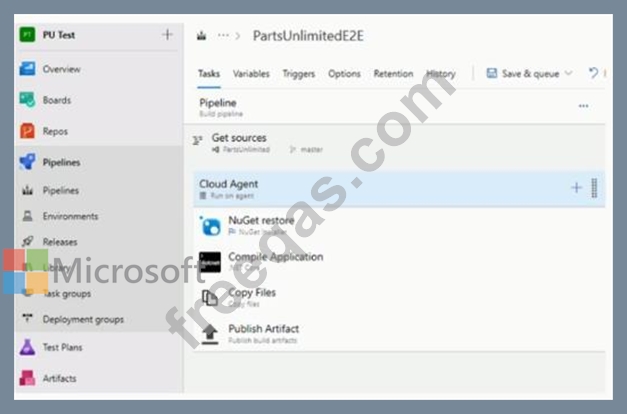
Use the drop-down menus to select the answer choice that completes each statement based on the information presented in the graphic.

Correct Answer:

Explanation

Box 1: 1
The Cloud agent job only.
Box 2: 4
The pipelines has the four tasks: NuGet restore, Compile Application, Copy Files, and Publish Artifact.
Reference:
https://azuredevopslabs.com/labs/azuredevops/continuousintegration/
insert code
  • ««
  • «
  • …
  • 14
  • 15
  • 16
  • 17
  • 18
  • 19
  • 20
  • 21
  • 22
  • 23
  • …
  • »
  • »»
[×]

Download PDF File

Enter your email address to download Microsoft.AZ-400.v2024-04-28.q185 Dumps

Email:

FreeQAs

Our website provides the Largest and the most Latest vendors Certification Exam materials around the world.

Using dumps we provide to Pass the Exam, we has the Valid Dumps with passing guranteed just which you need.

  • DMCA
  • About
  • Contact Us
  • Privacy Policy
  • Terms & Conditions
©2026 FreeQAs

www.freeqas.com materials do not contain actual questions and answers from Cisco's certification exams.
