FreeQAs
 Request Exam  Contact
  • Home
  • View All Exams
  • New QA's
  • Upload
PRACTICE EXAMS:
  • Oracle
  • Fortinet
  • Juniper
  • Microsoft
  • Cisco
  • Citrix
  • CompTIA
  • VMware
  • ISC
  • SAP
  • EMC
  • PMI
  • HP
  • Salesforce
  • Other
  • Oracle
    Oracle
  • Fortinet
    Fortinet
  • Juniper
    Juniper
  • Microsoft
    Microsoft
  • Cisco
    Cisco
  • Citrix
    Citrix
  • CompTIA
    CompTIA
  • VMware
    VMware
  • ISC
    ISC
  • SAP
    SAP
  • EMC
    EMC
  • PMI
    PMI
  • HP
    HP
  • Salesforce
    Salesforce
  1. Home
  2. Microsoft Certification
  3. AZ-400 Exam
  4. Microsoft.AZ-400.v2026-08-16.q229 Dumps
  • ««
  • «
  • …
  • 6
  • 7
  • 8
  • 9
  • 10
  • 11
  • 12
  • 13
  • 14
  • 15
  • …
  • »
  • »»
Download Now

Question 46

Hotspot Question
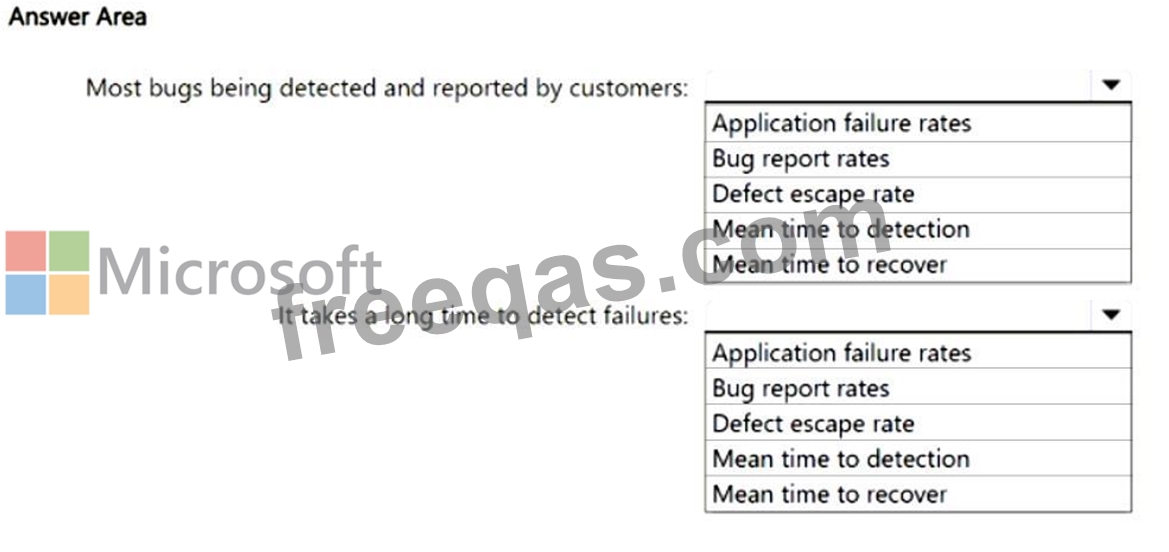
You have an Azure DevOps project that is used to build and test an app named App1.
You need to troubleshoot the following issues:
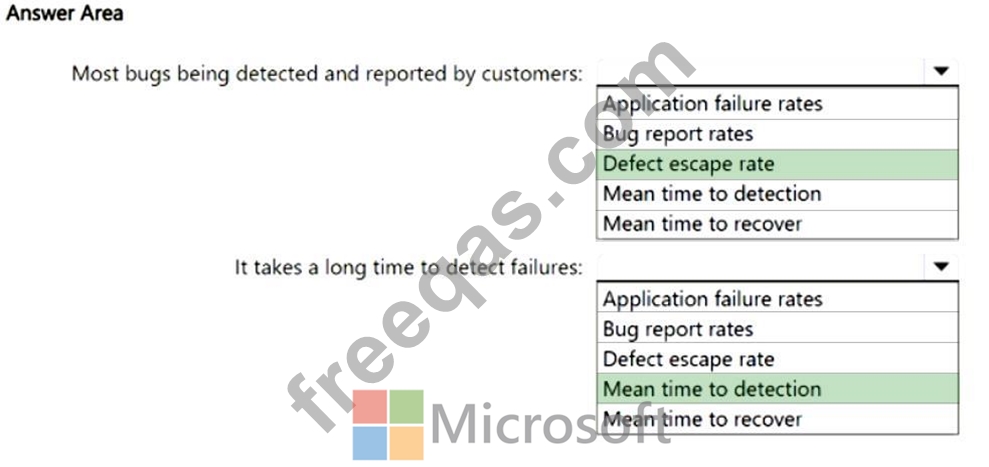
- Most bugs are detected and reported by customers.
- It takes a long time to detect failures.
Which metric should you review for each issue? To answer, select the appropriate options in the answer area.
NOTE: Each correct selection is worth one point.

Correct Answer:

Explanation:
Defect Escape Rate measures the proportion of bugs that escape internal testing processes and are instead found by end-users after deployment. It highlights gaps in the testing and quality assurance phases, resulting in defects being discovered externally by customers.
This metric is specifically used to evaluate the effectiveness of internal quality control. A high defect escape rate indicates that issues are not being identified and fixed before release, causing customers to encounter and report these bugs.
insert code

Question 47

You have an Azure DevOps project that contains a build pipeline. The build pipeline uses approximately 50 open source libraries.
You need to ensure that the project can be scanned for known security vulnerabilities in the open source libraries.
What should you do? To answer, select the appropriate options in the answer area.
NOTE: Each correct selection is worth one point.

Correct Answer:

Explanation:

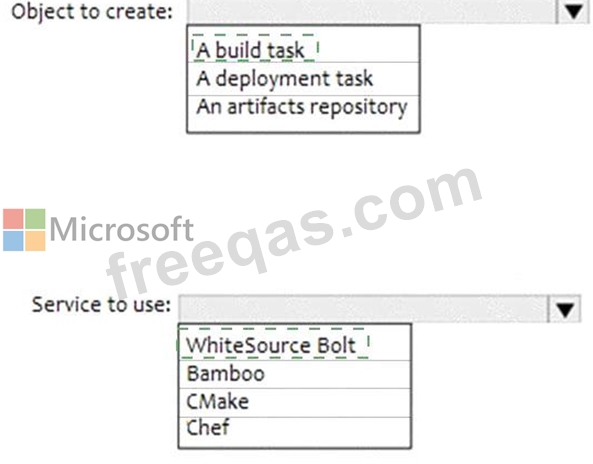
Box 1: A Build task
Trigger a build
You have a Java code provisioned by the Azure DevOps demo generator. You will use WhiteSource Bolt extension to check the vulnerable components present in this code.
* Go to Builds section under Pipelines tab, select the build definition WhiteSourceBolt and click on Queue to trigger a build.
* To view the build in progress status, click on ellipsis and select View build results.
Box 2: WhiteSource Bolt
WhiteSource is the leader in continuous open source software security and compliance management.
WhiteSource integrates into your build process, irrespective of your programming languages, build tools, or development environments. It works automatically, continuously, and silently in the background, checking the security, licensing, and quality of your open source components against WhiteSource constantly-updated de#nitive database of open source repositories.
References:
https://www.azuredevopslabs.com/labs/vstsextend/whitesource/
insert code

Question 48

Your company plans to use an agile approach to software development.
You need to recommend an application to provide communication between members of the development team who work in locations around the world. The applications must meet the following requirements:
Provide the ability to isolate the members of different project teams into separate communication

channels and to keep a history of the chats within those channels.
Be available on Windows 10, Mac OS, iOS, and Android operating systems.

Provide the ability to add external contractors and suppliers to projects.

Integrate directly with Azure DevOps.

What should you recommend?

Correct Answer: D
Explanation/Reference:
Explanation:
Slack is a popular team collaboration service that helps teams be more productive by keeping all communications in one place and easily searchable from virtually anywhere. All your messages, your files, and everything from Twitter, Dropbox, Google Docs, Azure DevOps, and more all together. Slack also has fully native apps for iOS and Android to give you the full functionality of Slack wherever you go.
Integrated with Azure DevOps
This integration keeps your team informed of activity happening in its Azure DevOps projects. With this integration, code check-ins, pull requests, work item updates, and build events show up directly in your team's Slack channel.
Note: Microsoft Teams would also be a correct answer, but it is not an option here.
References:
https://marketplace.visualstudio.com/items?itemName=ms-vsts.vss-services-slack Testlet 1 Case Study This is a case study. Case studies are not timed separately. You can use as much exam time as you would like to complete each case. However, there may be additional case studies and sections on this exam. You must manage your time to ensure that you are able to complete all questions included on this exam in the time provided.
To answer the questions included in a case study, you will need to reference information that is provided in the case study. Case studies might contain exhibits and other resources that provide more information about the scenario that is described in the case study. Each question is independent of the other question on this case study.
At the end of this case study, a review screen will appear. This screen allows you to review your answers and to make changes before you move to the next sections of the exam. After you begin a new section, you cannot return to this section.
To start the case study
To display the first question on this case study, click the Next button. Use the buttons in the left pane to explore the content of the case study before you answer the questions. Clicking these buttons displays information such as business requirements, existing environment, and problem statements. If the case study has an All Information tab, note that the information displayed is identical to the information displayed on the subsequent tabs. When you are ready to answer a question, click the Question button to return to the question.
Application Architecture
The company's primary application is a single monolithic retirement fund management system based on ASP.NET web forms that use logic written in VB.NET. Some new sections of the application are written in C#.
Variations of the application are created for individual customers. Currently, there are more than 80 live code branches in the application's code base.
The application was developed by using Microsoft Visual Studio. Source code is stored in Team Foundation Server (TFS) in the main office. The branch offices access the source code by using TFS proxy servers.
Architectural Issues
Litware focuses on writing new code for customers. No resources are provided to refactor or remove existing code. Changes to the code base take a long time, as dependencies are not obvious to individual developers.
Merge operations of the code often take months and involve many developers. Code merging frequently introduces bugs that are difficult to locate and resolve.
Customers report that ownership costs of the retirement fund management system increase continually.
The need to merge unrelated code makes even minor code changes expensive.
Customers report that bug reporting is overly complex.
Planned changes
Litware plans to develop a new suite of applications for investment planning. The investment planning applications will require only minor integration with the existing retirement fund management system.
The investment planning applications suite will include one multi-tier web application and two iOS mobile application. One mobile application will be used by employees; the other will be used by customers.
Litware plans to move to a more agile development methodology. Shared code will be extracted into a series of packages.
Litware has started an internal cloud transformation process and plans to use cloud-based services whenever suitable.
Litware wants to become proactive in detecting failures, rather than always waiting for customer bug reports.
Technical requirements
The company's investment planning applications suite must meet the following requirements:
New incoming connections through the firewall must be minimized.

Members of a group named Developers must be able to install packages.

The principle of least privilege must be used for all permission assignments.

A branching strategy that supports developing new functionality in isolation must be used.

Members of a group named Team Leaders must be able to create new packages and edit the

permissions of package feeds.
Visual Studio App Center must be used to centralize the reporting of mobile application crashes and

device types in use.
By default, all releases must remain available for 30 days, except for production releases, which must

be kept for 60 days.
Code quality and release quality are critical. During release, deployments must not proceed between

stages if any active bugs are logged against the release.
The mobile applications must be able to call the share pricing service of the existing retirement fund

management system. Until the system is upgraded, the service will only support basic authentication over HTTPS.
The required operating system configuration for the test servers changes weekly. Azure Automation

State Configuration must be used to ensure that the operating system on each test server is configured the same way when the servers are created and checked periodically.
Current Technical Issue
The test servers are configured correctly when first deployed, but they experience configuration drift over time. Azure Automation State Configuration fails to correct the configurations.
Azure Automation State Configuration nodes are registered by using the following command.
insert code

Question 49

You have an Azure subscription that contains a resources group named RG1. RG1 contains the following resources:
* Four Azure virtual machines that run Windows Server and have Internet Information Services (IIS) installed
* SQL Server on an Azure virtual machine
* An Azure Load Balancer
You need to deploy an application to the virtual machines in RG1 by using Azure Pipelines.
Which four actions should you perform in sequence? To answer, move the appropriate actions from the List of actions to the answer area and arrange them in the correct order.

Correct Answer:

Explanation:

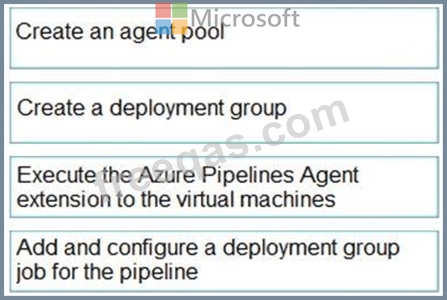
Step 1: Create an agent pool
AzurePipelines provides a pre-defined agent pool named Azure Pipelines with Microsoft-hosted agents.
Step 2: Create a deployment group
Deployment groups make it easy to define logical groups of target machines for deployment, and install the required agent oneach machine.
Step 3: Execute the Azure Pipelines Agent extension to the virtual machines Install the Azure Pipelines Agent Azure VM extension Step 4: Add and configure a deployment group job for the pipeline Tasks that you define in a deployment group job run on some or all of the target servers, depending on the arguments you specify for the tasks and the job itself.
Reference:
https://docs.microsoft.com/en-us/azure/devops/pipelines/release/deployment-groups/howto-provision- deployment-group-agents
insert code

Question 50

You are defining release strategies for two applications as shown in the following table.

Which release strategy should you use for each application? To answer, drag the appropriate release strategies to the correct applications. Each release strategy may be used once, more than once, or not at all. You may need to drag the split bar between panes or scroll to view content.
NOTE: Each correct selection is worth one point.

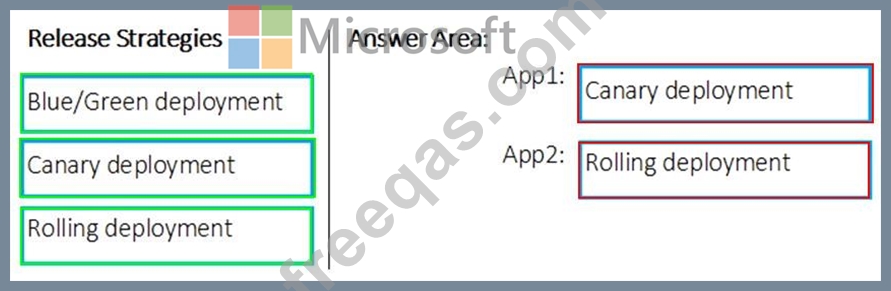
Correct Answer:

Explanation:
App1: Canary deployment
With canary deployment, you deploy a new application code in a small part of the production infrastructure. Once the application is signed off for release, only a few users are routed to it. This minimizes any impact.
With no errors reported, the new version can gradually roll out to the rest of the infrastructure.
App2: Rolling deployment:
In a rolling deployment, an application's new version gradually replaces the old one. The actual deployment happens over a period of time. During that time, new and old versions will coexist without affecting functionality or user experience. This process makes it easier to roll back any new component incompatible with the old components.
Incorrect Answers:
Blue/Green deployment
A blue/green deployment is a change management strategy for releasing software code. Blue/green deployments, which may also be referred to as A/B deployments require two identical hardware environments that are configured exactly the same way. While one environment is active and serving end users, the other environment remains idle.
Blue/green deployments are often used for consumer-facing applications and applications with critical uptime requirements. New code is released to the inactive environment, where it is thoroughly tested. Once the code has been vetted, the team makes the idle environment active, typically by adjusting a router configuration to redirect application program traffic. The process reverses when the next software iteration is ready for release.
References:
https://dev.to/mostlyjason/intro-to-deployment-strategies-blue-green-canary-and-more-3a3
insert code
  • ««
  • «
  • …
  • 6
  • 7
  • 8
  • 9
  • 10
  • 11
  • 12
  • 13
  • 14
  • 15
  • …
  • »
  • »»
[×]

Download PDF File

Enter your email address to download Microsoft.AZ-400.v2026-08-16.q229 Dumps

Email:

FreeQAs

Our website provides the Largest and the most Latest vendors Certification Exam materials around the world.

Using dumps we provide to Pass the Exam, we has the Valid Dumps with passing guranteed just which you need.

  • DMCA
  • About
  • Contact Us
  • Privacy Policy
  • Terms & Conditions
©2026 FreeQAs

www.freeqas.com materials do not contain actual questions and answers from Cisco's certification exams.