FreeQAs
 Request Exam  Contact
  • Home
  • View All Exams
  • New QA's
  • Upload
PRACTICE EXAMS:
  • Oracle
  • Fortinet
  • Juniper
  • Microsoft
  • Cisco
  • Citrix
  • CompTIA
  • VMware
  • ISC
  • SAP
  • EMC
  • PMI
  • HP
  • Salesforce
  • Other
  • Oracle
    Oracle
  • Fortinet
    Fortinet
  • Juniper
    Juniper
  • Microsoft
    Microsoft
  • Cisco
    Cisco
  • Citrix
    Citrix
  • CompTIA
    CompTIA
  • VMware
    VMware
  • ISC
    ISC
  • SAP
    SAP
  • EMC
    EMC
  • PMI
    PMI
  • HP
    HP
  • Salesforce
    Salesforce
  1. Home
  2. Microsoft Certification
  3. AZ-400 Exam
  4. Microsoft.AZ-400.v2026-08-16.q229 Dumps
  • «
  • 1
  • 2
  • 3
  • 4
  • 5
  • 6
  • 7
  • 8
  • 9
  • 10
  • …
  • »
  • »»
Download Now

Question 1

How should you configure the filters for the Project5 trigger? To answer, select the appropriate option in the answer area.
NOTE: Each correct selection is worth one point.
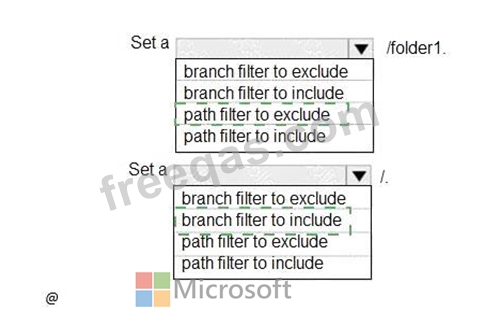
Correct Answer:

Explanation

Scenario:

References: https://docs.microsoft.com/en-us/azure/devops/pipelines/build/triggers
insert code

Question 2

You create an alert rule in Azure Monitor as shown in the following exhibit.

Which action will trigger an alert?

Correct Answer: A
insert code

Question 3

You have an Azure subscription that contains 50 virtual machines.
You plan to manage the configuration of the virtual machines by using Azure Automation State Configuration.
You need to create the Desired State Configuration (DSC) configuration files.
How should you structure the code blocks?

Correct Answer: D
The Configuration block. This is the outermost script block. You define it by using the Configuration keyword and providing a name. In this case, the name of the configuration is MyDscConfiguration.
One or more Node blocks. These define the nodes (computers or VMs) that you are configuring.
In the above configuration, there is one Node block that targets a computer named TEST-PC1.
The Node block can accept multiple computer names.
One or more resource blocks. This is where the configuration sets the properties for the resources that it is configuring. In this case, there are two resource blocks, each of which call the WindowsFeature resource.
https://docs.microsoft.com/en-us/powershell/dsc/configurations/configurations?view=dsc-
1.1#configuration-syntax
https://docs.microsoft.com/en-us/azure/virtual-machines/extensions/dsc-overview
insert code

Question 4

You plan to share packages that you wrote, tested, validated, and deployed by using Azure Artifacts.
You need to release multiple builds of each package by using a single feed. The solution must limit the release of packages that are in development.
What should you use?

Correct Answer: C
Upstream sources enable you to manage all of your product's dependencies in a single feed. We recommend publishing all of the packages for a given product to that product's feed, and managing that product's dependencies from remote feeds in the same feed, via upstream sources. This setup has a few benefits:
* Simplicity: your NuGet.config, .npmrc, or settings.xml contains exactly one feed (your feed).
* Determinism: your feed resolves package requests in order, so rebuilding the same codebase at the same commit or changeset uses the same set of packages
* Provenance: your feed knows the provenance of packages it saved via upstream sources, so you can verify that you're using the original package, not a custom or malicious copy published to your feed
* Peace of mind: packages used via upstream sources are guaranteed to be saved in the feed on first use; if the upstream source is disabled/removed, or the remote feed goes down or deletes a package you depend on, you can continue to develop and build References: https://docs.microsoft.com/en-us/azure/devops/artifacts/concepts/upstream-sources?view=vsts
insert code

Question 5

Note: This question is part of a series of questions that present the same scenario. Each question in the series contains a unique solution that might meet the stated goals. Some question sets might have more than one correct solution, while others might not have a correct solution.
After you answer a question in this section, you will NOT be able to return to it. As a result, these questions will not appear in the review screen.
You plan to create a release pipeline that will deploy Azure resources by using Azure Resource Manager templates. The release pipeline will create the following resources:
- Two resource groups
- Four Azure virtual machines in one resource group
- Two Azure SQL databases in other resource group
You need to recommend a solution to deploy the resources.
Solution: Create two standalone templates, each of which will deploy the resources in its respective group.
Does this meet the goal?


Correct Answer: B
For small to medium solutions, a single template is easier to understand and maintain. You can see all the resources and values in a single file. For advanced scenarios, linked templates enable you to break down the solution into targeted components. You can easily reuse these templates for other scenarios.
References:
https://docs.microsoft.com/en-us/azure/azure-resource-manager/templates/linked-templates
https://docs.microsoft.com/en-us/azure/azure-resource-manager/templates/linked- templates?tabs=azure-powershell
insert code
  • «
  • 1
  • 2
  • 3
  • 4
  • 5
  • 6
  • 7
  • 8
  • 9
  • 10
  • …
  • »
  • »»
[×]

Download PDF File

Enter your email address to download Microsoft.AZ-400.v2026-08-16.q229 Dumps

Email:

FreeQAs

Our website provides the Largest and the most Latest vendors Certification Exam materials around the world.

Using dumps we provide to Pass the Exam, we has the Valid Dumps with passing guranteed just which you need.

  • DMCA
  • About
  • Contact Us
  • Privacy Policy
  • Terms & Conditions
©2026 FreeQAs

www.freeqas.com materials do not contain actual questions and answers from Cisco's certification exams.