FreeQAs
 Request Exam  Contact
  • Home
  • View All Exams
  • New QA's
  • Upload
PRACTICE EXAMS:
  • Oracle
  • Fortinet
  • Juniper
  • Microsoft
  • Cisco
  • Citrix
  • CompTIA
  • VMware
  • ISC
  • SAP
  • EMC
  • PMI
  • HP
  • Salesforce
  • Other
  • Oracle
    Oracle
  • Fortinet
    Fortinet
  • Juniper
    Juniper
  • Microsoft
    Microsoft
  • Cisco
    Cisco
  • Citrix
    Citrix
  • CompTIA
    CompTIA
  • VMware
    VMware
  • ISC
    ISC
  • SAP
    SAP
  • EMC
    EMC
  • PMI
    PMI
  • HP
    HP
  • Salesforce
    Salesforce
  1. Home
  2. Microsoft Certification
  3. AZ-500 Exam
  4. Microsoft.AZ-500.v2022-04-20.q230 Dumps
  • «
  • 1
  • 2
  • 3
  • 4
  • 5
  • 6
  • 7
  • 8
  • 9
  • 10
  • …
  • »
  • »»
Download Now

Question 6

Your network contains an on-premises Active Directory domain named adatum.com that syncs to Azure Active Directory (Azure AD).
The Azure AD tenant contains the users shown in the following table.

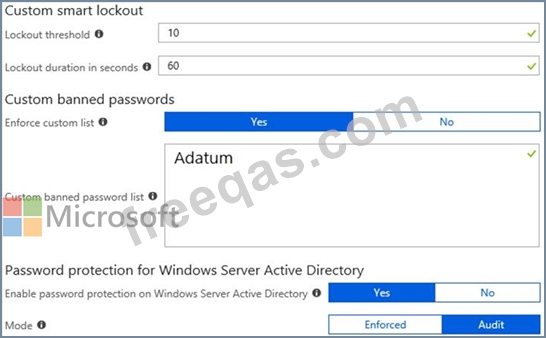
You configure the Authentication methods - Password Protection settings for adatum.com as shown in the following exhibit.
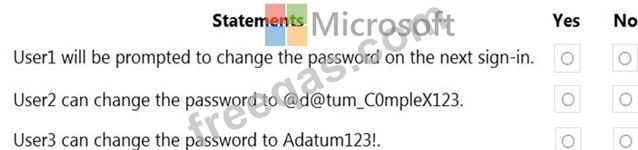
For each of the following statements, select Yes if the statement is true. Otherwise, select No.
NOTE: Each correct selection is worth one point.
Correct Answer:

Reference:
https://docs.microsoft.com/en-us/azure/active-directory/authentication/howto-password-ban-bad-on-premises-deploy
https://docs.microsoft.com/en-us/azure/active-directory/authentication/concept-password-ban-bad
insert code

Question 7

You need to create a new Azure Active Directory (Azure AD) directory named 10317806.onmicrosoft.com.
The new directory must contain a user named user10317806 who is configured to sign in by using Azure Multi-Factor Authentication (MFA).

Correct Answer:
See the explanation below.
Explanation
To create a new Azure AD tenant:
1. Browse to the Azure portal and sign in with an account that has an Azure subscription.
2. Select the plus icon (+) and search for Azure Active Directory.

3. Select Azure Active Directory

4. Select Create.
5. Provide an Organization name (10317806) and an Initial domain name (10317806). Then select Create.
This will create the directory named
10317806.onmicrosoft.com.

6. After directory creation is complete, select the information box to manage your new directory.
To create the user:
1. In the Azure portal, make sure you are on the Azure Active Directory fly out.

If not, select the Azure Active Directory icon from the left services navigation.

2. Under Manage, select Users.

3. Select All users and then select
4. Provide a Name and User name (user10317806) for the user. When you're done, select Create.
To enable MFA:
1. In the Azure portal, make sure you are on the Azure Active Directory fly out.

If not, select the Azure Active Directory icon from the left services navigation.

2. Under Manage, select Users.

3. Click on the Multi-Factor Authentication
4. Tick the checkbox next to the user's name and click the
Reference:
https://docs.microsoft.com/en-us/power-bi/developer/create-an-azure-active-directory-tenant
insert code

Question 8

You have an Azure subscription named Subscription1 that contains the resources shown in the following table.

You have an Azure subscription named Subscription2 that contains the following resources:
An Azure Sentinel workspace
An Azure Event Grid instance
You need to ingest the CEF messages from the NVAs to Azure Sentinel.
What should you configure for each subscription? To answer, select the appropriate options in the answer area.
NOTE: Each correct selection is worth one point.

Correct Answer:
insert code

Question 9

You are implementing conditional access policies.
You must evaluate the existing Azure Active Directory (Azure AD) risk events and risk levels to configure and implement the policies.
You need to identify the risk level of the following risk events:
* Users with leaked credentials
* Impossible travel to atypical locations
* Sign ins from IP addresses with suspicious activity
Which level should you identify for each risk event? To answer, drag the appropriate levels to the correct risk events. Each level may be used once, more than once, or not at all. You may need to drag the split bar between panes or scroll to view content.
NOTE: Each correct selection is worth one point.

Correct Answer:

Explanation

Azure AD Identity protection can detect six types of suspicious sign-in activities:
* Users with leaked credentials
* Sign-ins from anonymous IP addresses
* Impossible travel to atypical locations
* Sign-ins from infected devices
* Sign-ins from IP addresses with suspicious activity
* Sign-ins from unfamiliar locations
These six types of events are categorized in to 3 levels of risks - High, Medium & Low:

References:
http://www.rebeladmin.com/2018/09/step-step-guide-configure-risk-based-azure-conditional-access-policies/
insert code

Question 10

You have an Azure subscription that contains the following resources:
* A network virtual appliance (NVA) that runs non-Microsoft firewall software and routes all outbound traffic from the virtual machines to the internet
* An Azure function that contains a script to manage the firewall rules of the NVA
* Azure Security Center standard tier enabled for all virtual machines
* An Azure Sentinel workspace
* 30 virtual machines
You need to ensure that when a high-priority alert is generated in Security Center for a virtual machine, an incident is created in Azure Sentinel and then a script is initiated to configure a firewall rule for the NVA.
How should you configure Azure Sentinel to meet the requirements? To answer, drag the appropriate components to the correct requirements. Each component may be used once, more than once, or not at all. You may need to drag the split bar between panes or scroll to view content.
NOTE: Each correct selection is worth one point.

Correct Answer:
Explanation

Reference:
https://docs.microsoft.com/en-us/azure/sentinel/create-incidents-from-alerts
https://docs.microsoft.com/en-us/azure/sentinel/connect-azure-security-center
insert code
  • «
  • 1
  • 2
  • 3
  • 4
  • 5
  • 6
  • 7
  • 8
  • 9
  • 10
  • …
  • »
  • »»
[×]

Download PDF File

Enter your email address to download Microsoft.AZ-500.v2022-04-20.q230 Dumps

Email:

FreeQAs

Our website provides the Largest and the most Latest vendors Certification Exam materials around the world.

Using dumps we provide to Pass the Exam, we has the Valid Dumps with passing guranteed just which you need.

  • DMCA
  • About
  • Contact Us
  • Privacy Policy
  • Terms & Conditions
©2026 FreeQAs

www.freeqas.com materials do not contain actual questions and answers from Cisco's certification exams.
