FreeQAs
 Request Exam  Contact
  • Home
  • View All Exams
  • New QA's
  • Upload
PRACTICE EXAMS:
  • Oracle
  • Fortinet
  • Juniper
  • Microsoft
  • Cisco
  • Citrix
  • CompTIA
  • VMware
  • ISC
  • SAP
  • EMC
  • PMI
  • HP
  • Salesforce
  • Other
  • Oracle
    Oracle
  • Fortinet
    Fortinet
  • Juniper
    Juniper
  • Microsoft
    Microsoft
  • Cisco
    Cisco
  • Citrix
    Citrix
  • CompTIA
    CompTIA
  • VMware
    VMware
  • ISC
    ISC
  • SAP
    SAP
  • EMC
    EMC
  • PMI
    PMI
  • HP
    HP
  • Salesforce
    Salesforce
  1. Home
  2. Microsoft Certification
  3. AZ-500 Exam
  4. Microsoft.AZ-500.v2023-10-20.q108 Dumps
  • «
  • 1
  • 2
  • 3
  • 4
  • 5
  • 6
  • 7
  • 8
  • 9
  • 10
  • …
  • »
  • »»
Download Now

Question 21

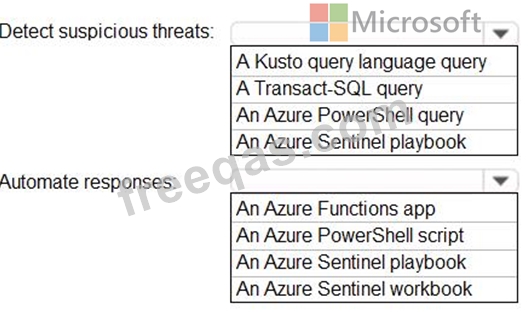
You plan to use Azure Sentinel to create an analytic rule that will detect suspicious threats and automate responses.
Which components are required for the rule? To answer, select the appropriate options in the answer area.
NOTE: Each correct selection is worth one point.
Correct Answer:

Reference:
https://docs.microsoft.com/en-us/azure/sentinel/tutorial-detect-threats-custom
https://docs.microsoft.com/en-us/azure/sentinel/tutorial-respond-threats-playbook
insert code

Question 22

Your network contains an on-premises Active Directory domain named adatum.com that syncs to Azure Active Directory (Azure AD).
The Azure AD tenant contains the users shown in the following table.

You configure the Authentication methods - Password Protection settings for adatum.com as shown in the following exhibit.
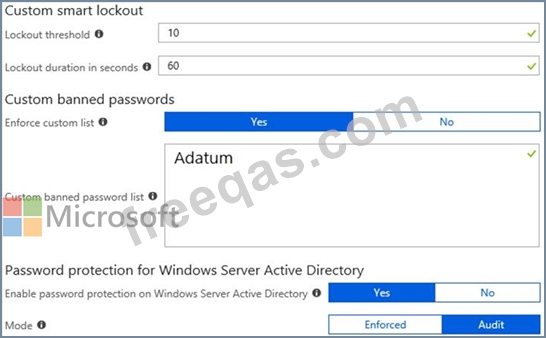
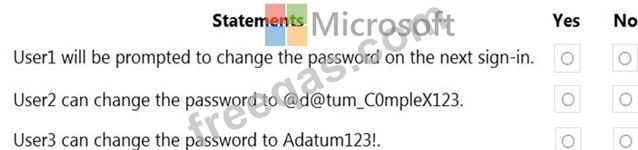
For each of the following statements, select Yes if the statement is true. Otherwise, select No.
NOTE: Each correct selection is worth one point.
Correct Answer:

Reference:
https://docs.microsoft.com/en-us/azure/active-directory/authentication/howto-password-ban-bad-on-premises-deploy
https://docs.microsoft.com/en-us/azure/active-directory/authentication/concept-password-ban-bad
insert code

Question 23

You have an Azure subscription named Sub1 that contains an Azure Storage account named Contosostorage1 and an Azure key vault named Contosokeyvault1.
You plan to create an Azure Automation runbook that will rotate the keys of Contosostorage1 and store them in Contosokeyvault1.
You need to implement prerequisites to ensure that you can implement the runbook.
Which three actions should you perform in sequence? To answer, move the appropriate actions from the list of actions to the answer area and arrange them in the correct order.

Correct Answer:

Explanation

Step 1: Create an Azure Automation account
Runbooks live within the Azure Automation account and can execute PowerShell scripts.
Step 2: Import PowerShell modules to the Azure Automation account
Under 'Assets' from the Azure Automation account Resources section select 'to add in Modules to the runbook. To execute key vault cmdlets in the runbook, we need to add AzureRM.profile and AzureRM.key vault.
Step 3: Create a connection resource in the Azure Automation account
You can use the sample code below, taken from the AzureAutomationTutorialScript example runbook, to authenticate using the Run As account to manage Resource Manager resources with your runbooks. The AzureRunAsConnection is a connection asset automatically created when we created 'run as accounts' above.
This can be found under Assets -> Connections. After the authentication code, run the same code above to get all the keys from the vault.
$connectionName = "AzureRunAsConnection"
try
{
# Get the connection "AzureRunAsConnection "
$servicePrincipalConnection=Get-AutomationConnection -Name $connectionName
"Logging in to Azure..."
Add-AzureRmAccount `
-ServicePrincipal `
-TenantId $servicePrincipalConnection.TenantId `
-ApplicationId $servicePrincipalConnection.ApplicationId `
-CertificateThumbprint $servicePrincipalConnection.CertificateThumbprint
}
References:
https://www.rahulpnath.com/blog/accessing-azure-key-vault-from-azure-runbook/
insert code

Question 24

You have an Azure subscription that contains the virtual networks shown in the following table.

The Azure virtual machines on SpokeVNetSubnet0 can communicate with the computers on the on-premises network.
You plan to deploy an Azure firewall to HubVNet.
You create the following two routing tables:
RT1: Includes a user-defined route that points to the private IP address of the Azure firewall as a next hop address RT2: Disables BGP route propagation and defines the private IP address of the Azure firewall as the default gateway You need to ensure that traffic between SpokeVNetSubnet0 and the on-premises network flows through the Azure firewall.
To which subnet should you associate each route table? To answer, drag the appropriate subnets to the correct route tables. Each subnet may be used once, more than once, or not at all. You may need to drag the split bar between panes or scroll to view content.
NOTE: Each correct selection is worth one point.

Correct Answer:
insert code

Question 25

You have an Azure Active Directory (Azure AD) tenant that contains the users shown in the following table.

In Azure AD Privileged Identity Management (PIM), the Role settings for the Contributor role are configured as shown in the exhibit. (Click the Exhibit tab.)

You assign users the Contributor role on May 1, 2019 as shown in the following table.

For each of the following statements, select Yes if the statement is true. Otherwise, select No.
NOTE: Each correct selection is worth one point.

Correct Answer:

Reference:
https://docs.microsoft.com/en-us/azure/active-directory/privileged-identity-management/pim-resource-roles-assign-roles
insert code
  • «
  • 1
  • 2
  • 3
  • 4
  • 5
  • 6
  • 7
  • 8
  • 9
  • 10
  • …
  • »
  • »»
[×]

Download PDF File

Enter your email address to download Microsoft.AZ-500.v2023-10-20.q108 Dumps

Email:

FreeQAs

Our website provides the Largest and the most Latest vendors Certification Exam materials around the world.

Using dumps we provide to Pass the Exam, we has the Valid Dumps with passing guranteed just which you need.

  • DMCA
  • About
  • Contact Us
  • Privacy Policy
  • Terms & Conditions
©2026 FreeQAs

www.freeqas.com materials do not contain actual questions and answers from Cisco's certification exams.
