FreeQAs
 Request Exam  Contact
  • Home
  • View All Exams
  • New QA's
  • Upload
PRACTICE EXAMS:
  • Oracle
  • Fortinet
  • IBM
  • Juniper
  • Microsoft
  • Cisco
  • Citrix
  • CompTIA
  • VMware
  • ISC
  • SAP
  • EMC
  • PMI
  • HP
  • Salesforce
  • Other
  • Oracle
    Oracle
  • Fortinet
    Fortinet
  • IBM
    IBM
  • Juniper
    Juniper
  • Microsoft
    Microsoft
  • Cisco
    Cisco
  • Citrix
    Citrix
  • CompTIA
    CompTIA
  • VMware
    VMware
  • ISC
    ISC
  • SAP
    SAP
  • EMC
    EMC
  • PMI
    PMI
  • HP
    HP
  • Salesforce
    Salesforce
  1. Home
  2. Microsoft Certification
  3. AZ-500 Exam
  4. Microsoft.AZ-500.v2025-07-07.q257 Dumps
  • ««
  • «
  • …
  • 34
  • 35
  • 36
  • 37
  • 38
  • 39
  • 40
  • 41
  • 42
  • 43
  • …
  • »
  • »»
Download Now

Question 186

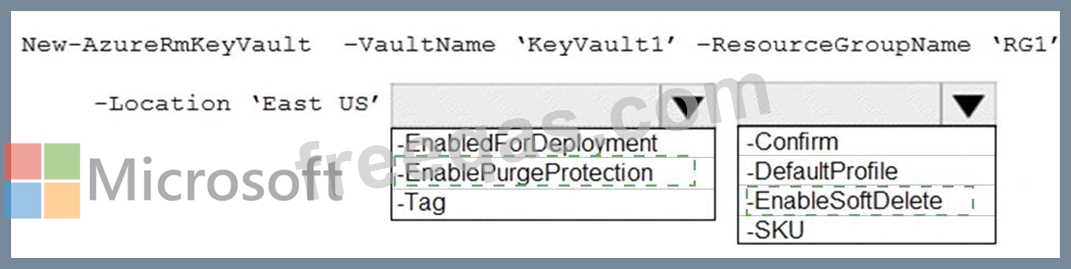
You need to create an Azure key vault. The solution must ensure that any object deleted from the key vault be retained for 90 days.
How should you complete the command? To answer, select the appropriate options in the answer area.
NOTE: Each correct selection is worth one point.
Correct Answer:

Explanation:

Box 1: -EnablePurgeProtection
If specified, protection against immediate deletion is enabled for this vault; requires soft delete to be enabled as well.
Box 2: -EnableSoftDelete
Specifies that the soft-delete functionality is enabled for this key vault. When soft-delete is enabled, for a grace period, you can recover this key vault and its contents after it is deleted.
References:
https://docs.microsoft.com/en-us/powershell/module/azurerm.keyvault/new-azurermkeyvault
insert code

Question 187

: 2 HOTSPOT
Which virtual networks in Sub1 can User2 modify and delete in their current state? To answer, select the appropriate options in the answer area.
NOTE: Each correct selection is worth one point.

Correct Answer:

Explanation

Box 1: VNET4 and VNET1 only
RG1 has only Delete lock, while there are no locks on RG4.
RG2 and RG3 both have Read-only locks.
Box 2: VNET4 only
There are no locks on RG4, while the other resource groups have either Delete or Read-only locks.
Note: As an administrator, you may need to lock a subscription, resource group, or resource to prevent other users in your organization from accidentally deleting or modifying critical resources. You can set the lock level to CanNotDelete or ReadOnly. In the portal, the locks are called Delete and Read-only respectively.
* CanNotDelete means authorized users can still read and modify a resource, but they can't delete the resource.
* ReadOnly means authorized users can read a resource, but they can't delete or update the resource.
Applying this lock is similar to restricting all authorized users to the permissions granted by the Reader role.
Scenario:
User2 is a Security administrator.
Sub1 contains six resource groups named RG1, RG2, RG3, RG4, RG5, and RG6.
User2 creates the virtual networks shown in the following table.

Sub1 contains the locks shown in the following table.
References:
https://docs.microsoft.com/en-us/azure/azure-resource-manager/resource-group-lock-resources
insert code

Question 188

You have an Azure subscription.
You create a new virtual network named VNet1.
You plan to deploy an Azure web app named App1 that will use VNet1 and will be reachable by using private IP addresses. The solution must support inbound and outbound network traffic.
What should you do?

Correct Answer: C
insert code

Question 189

You have an Azure subscription that contains the resources shown in the following table.

You plan to deploy the virtual machines shown in the following table.

You need to assign managed identities to the virtual machines. The solution must meet the following requirements:
Assign each virtual machine the required roles.
Use the principle of least privilege.
What is the minimum number of managed identities required?

Correct Answer: B
We have two different sets of required permissions. VM1 and VM2 have the same permission requirements.
VM3 and VM4 have the same permission requirements.
A user-assigned managed identity can be assigned to one or many resources. By using user-assigned managed identities, we can create just two managed identities: one with the permission requirements for VM1 and VM2 and the other with the permission requirements for VM3 and VM4.
Reference:
https://docs.microsoft.com/en-us/azure/active-directory/managed-identities-azure-resources/overview
insert code

Question 190

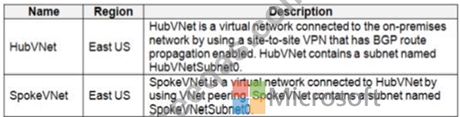
You have an Azure subscription that contains the virtual networks shown in the following table.

The Azure virtual machines on SpokeVNetSubnet0 can communicate with the computers on the on-premises network.
You plan to deploy an Azure firewall to HubVNet.
You create the following two routing tables:
* RT1: Includes a user-defined route that points to the private IP address of the Azure firewall as a next hop address
* RT2: Disables BGP route propagation and defines the private IP address of the Azure firewall as the default gateway You need to ensure that traffic between SpokeVNetSubnet0 and the on-premises network flows through the Azure firewall.
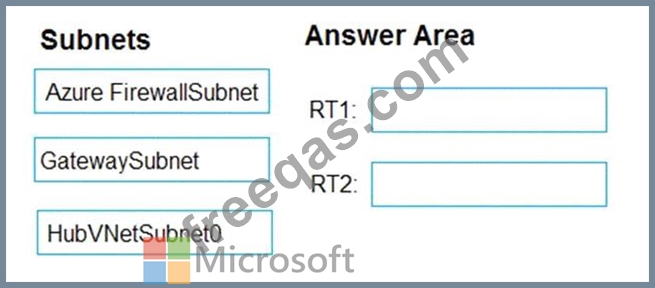
To which subnet should you associate each route table? To answer, drag the appropriate subnets to the correct route tables. Each subnet may be used once, more than once, or not at all. You may need to drag the split bar between panes or scroll to view content.
NOTE: Each correct selection is worth one point.

Correct Answer:

Explanation
insert code
  • ««
  • «
  • …
  • 34
  • 35
  • 36
  • 37
  • 38
  • 39
  • 40
  • 41
  • 42
  • 43
  • …
  • »
  • »»
[×]

Download PDF File

Enter your email address to download Microsoft.AZ-500.v2025-07-07.q257 Dumps

Email:

FreeQAs

Our website provides the Largest and the most Latest vendors Certification Exam materials around the world.

Using dumps we provide to Pass the Exam, we has the Valid Dumps with passing guranteed just which you need.

  • DMCA
  • About
  • Contact Us
  • Privacy Policy
  • Terms & Conditions
©2026 FreeQAs

www.freeqas.com materials do not contain actual questions and answers from Cisco's certification exams.