What should you implement to meet the virtual network requirements for the virtual machines that connect to Vnet4 and Vnet5?
Your company has an Azure virtual network named Vnet1 that uses an IP address space of 192.168.0.0/20.
Vnet1 contains a subnet named Subnet1 that uses an IP address space of 192.168.0.0/24.
You create an IPv6 address range to Vnet1 by using a CIDR suffix of /48.
You need to enable the virtual machines on Subnet1 to communicate with each other by using IPv6 addresses assigned by the company. The solution must minimize the number of additional IPv4 addresses.
What should you do? To answer, select the appropriate options in the answer area.
NOTE: Each correct selection is worth one point.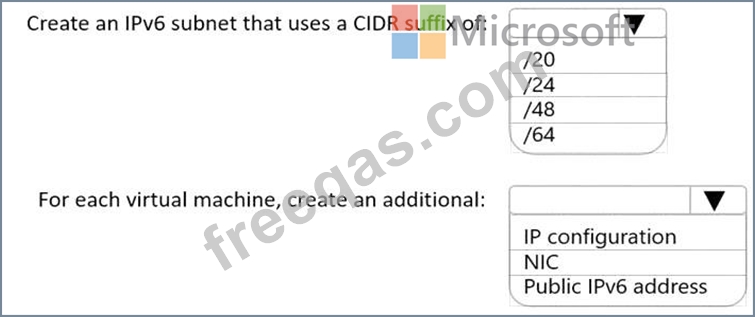


You configure a route table named RT1 that has the routes shown in the following table.
You have an Azure virtual network named Vnet1 that has the subnets shown in the following table.
You have the resources shown in the following table.
Vnet1 connects to an ExpressRoute circuit. The on-premises router advertises the following routes:
* 0.0.0.0/0
* 10.0.0.0/16
For each of the following statements, select Yes if the statement is true. Otherwise, select No. NOTE: Each correct selection is worth one point.

You need to configure GW1 to meet the network security requirements for the P2S VPN users.
Which Tunnel type should you select in the Point-to-site configuration settings of GW1?
You have the hybrid network shown in the Network Diagram exhibit.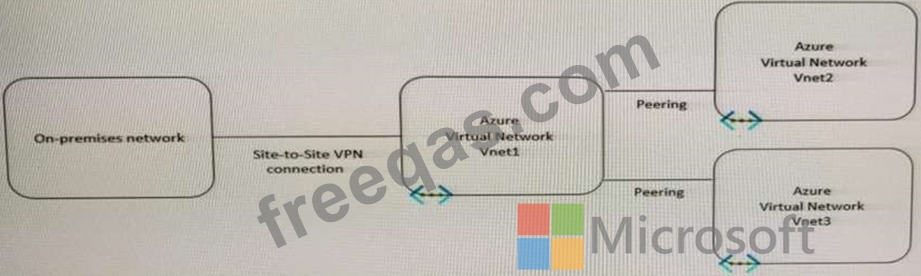
You have a peering connection between Vnet1 and Vnet2 as shown in the Peering-Vnet1-Vnet2 exhibit.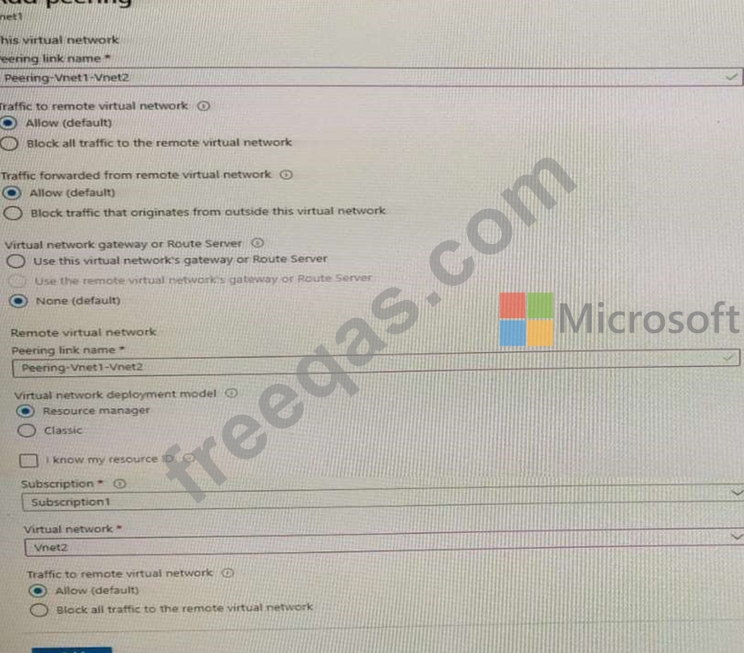
You have a peering connection between Vnet1 and Vnet3 as shown in the Peering -Vnet1-Vnet3 exhibit.
For each of the following statements, select Yes if the statement is true. Otherwise, select No.
NOTE: Each correct selection is worth one point.


