You have a server named Server1 that runs Windows Server and has the Hyper-V server role installed. You have a Hyper-V failover cluster named Cluster1. All servers are members of the same domain.
You need to ensure that you use Hyper-V Replica with Kerberos authentication on the default port to replicate virtual machines from Cluster1 to Server1.
What should you do on Server1?
You have two physical servers named AppSrv1 and AppSrv2 and an unconfigured server named Server1. All the servers run Windows Server. Only Server1 can access the internet.
You plan to use Azure Site Recovery to replicate AppSrv1 and AppSrv2 to Azure.
You need to deploy the required components to AppSrv1, AppSrv2, and Server1.
Which components should you deploy? To answer, drag the appropriate components to the correct servers.
Each component may be used once, more than once, or not at all. You may need to drag the split bar between panes or scroll to view content.
NOTE: Each correct selection is worth one point.

You need to back up Server 4 to meet the technical requirements.
What should you do first?
You have an on-premises server named Server1 that runs Windows Server and has the Hyper-V server role installed.
You have an Azure subscription.
You plan to back up Server1 to Azure by using Azure Backup.
Which two Azure Backup options require you to deploy Microsoft Azure Backup Server (MABS)? Each correct answer presents a complete solution.
NOTE: Each correct selection is worth one point.
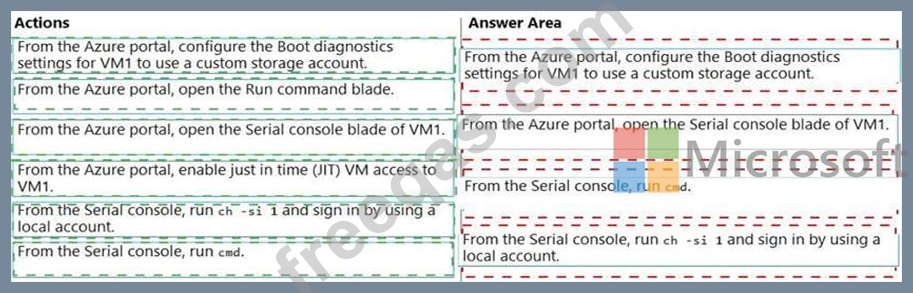
You have an Azure virtual machine named VM1 that has the Web Server (IIS) server role installed. VM1 hosts a critical line-of-business (LOB) application.
After the security team at your company deploys a new security baseline to VM1, users begin reporting that the application is unresponsive.
You suspect that the security baseline has caused networking issues.
You need to perform a network trace on VM1.
What should you do?

