FreeQAs
 Request Exam  Contact
  • Home
  • View All Exams
  • New QA's
  • Upload
PRACTICE EXAMS:
  • Oracle
  • Fortinet
  • Juniper
  • Microsoft
  • Cisco
  • Citrix
  • CompTIA
  • VMware
  • ISC
  • SAP
  • EMC
  • PMI
  • HP
  • Salesforce
  • Other
  • Oracle
    Oracle
  • Fortinet
    Fortinet
  • Juniper
    Juniper
  • Microsoft
    Microsoft
  • Cisco
    Cisco
  • Citrix
    Citrix
  • CompTIA
    CompTIA
  • VMware
    VMware
  • ISC
    ISC
  • SAP
    SAP
  • EMC
    EMC
  • PMI
    PMI
  • HP
    HP
  • Salesforce
    Salesforce
  1. Home
  2. Microsoft Certification
  3. DP-100 Exam
  4. Microsoft.DP-100.v2022-03-09.q103 Dumps
  • «
  • 1
  • 2
  • 3
  • 4
  • 5
  • 6
  • 7
  • 8
  • 9
  • 10
  • …
  • »
  • »»
Download Now

Question 11

You have a dataset that contains over 150 features. You use the dataset to train a Support Vector Machine (SVM) binary classifier.
You need to use the Permutation Feature Importance module in Azure Machine Learning Studio to compute a set of feature importance scores for the dataset.
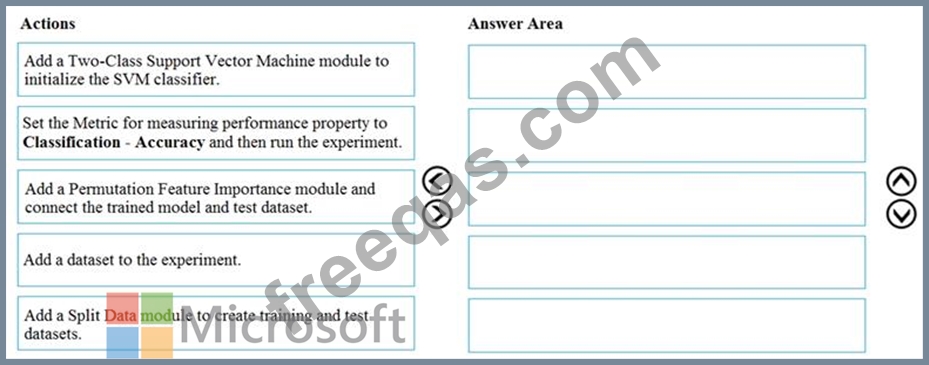
In which order should you perform the actions? To answer, move all actions from the list of actions to the answer area and arrange them in the correct order.
Correct Answer:

Explanation:
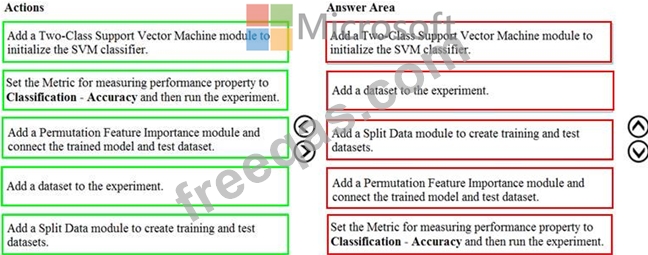
Step 1: Add a Two-Class Support Vector Machine module to initialize the SVM classifier.
Step 2: Add a dataset to the experiment
Step 3: Add a Split Data module to create training and test dataset.
To generate a set of feature scores requires that you have an already trained model, as well as a test dataset.
Step 4: Add a Permutation Feature Importance module and connect to the trained model and test dataset.
Step 5: Set the Metric for measuring performance property to Classification - Accuracy and then run the experiment.
Reference:
https://docs.microsoft.com/en-us/azure/machine-learning/studio-module-reference/two-class-support-vector-machine
https://docs.microsoft.com/en-us/azure/machine-learning/studio-module-reference/permutation-feature-importance
insert code

Question 12

You plan to use a Data Science Virtual Machine (DSVM) with the open source deep learning frameworks Caffe2 and Theano. You need to select a pre configured DSVM to support the framework.
What should you create?

Correct Answer: E
insert code

Question 13

Note: This question is part of a series of questions that present the same scenario. Each question in the series contains a unique solution that might meet the stated goals. Some question sets might have more than one correct solution, while others might not have a correct solution.
After you answer a question in this section, you will NOT be able to return to it. As a result, these questions will not appear in the review screen.
You are creating a model to predict the price of a student's artwork depending on the following variables: the student's length of education, degree type, and art form.
You start by creating a linear regression model.
You need to evaluate the linear regression model.
Solution: Use the following metrics: Mean Absolute Error, Root Mean Absolute Error, Relative Absolute Error, Relative Squared Error, and the Coefficient of Determination.
Does the solution meet the goal?

Correct Answer: A
The following metrics are reported for evaluating regression models. When you compare models, they are ranked by the metric you select for evaluation.
Mean absolute error (MAE) measures how close the predictions are to the actual outcomes; thus, a lower score is better.
Root mean squared error (RMSE) creates a single value that summarizes the error in the model. By squaring the difference, the metric disregards the difference between over-prediction and under-prediction.
Relative absolute error (RAE) is the relative absolute difference between expected and actual values; relative because the mean difference is divided by the arithmetic mean.
Relative squared error (RSE) similarly normalizes the total squared error of the predicted values by dividing by the total squared error of the actual values.
Mean Zero One Error (MZOE) indicates whether the prediction was correct or not. In other words: ZeroOneLoss(x,y) = 1 when x!=y; otherwise 0.
Coefficient of determination, often referred to as R2, represents the predictive power of the model as a value between 0 and 1. Zero means the model is random (explains nothing); 1 means there is a perfect fit. However, caution should be used in interpreting R2 values, as low values can be entirely normal and high values can be suspect.
AUC.
Reference:
https://docs.microsoft.com/en-us/azure/machine-learning/studio-module-reference/evaluate-model
insert code

Question 14

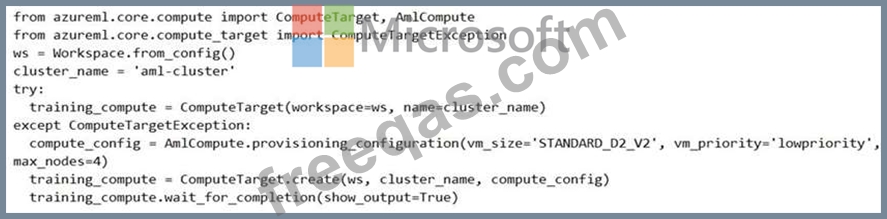
You are preparing to use the Azure ML SDK to run an experiment and need to create compute. You run the following code:
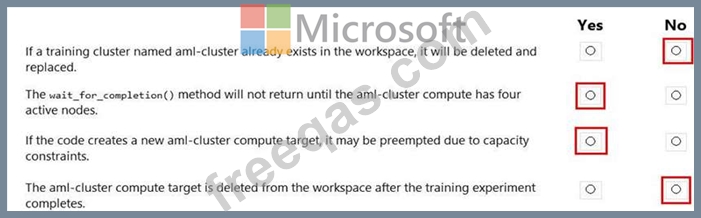
For each of the following statements, select Yes if the statement is true. Otherwise, select No.
NOTE: Each correct selection is worth one point.
Correct Answer:

Explanation:
Box 1: No
If a training cluster already exists it will be used.
Box 2: Yes
The wait_for_completion method waits for the current provisioning operation to finish on the cluster.
Box 3: Yes
Low Priority VMs use Azure's excess capacity and are thus cheaper but risk your run being pre-empted.
Box 4: No
Need to use training_compute.delete() to deprovision and delete the AmlCompute target.
Reference:
https://notebooks.azure.com/azureml/projects/azureml-getting-started/html/how-to-use-azureml/training/train-on-amlcompute/train-on-amlcompute.ipynb
https://docs.microsoft.com/en-us/python/api/azureml-core/azureml.core.compute.computetarget
insert code

Question 15

You configure a Deep Learning Virtual Machine for Windows.
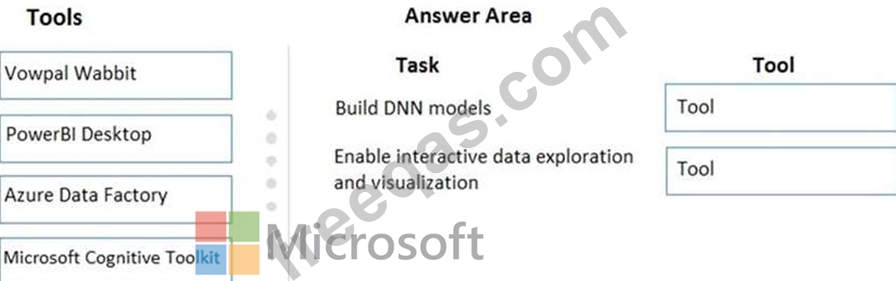
You need to recommend tools and frameworks to perform the following:
Build deep neural network (DNN) models
Perform interactive data exploration and visualization
Which tools and frameworks should you recommend? To answer, drag the appropriate tools to the correct tasks. Each tool may be used once, more than once, or not at all. You may need to drag the split bar between panes or scroll to view content.
NOTE: Each correct selection is worth one point.
Correct Answer:

Explanation:
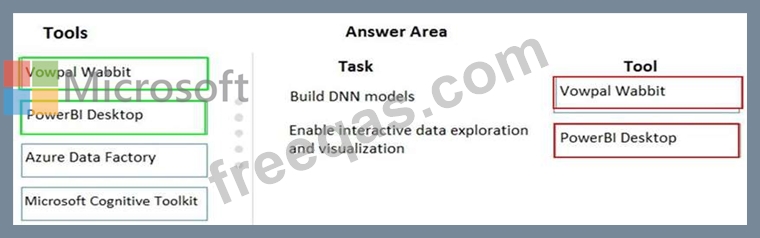
Box 1: Vowpal Wabbit
Use the Train Vowpal Wabbit Version 8 module in Azure Machine Learning Studio (classic), to create a machine learning model by using Vowpal Wabbit.
Box 2: PowerBI Desktop
Power BI Desktop is a powerful visual data exploration and interactive reporting tool BI is a name given to a modern approach to business decision making in which users are empowered to find, explore, and share insights from data across the enterprise.
References:
https://docs.microsoft.com/en-us/azure/machine-learning/studio-module-reference/train-vowpal-wabbit-version-8-model
https://docs.microsoft.com/en-us/azure/architecture/data-guide/scenarios/interactive-data-exploration
insert code
  • «
  • 1
  • 2
  • 3
  • 4
  • 5
  • 6
  • 7
  • 8
  • 9
  • 10
  • …
  • »
  • »»
[×]

Download PDF File

Enter your email address to download Microsoft.DP-100.v2022-03-09.q103 Dumps

Email:

FreeQAs

Our website provides the Largest and the most Latest vendors Certification Exam materials around the world.

Using dumps we provide to Pass the Exam, we has the Valid Dumps with passing guranteed just which you need.

  • DMCA
  • About
  • Contact Us
  • Privacy Policy
  • Terms & Conditions
©2026 FreeQAs

www.freeqas.com materials do not contain actual questions and answers from Cisco's certification exams.
