FreeQAs
 Request Exam  Contact
  • Home
  • View All Exams
  • New QA's
  • Upload
PRACTICE EXAMS:
  • Oracle
  • Fortinet
  • Juniper
  • Microsoft
  • Cisco
  • Citrix
  • CompTIA
  • VMware
  • ISC
  • SAP
  • EMC
  • PMI
  • HP
  • Salesforce
  • Other
  • Oracle
    Oracle
  • Fortinet
    Fortinet
  • Juniper
    Juniper
  • Microsoft
    Microsoft
  • Cisco
    Cisco
  • Citrix
    Citrix
  • CompTIA
    CompTIA
  • VMware
    VMware
  • ISC
    ISC
  • SAP
    SAP
  • EMC
    EMC
  • PMI
    PMI
  • HP
    HP
  • Salesforce
    Salesforce
  1. Home
  2. Microsoft Certification
  3. DP-203 Exam
  4. Microsoft.DP-203.v2023-01-01.q218 Dumps
  • ««
  • «
  • …
  • 29
  • 30
  • 31
  • 32
  • 33
  • 34
  • 35
  • 36
  • 37
  • 38
  • …
  • »
  • »»
Download Now

Question 161

You have an Azure Storage account that generates 200,000 new files daily. The file names have a format of
{YYYY}/{MM}/{DD}/{HH}/{CustomerID}.csv.
You need to design an Azure Data Factory solution that will load new data from the storage account to an Azure Data Lake once hourly. The solution must minimize load times and costs.
How should you configure the solution? To answer, select the appropriate options in the answer area.
NOTE: Each correct selection is worth one point.

Correct Answer:

Explanation
Table Description automatically generated

Box 1: Incremental load
Box 2: Tumbling window
Tumbling windows are a series of fixed-sized, non-overlapping and contiguous time intervals. The following diagram illustrates a stream with a series of events and how they are mapped into 10-second tumbling windows.
Timeline Description automatically generated

Reference:
https://docs.microsoft.com/en-us/stream-analytics-query/tumbling-window-azure-stream-analytics
insert code

Question 162

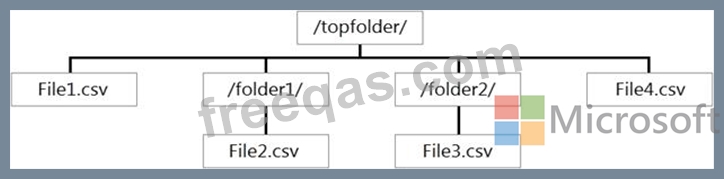
You have files and folders in Azure Data Lake Storage Gen2 for an Azure Synapse workspace as shown in the following exhibit.

You create an external table named ExtTable that has LOCATION='/topfolder/'.
When you query ExtTable by using an Azure Synapse Analytics serverless SQL pool, which files are returned?

Correct Answer: B
To run a T-SQL query over a set of files within a folder or set of folders while treating them as a single entity or rowset, provide a path to a folder or a pattern (using wildcards) over a set of files or folders.
Reference:
https://docs.microsoft.com/en-us/azure/synapse-analytics/sql/query-data-storage#query-multiple-files-or-folders
insert code

Question 163

You have files and folders in Azure Data Lake Storage Gen2 for an Azure Synapse workspace as shown in the following exhibit.

You create an external table named ExtTable that has LOCATION='/topfolder/'.
When you query ExtTable by using an Azure Synapse Analytics serverless SQL pool, which files are returned?

Correct Answer: C
To run a T-SQL query over a set of files within a folder or set of folders while treating them as a single entity or rowset, provide a path to a folder or a pattern (using wildcards) over a set of files or folders.
Reference:
https://docs.microsoft.com/en-us/azure/synapse-analytics/sql/query-data-storage#query-multiple-files-or-folders
insert code

Question 164

You have an Azure Data Lake Storage Gen2 container.
Data is ingested into the container, and then transformed by a data integration application. The data is NOT modified after that. Users can read files in the container but cannot modify the files.
You need to design a data archiving solution that meets the following requirements:
* New data is accessed frequently and must be available as quickly as possible.
* Data that is older than five years is accessed infrequently but must be available within one second when requested.
* Data that is older than seven years is NOT accessed. After seven years, the data must be persisted at the lowest cost possible.
* Costs must be minimized while maintaining the required availability.
How should you manage the data? To answer, select the appropriate options in the answer area.
NOTE: Each correct selection is worth one point

Correct Answer:

Explanation

Box 1: Move to cool storage
Box 2: Move to archive storage
Archive - Optimized for storing data that is rarely accessed and stored for at least 180 days with flexible latency requirements, on the order of hours.
The following table shows a comparison of premium performance block blob storage, and the hot, cool, and archive access tiers.

Reference:
https://docs.microsoft.com/en-us/azure/storage/blobs/storage-blob-storage-tiers Explanation:
Box 1: Replicated
Replicated tables are ideal for small star-schema dimension tables, because the fact table is often distributed on a column that is not compatible with the connected dimension tables. If this case applies to your schema, consider changing small dimension tables currently implemented as round-robin to replicated.
Box 2: Replicated
Box 3: Replicated
Box 4: Hash-distributed
For Fact tables use hash-distribution with clustered columnstore index. Performance improves when two hash tables are joined on the same distribution column.
Reference:
https://azure.microsoft.com/en-us/updates/reduce-data-movement-and-make-your-queries-more-efficient-with-th
https://azure.microsoft.com/en-us/blog/replicated-tables-now-generally-available-in-azure-sql-data-warehouse/
insert code

Question 165

You plan to create an Azure Synapse Analytics dedicated SQL pool.
You need to minimize the time it takes to identify queries that return confidential information as defined by the company's data privacy regulations and the users who executed the queues.
Which two components should you include in the solution? Each correct answer presents part of the solution.
NOTE: Each correct selection is worth one point.

Correct Answer: A,C
A: You can classify columns manually, as an alternative or in addition to the recommendation-based classification:

1. Select Add classification in the top menu of the pane.
2. In the context window that opens, select the schema, table, and column that you want to classify, and the information type and sensitivity label.
3. Select Add classification at the bottom of the context window.
C: An important aspect of the information-protection paradigm is the ability to monitor access to sensitive data.
Azure SQL Auditing has been enhanced to include a new field in the audit log called data_sensitivity_information. This field logs the sensitivity classifications (labels) of the data that was returned by a query. Here's an example:

Reference:
https://docs.microsoft.com/en-us/azure/azure-sql/database/data-discovery-and-classification-overview
insert code
  • ««
  • «
  • …
  • 29
  • 30
  • 31
  • 32
  • 33
  • 34
  • 35
  • 36
  • 37
  • 38
  • …
  • »
  • »»
[×]

Download PDF File

Enter your email address to download Microsoft.DP-203.v2023-01-01.q218 Dumps

Email:

FreeQAs

Our website provides the Largest and the most Latest vendors Certification Exam materials around the world.

Using dumps we provide to Pass the Exam, we has the Valid Dumps with passing guranteed just which you need.

  • DMCA
  • About
  • Contact Us
  • Privacy Policy
  • Terms & Conditions
©2026 FreeQAs

www.freeqas.com materials do not contain actual questions and answers from Cisco's certification exams.