The following code segment is used to create an Azure Databricks cluster.
For each of the following statements, select Yes if the statement is true. Otherwise, select No.
NOTE: Each correct selection is worth one point.


You have an Azure Synapse Analytics dedicated SQL pool that contains the users shown in the following table.
User1 executes a query on the database, and the query returns the results shown in the following exhibit.
User1 is the only user who has access to the unmasked data.
Use the drop-down menus to select the answer choice that completes each statement based on the information presented in the graphic.
NOTE: Each correct selection is worth one point.

You have an Azure Blob storage account that contains a folder. The folder contains 120,000 files. Each file contains 62 columns.
Each day, 1,500 new files are added to the folder.
You plan to incrementally load five data columns from each new file into an Azure Synapse Analytics workspace.
You need to minimize how long it takes to perform the incremental loads.
What should you use to store the files and format?

You have files and folders in Azure Data Lake Storage Gen2 for an Azure Synapse workspace as shown in the following exhibit.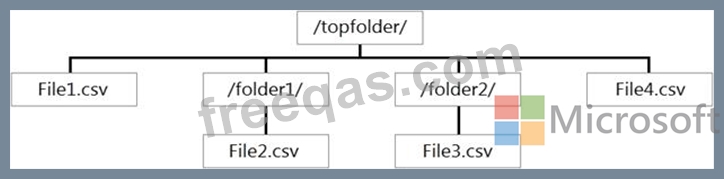
You create an external table named ExtTable that has LOCATION='/topfolder/'.
When you query ExtTable by using an Azure Synapse Analytics serverless SQL pool, which files are returned?
You have an Azure Synapse Analytics workspace named WS1.
You have an Azure Data Lake Storage Gen2 container that contains JSON-formatted files in the following format.
You need to use the serverless SQL pool in WS1 to read the files.
How should you complete the Transact-SQL statement? To answer, drag the appropriate values to the correct targets. Each value may be used once, more than once, or not at all. You may need to drag the split bar between panes or scroll to view content.
NOTE: Each correct selection is worth one point.


