You have an Azure SQL database named db1. You need to retrieve the resource usage of db1 from the last week. How should you complete the statement? To answer, select the appropriate options in the answer area. NOTE: Each correct selection is worth one point.
Correct Answer:
Explanation: Box 1: sys.resource_stats sys.resource_stats returns CPU usage and storage data for an Azure SQL Database. It has database_name and start_time columns. Box 2: DateAdd The following example returns all databases that are averaging at least 80% of compute utilization over the last one week. DECLARE @s datetime; DECLARE @e datetime; SET @s= DateAdd(d,-7,GetUTCDate()); SET @e= GETUTCDATE(); SELECT database_name, AVG(avg_cpu_percent) AS Average_Compute_Utilization FROM sys.resource_stats WHERE start_time BETWEEN @s AND @e GROUP BY database_name HAVING AVG(avg_cpu_percent) >= 80 Incorrect Answers: sys.dm_exec_requests: sys.dm_exec_requests returns information about each request that is executing in SQL Server. It does not have a column named database_name. sys.dm_db_resource_stats: sys.dm_db_resource_stats does not have any start_time column. Note: sys.dm_db_resource_stats returns CPU, I/O, and memory consumption for an Azure SQL Database database. One row exists for every 15 seconds, even if there is no activity in the database. Historical data is maintained for approximately one hour. Sys.dm_user_db_resource_governance returns actual configuration and capacity settings used by resource governance mechanisms in the current database or elastic pool. It does not have any start_time column. Reference: https://docs.microsoft.com/en-us/sql/relational-databases/system-catalog-views/sys-resource-stats-azure-sql-database
Question 52
You have an Azure subscription that contains an Azure Data Factory version 2 (V2) data factory named df1. DF1 contains a linked service. You have an Azure Key vault named vault1 that contains an encryption kay named key1. You need to encrypt df1 by using key1. What should you do first?
Correct Answer: B
Section: [none] Explanation: A customer-managed key can only be configured on an empty data Factory. The data factory can't contain any resources such as linked services, pipelines and data flows. It is recommended to enable customer-managed key right after factory creation. Note: Azure Data Factory encrypts data at rest, including entity definitions and any data cached while runs are in progress. By default, data is encrypted with a randomly generated Microsoft-managed key that is uniquely assigned to your data factory. Incorrect Answers: A, D: Should enable Soft Delete and Do Not Purge on Azure Key Vault. Using customer-managed keys with Data Factory requires two properties to be set on the Key Vault, Soft Delete and Do Not Purge. These properties can be enabled using either PowerShell or Azure CLI on a new or existing key vault. Reference: https://docs.microsoft.com/en-us/azure/data-factory/enable-customer-managed-key Testlet 1 This is a case study. Case studies are not timed separately. You can use as much exam time as you would like to complete each case. However, there may be additional case studies and sections on this exam. You must manage your time to ensure that you are able to complete all questions included on this exam in the time provided. To answer the questions included in a case study, you will need to reference information that is provided in the case study. Case studies might contain exhibits and other resources that provide more information about the scenario that is described in the case study. Each question is independent of the other questions in this case study. At the end of this case study, a review screen will appear. This screen allows you to review your answers and to make changes before you move to the next section of the exam. After you begin a new section, you cannot return to this section. To start the case study To display the first question in this case study, click the Next button. Use the buttons in the left pane to explore the content of the case study before you answer the questions. Clicking these buttons displays information such as business requirements, existing environment, and problem statements. If the case study has an All Information tab, note that the information displayed is identical to the information displayed on the subsequent tabs. When you are ready to answer a question, click the Question button to return to the question. Overview Litware, Inc. is a renewable energy company that has a main office in Boston. The main office hosts a sales department and the primary datacenter for the company. Physical Locations Litware has a manufacturing office and a research office is separate locations near Boston. Each office has its own datacenter and internet connection. Existing Environment Network Environment The manufacturing and research datacenters connect to the primary datacenter by using a VPN. The primary datacenter has an ExpressRoute connection that uses both Microsoft peering and private peering. The private peering connects to an Azure virtual network named HubVNet. Identity Environment Litware has a hybrid Azure Active Directory (Azure AD) deployment that uses a domain named litwareinc.com. All Azure subscriptions are associated to the litwareinc.com Azure AD tenant. Database Environment The sales department has the following database workload: * An on-premises named SERVER1 hosts an instance of Microsoft SQL Server 2012 and two 1-TB databases. * A logical server named SalesSrv01A contains a geo-replicated Azure SQL database named SalesSQLDb1. SalesSQLDb1 is in an elastic pool named SalesSQLDb1Pool. SalesSQLDb1 uses database firewall rules and contained database users. * An application named SalesSQLDb1App1 uses SalesSQLDb1. The manufacturing office contains two on-premises SQL Server 2016 servers named SERVER2 and SERVER3. The servers are nodes in the same Always On availability group. The availability group contains a database named ManufacturingSQLDb1 Database administrators have two Azure virtual machines in HubVnet named VM1 and VM2 that run Windows Server 2019 and are used to manage all the Azure databases. Licensing Agreement Litware is a Microsoft Volume Licensing customer that has License Mobility through Software Assurance. Current Problems SalesSQLDb1 experiences performance issues that are likely due to out-of-date statistics and frequent blocking queries. Requirements Planned Changes Litware plans to implement the following changes: * Implement 30 new databases in Azure, which will be used by time-sensitive manufacturing apps that have varying usage patterns. Each database will be approximately 20 GB. * Create a new Azure SQL database named ResearchDB1 on a logical server named ResearchSrv01. ResearchDB1 will contain Personally Identifiable Information (PII) data. * Develop an app named ResearchApp1 that will be used by the research department to populate and access ResearchDB1. * Migrate ManufacturingSQLDb1 to the Azure virtual machine platform. * Migrate the SERVER1 databases to the Azure SQL Database platform. Technical Requirements Litware identifies the following technical requirements: * Maintenance tasks must be automated. * The 30 new databases must scale automatically. * The use of an on-premises infrastructure must be minimized. * Azure Hybrid Use Benefits must be leveraged for Azure SQL Database deployments. * All SQL Server and Azure SQL Database metrics related to CPU and storage usage and limits must be analyzed by using Azure built-in functionality. Security and Compliance Requirements Litware identifies the following security and compliance requirements: * Store encryption keys in Azure Key Vault. * Retain backups of the PII data for two months. * Encrypt the PII data at rest, in transit, and in use. * Use the principle of least privilege whenever possible. * Authenticate database users by using Active Directory credentials. * Protect Azure SQL Database instances by using database-level firewall rules. * Ensure that all databases hosted in Azure are accessible from VM1 and VM2 without relying on public endpoints. Business Requirements Litware identifies the following business requirements: * Meet an SLA of 99.99% availability for all Azure deployments. * Minimize downtime during the migration of the SERVER1 databases. * Use the Azure Hybrid Use Benefits when migrating workloads to Azure. * Once all requirements are met, minimize costs whenever possible.
Question 53
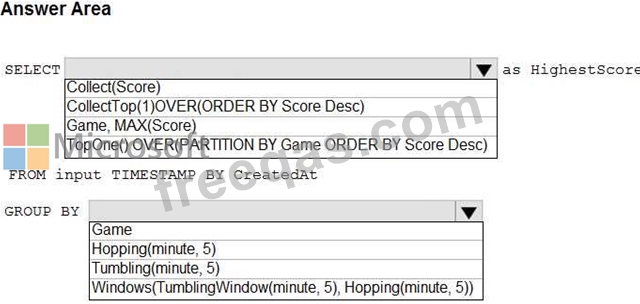
HOTSPOT You are building an Azure Stream Analytics job to retrieve game data. You need to ensure that the job returns the highest scoring record for each five-minute time interval of each game. How should you complete the Stream Analytics query? To answer, select the appropriate options in the answer area. NOTE: Each correct selection is worth one point. Hot Area:
Correct Answer:
Section: [none] Explanation: Box 1: TopOne() OVER(PARTITION BY Game ORDER BY Score Desc) TopOne returns the top-rank record, where rank defines the ranking position of the event in the window according to the specified ordering. Ordering/ranking is based on event columns and can be specified in ORDER BY clause. Analytic Function Syntax: TopOne() OVER ([<PARTITION BY clause>] ORDER BY (<column name> [ASC |DESC])+ <LIMIT DURATION clause> [<WHEN clause>]) Box 2: Tumbling(minute 5) Tumbling window functions are used to segment a data stream into distinct time segments and perform a function against them, such as the example below. The key differentiators of a Tumbling window are that they repeat, do not overlap, and an event cannot belong to more than one tumbling window. Reference: https://docs.microsoft.com/en-us/stream-analytics-query/topone-azure-stream-analytics https://github.com/MicrosoftDocs/azure-docs/blob/master/articles/stream-analytics/stream-analytics-window- functions.md
Question 54
You have an Azure SQL database named sqldb1. You need to minimize the possibility of Query Store transitioning to a read-only state. What should you do?
Correct Answer: B
The Max Size (MB) limit isn't strictly enforced. Storage size is checked only when Query Store writes data to disk. This interval is set by the Data Flush Interval (Minutes) option. If Query Store has breached the maximum size limit between storage size checks, it transitions to read-only mode. Incorrect Answers: C: Statistics Collection Interval: Defines the level of granularity for the collected runtime statistic, expressed in minutes. The default is 60 minutes. Consider using a lower value if you require finer granularity or less time to detect and mitigate issues. Keep in mind that the value directly affects the size of Query Store data. Reference: https://docs.microsoft.com/en-us/sql/relational-databases/performance/best-practice-with-the-query-store
Question 55
A data engineer creates a table to store employee information for a new application. All employee names are in the US English alphabet. All addresses are locations in the United States. The data engineer uses the following statement to create the table. You need to recommend changes to the data types to reduce storage and improve performance. Which two actions should you recommend? Each correct answer presents part of the solution. NOTE: Each correct selection is worth one point.