You have a database in an Azure Cosmos DB Core (SQL) API account. The database is backed up every two hours.
You need to implement a solution that supports point-in-time restore.
What should you do first?
The following is a sample of a document in orders.
The orders container uses customerId as the partition key.
You need to provide a report of the total items ordered per month by item type. The solution must meet the following requirements:
Ensure that the report can run as quickly as possible.
Minimize the consumption of request units (RUs).
What should you do?
You have an application named App1 that reads the data in an Azure Cosmos DB Core (SQL) API account. App1 runs the same read queries every minute. The default consistency level for the account is set to eventual.
You discover that every query consumes request units (RUs) instead of using the cache.
You verify the IntegratedCacheiteItemHitRate metric and the IntegratedCacheQueryHitRate metric. Both metrics have values of 0.
You verify that the dedicated gateway cluster is provisioned and used in the connection string.
You need to ensure that App1 uses the Azure Cosmos DB integrated cache.
What should you configure?
You have an Azure Cosmos DB Core (SQL) API account that is used by 10 web apps.
You need to analyze the data stored in the account by using Apache Spark to create machine learning models. The solution must NOT affect the performance of the web apps.
Which two actions should you perform? Each correct answer presents part of the solution.
NOTE: Each correct selection is worth one point.
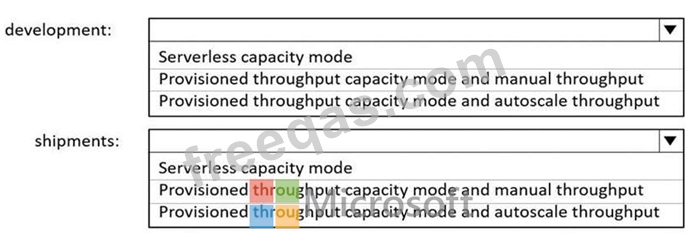
You plan to deploy two Azure Cosmos DB Core (SQL) API accounts that will each contain a single database. The accounts will be configured as shown in the following table.
How should you provision the containers within each account to minimize costs? To answer, select the appropriate options in the answer area.
NOTE: Each correct selection is worth one point.