FreeQAs
 Request Exam  Contact
  • Home
  • View All Exams
  • New QA's
  • Upload
PRACTICE EXAMS:
  • Oracle
  • Fortinet
  • Juniper
  • Microsoft
  • Cisco
  • Citrix
  • CompTIA
  • VMware
  • ISC
  • SAP
  • EMC
  • PMI
  • HP
  • Salesforce
  • Other
  • Oracle
    Oracle
  • Fortinet
    Fortinet
  • Juniper
    Juniper
  • Microsoft
    Microsoft
  • Cisco
    Cisco
  • Citrix
    Citrix
  • CompTIA
    CompTIA
  • VMware
    VMware
  • ISC
    ISC
  • SAP
    SAP
  • EMC
    EMC
  • PMI
    PMI
  • HP
    HP
  • Salesforce
    Salesforce
  1. Home
  2. Microsoft Certification
  3. DP-420 Exam
  4. Microsoft.DP-420.v2023-10-30.q97 Dumps
  • ««
  • «
  • …
  • 10
  • 11
  • 12
  • 13
  • 14
  • 15
  • 16
  • 17
  • 18
  • 19
  • …
  • »
  • »»
Download Now

Question 66

You have a database named db1 in an Azure Cosmos DB for NoSQL account named account1. The db1 database has a manual throughput of 4,000 request units per second (RU/s).
You need to move db1 from manual throughput to autoscale throughput by using the Azure CLI. The solution must provide a minimum of 4,000 RU/s and a maximum of 40,000 RU/s.
How should you complete the CLI statements? To answer, select the appropriate options in the answer area.
NOTE: Each correct selection is worth one point.

Correct Answer:
insert code

Question 67

You have an Azure Cosmos DB for NoSQL account that has multiple write regions.
You need to receive an alert when requests that target the database exceed the available request units per second (RU/s).
Which Azure Monitor signal should you use?

Correct Answer: B
Explanation
Azure Monitor is a service that provides comprehensive monitoring for Azure resources, including Azure Cosmos DB. You can use Azure Monitor to collect, analyze, and alert on metrics and logs from your Azure Cosmos DB account. You can create alerts for Azure Cosmos DB using Azure Monitor based on the metrics, activity log events, or Log Analytics logs on your account1.
For your scenario, if you want to receive an alert when requests that target the database exceed the available request units per second (RU/s), you should use the Document Quota metric. This metric measures the percentage of RU/s consumed by your account or container. You can create an alert rule on this metric from the Azure portal by following these steps2:
* In the Azure portal, select the Azure Cosmos DB account you want to monitor.
* Under the Monitoring section of the sidebar, select Alerts, and then select New alert rule.
* In the Create alert rule pane, fill out the Scope section by selecting your subscription name and resource type (Azure Cosmos DB accounts).
* In the Condition section, select Add condition and choose Document Quota from the list of signals.
* In the Configure signal logic pane, specify the threshold value and operator for your alert condition. For example, you can choose Greater than or equal to 90 as the threshold value and operator to receive an alert when your RU/s consumption reaches 90% or more of your provisioned throughput.
* In the Alert rule details section, specify a name and description for your alert rule.
* In the Actions section, select Add action group and choose how you want to receive notifications for your alert. For example, you can choose Email/SMS/Push/Voice as an action type and enter your email address or phone number as a receiver.
* Review your alert rule settings and select Create alert rule to save it.
insert code

Question 68

You are designing a data model for an Azure Cosmos DB for NoSQL account.
What are the partition limits for request units per second (RU/s) and storage? To answer, select the appropriate options in the answer area.
NOTE: Each correct selection is worth one point.

Correct Answer:

Explanation
insert code

Question 69

You have a database in an Azure Cosmos DB Core (SQL) API account.
You plan to create a container that will store employee data for 5,000 small businesses. Each business will have up to 25 employees. Each employee item will have an emailAddress value.
You need to ensure that the emailAddress value for each employee within the same company is unique.
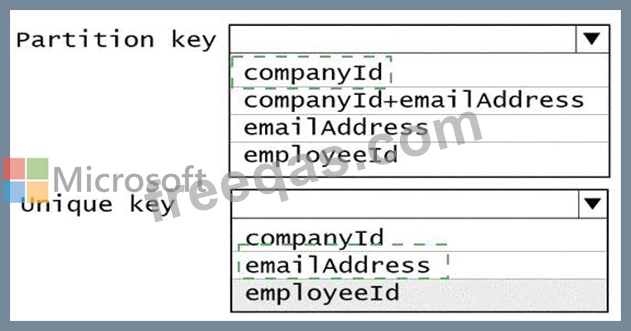
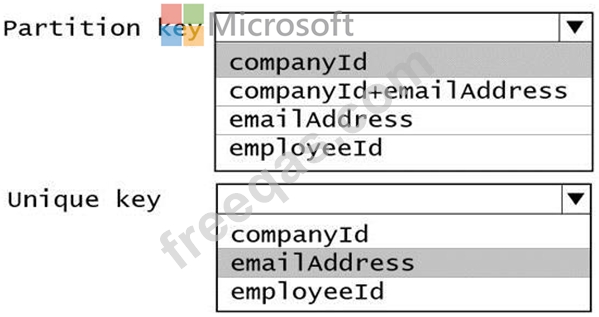
To what should you set the partition key and the unique key? To answer, select the appropriate options in the answer area.
NOTE: Each correct selection is worth one point.
Correct Answer:

Explanation

Box 1: CompanyID
After you create a container with a unique key policy, the creation of a new or an update of an existing item resulting in a duplicate within a logical partition is prevented, as specified by the unique key constraint. The partition key combined with the unique key guarantees the uniqueness of an item within the scope of the container.
For example, consider an Azure Cosmos container with Email address as the unique key constraint and CompanyID as the partition key. When you configure the user's email address with a unique key, each item has a unique email address within a given CompanyID. Two items can't be created with duplicate email addresses and with the same partition key value.
Box 2: emailAddress
Reference: https://docs.microsoft.com/en-us/azure/cosmos-db/unique-keys
insert code

Question 70

You need to identify which connectivity mode to use when implementing App2. The solution must support the planned changes and meet the business requirements.
Which connectivity mode should you identify?


Correct Answer: C
Scenario: Develop an app named App2 that will run from the retail stores and query the data in account2. App2 must be limited to a single DNS endpoint when accessing account2.
By using Azure Private Link, you can connect to an Azure Cosmos account via a private endpoint. The private endpoint is a set of private IP addresses in a subnet within your virtual network.
When you're using Private Link with an Azure Cosmos account through a direct mode connection, you can use only the TCP protocol. The HTTP protocol is not currently supported.
Reference:
https://docs.microsoft.com/en-us/azure/cosmos-db/how-to-configure-private-endpoints
insert code
  • ««
  • «
  • …
  • 10
  • 11
  • 12
  • 13
  • 14
  • 15
  • 16
  • 17
  • 18
  • 19
  • …
  • »
  • »»
[×]

Download PDF File

Enter your email address to download Microsoft.DP-420.v2023-10-30.q97 Dumps

Email:

FreeQAs

Our website provides the Largest and the most Latest vendors Certification Exam materials around the world.

Using dumps we provide to Pass the Exam, we has the Valid Dumps with passing guranteed just which you need.

  • DMCA
  • About
  • Contact Us
  • Privacy Policy
  • Terms & Conditions
©2026 FreeQAs

www.freeqas.com materials do not contain actual questions and answers from Cisco's certification exams.