FreeQAs
 Request Exam  Contact
  • Home
  • View All Exams
  • New QA's
  • Upload
PRACTICE EXAMS:
  • Oracle
  • Fortinet
  • IBM
  • Juniper
  • Microsoft
  • Cisco
  • Citrix
  • CompTIA
  • VMware
  • ISC
  • SAP
  • EMC
  • PMI
  • HP
  • Salesforce
  • Other
  • Oracle
    Oracle
  • Fortinet
    Fortinet
  • IBM
    IBM
  • Juniper
    Juniper
  • Microsoft
    Microsoft
  • Cisco
    Cisco
  • Citrix
    Citrix
  • CompTIA
    CompTIA
  • VMware
    VMware
  • ISC
    ISC
  • SAP
    SAP
  • EMC
    EMC
  • PMI
    PMI
  • HP
    HP
  • Salesforce
    Salesforce
  1. Home
  2. Microsoft Certification
  3. DP-420 Exam
  4. Microsoft.DP-420.v2024-08-19.q100 Dumps
  • «
  • 1
  • 2
  • 3
  • 4
  • 5
  • 6
  • 7
  • 8
  • 9
  • 10
  • …
  • »
  • »»
Download Now

Question 16

Note: This question is part of a series of questions that present the same scenario. Each question in the series contains a unique solution that might meet the stated goals. Some question sets might have more than one correct solution, while others might not have a correct solution.
After you answer a question in this section, you will NOT be able to return to it. As a result, these questions will not appear in the review screen.
You have a container named container1 in an Azure Cosmos DB Core (SQL) API account.
You need to make the contents of container1 available as reference data for an Azure Stream Analytics job.
Solution: You create an Azure Synapse pipeline that uses Azure Cosmos DB Core (SQL) API as the input and Azure Blob Storage as the output.
Does this meet the goal?

Correct Answer: B
Instead create an Azure function that uses Azure Cosmos DB Core (SQL) API change feed as a trigger and Azure event hub as the output.
The Azure Cosmos DB change feed is a mechanism to get a continuous and incremental feed of records from an Azure Cosmos container as those records are being created or modified. Change feed support works by listening to container for any changes. It then outputs the sorted list of documents that were changed in the order in which they were modified.
The following diagram represents the data flow and components involved in the solution:

Reference: https://docs.microsoft.com/en-us/azure/cosmos-db/sql/changefeed-ecommerce-solution
insert code

Question 17

You plan to store order data in Azure Cosmos DB for NoSQL account. The data contains information about orders and their associated items.
You need to develop a model that supports order read operations. The solution must minimize the number or requests.

Correct Answer: B
Explanation
Azure Cosmos DB is a multi-model database that supports various data models, such as documents, key-value, graph, and column-family3. The core content-model of Cosmos DB's database engine is based on atom-record-sequence (ARS), which allows it to store and query different types of data in a flexible and efficient way3.
To develop a model that supports order read operations and minimizes the number of requests, you should consider the following factors:
The size and shape of your data
The frequency and complexity of your queries
The latency and throughput requirements of your application
The trade-offs between storage efficiency and query performance
Based on these factors, one possible model that you could implement is B. Create a single database that contains one container. Create a separate document for each order and embed the order items into the order documents.
This model has the following advantages:
It stores orders and order items as self-contained documents that can be easily retrieved by order ID1.
It avoids storing redundant data or creating additional containers for order items1.
It allows you to view the order history of a customer with simple queries1.
It leverages the benefits of embedding data, such as reducing the number of requests, improving query performance, and simplifying data consistency2.
This model also has some limitations, such as:
It may not be suitable for some order items that have data that is greater than 2 KB, as it could exceed the maximum document size limit of 2 MB2.
It may not be optimal for scenarios where order items need to be queried independently from orders or aggregated by other criteria2.
It may not support transactions across multiple orders or customers, as transactions are scoped to a single logical partition2.
Depending on your specific use case and requirements, you may need to adjust this model or choose a different one. For example, you could use a hybrid data model that combines embedding and referencing data2
, or you could use a graph data model that expresses entities and relationships as vertices and edges.
insert code

Question 18

The settings for a container in an Azure Cosmos DB Core (SQL) API account are configured as shown in the following exhibit.
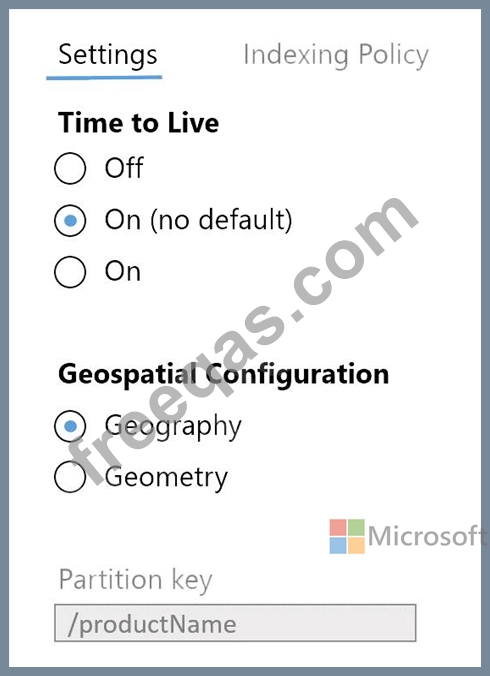
Which statement describes the configuration of the container?

Correct Answer: C
When DefaultTimeToLive is -1 then your Time to Live setting is On (No default) Time to Live on a container, if present and the value is set to "-1", it is equal to infinity, and items don't expire by default.
Time to Live on an item:
This Property is applicable only if DefaultTimeToLive is present and it is not set to null for the parent container.
If present, it overrides the DefaultTimeToLive value of the parent container.
insert code

Question 19

You are developing an application that will connect to an Azure Cosmos DB for NoSQL account. The account has a single readme region and one agonal read region. The regions are configured for automatic failover.
The account has the following connect strings. (Line numbers are included for reference only.)
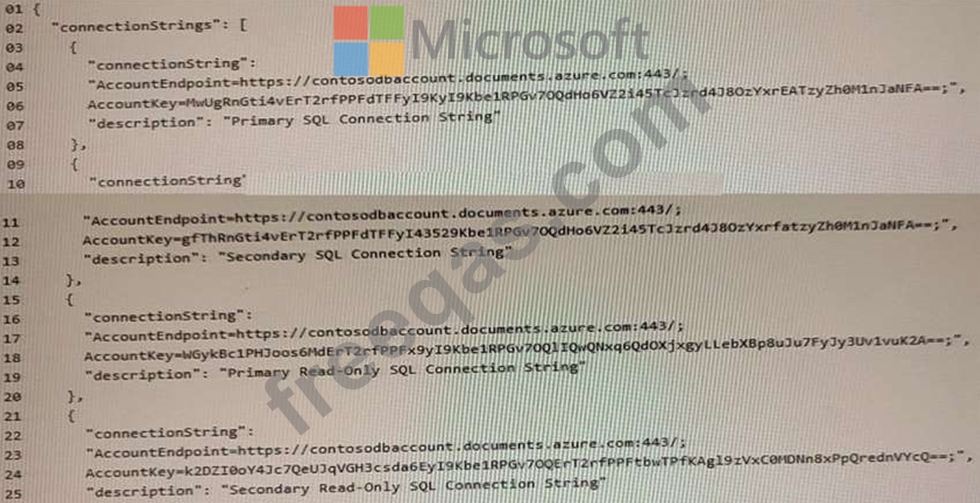
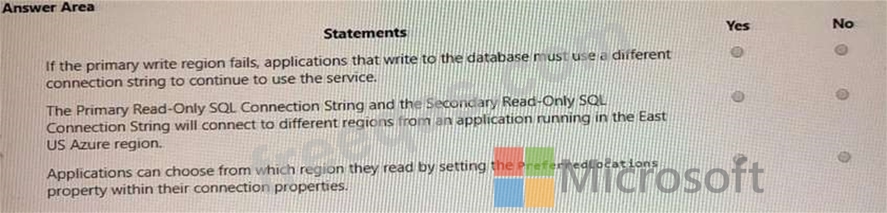
For each of the following statements, select Yes if the statement is true. otherwise, select No.
NOTE: Each correct selection is worth one point.
Correct Answer:

Explanation
If the primary write region fails, applications that write to the database must use a different connection string to continue to use the service. = NOYou do not need to use a different connection string to continue to use the service if the primary write region fails. This is because Azure Cosmos DB supports automatic failover, which means that it will automatically switch the primary write region to another region in case of a regional outage2
. The application does not need to change the connection string or specify the failover priority3. The connection string contains a list of all the regions associated with your account, and Azure Cosmos DB will route the requests to the appropriate region based on the availability and latency1.
The primary Read-Only SQL Connection String and the Secondary Read-Only SQL Connection String will connect to different regions from an application running in the East US Azure region = YesThe primary read-only SQL connection string and the secondary read-only SQL connection string will connect to different regions from an application running in the East US Azure region. This is because the primary read-only SQL connection string contains the endpoint for the East US region, which is the same as the primary write region.
The secondary read-only SQL connection string contains the endpoint for the West US region, which is the additional read region. Therefore, if an application running in the East US Azure region uses these connection strings, it will connect to different regions depending on which one it chooses.
Applications can choose from which region by setting the PreferredLocations property within their connection properties = Yes Applications can choose from which region by setting the PreferredLocations property within their connection properties. This property allows you to specify a list of regions that you prefer to read from based on their proximity to your application2. Azure Cosmos DB will route the requests to the appropriate region based on the availability and latency1. You can also set the ApplicationRegion property to the region where your application is deployed, and Azure Cosmos DB will automatically populate the PreferredLocations property based on the geo-proximity from that location
insert code

Question 20

You have a database named db1 in an Azure Cosmos DB for NoSQL account named account1. The db1 database has a manual throughput of 4,000 request units per second (RU/s).
You need to move db1 from manual throughput to autoscale throughput by using the Azure CLI. The solution must provide a minimum of 4,000 RU/s and a maximum of 40,000 RU/s.
How should you complete the CLI statements? To answer, select the appropriate options in the answer area.
NOTE: Each correct selection is worth one point.

Correct Answer:
insert code
  • «
  • 1
  • 2
  • 3
  • 4
  • 5
  • 6
  • 7
  • 8
  • 9
  • 10
  • …
  • »
  • »»
[×]

Download PDF File

Enter your email address to download Microsoft.DP-420.v2024-08-19.q100 Dumps

Email:

FreeQAs

Our website provides the Largest and the most Latest vendors Certification Exam materials around the world.

Using dumps we provide to Pass the Exam, we has the Valid Dumps with passing guranteed just which you need.

  • DMCA
  • About
  • Contact Us
  • Privacy Policy
  • Terms & Conditions
©2026 FreeQAs

www.freeqas.com materials do not contain actual questions and answers from Cisco's certification exams.
