FreeQAs
 Request Exam  Contact
  • Home
  • View All Exams
  • New QA's
  • Upload
PRACTICE EXAMS:
  • Oracle
  • Fortinet
  • Juniper
  • Microsoft
  • Cisco
  • Citrix
  • CompTIA
  • VMware
  • ISC
  • SAP
  • EMC
  • PMI
  • HP
  • Salesforce
  • Other
  • Oracle
    Oracle
  • Fortinet
    Fortinet
  • Juniper
    Juniper
  • Microsoft
    Microsoft
  • Cisco
    Cisco
  • Citrix
    Citrix
  • CompTIA
    CompTIA
  • VMware
    VMware
  • ISC
    ISC
  • SAP
    SAP
  • EMC
    EMC
  • PMI
    PMI
  • HP
    HP
  • Salesforce
    Salesforce
  1. Home
  2. Microsoft Certification
  3. SC-200 Exam
  4. Microsoft.SC-200.v2025-06-05.q297 Dumps
  • ««
  • «
  • …
  • 16
  • 17
  • 18
  • 19
  • 20
  • 21
  • 22
  • 23
  • 24
  • 25
  • …
  • »
  • »»
Download Now

Question 96

You have an Azure subscription.
You need to delegate permissions to meet the following requirements:
* Enable and disable advanced features of Microsoft Defender for Cloud.
* Apply security recommendations to a resource.
The solution must use the principle of least privilege.
Which Microsoft Defender for Cloud role should you use for each requirement? To answer, drag the appropriate roles to the correct requirements. Each role may be used once, mote than once, or not at all. You may need to drag the split bar between panes or scroll to view content.
NOTE: Each correct selection is worth one point.

Correct Answer:
insert code

Question 97

You need to modify the anomaly detection policy settings to meet the Microsoft Defender for Cloud Apps requirements and resolve the reported problem.
Which policy should you modify?


Correct Answer: D
Topic 1, Litware inc.
Overview
This is a case study. Case studies are not timed separately. You can use as much exam time as you would like to complete each case. However, there may be additional case studies and sections on this exam. You must manage your time to ensure that you are able to complete all questions included on this exam in the time provided.
To answer the questions included in a case study, you will need to reference information that is provided in the case study. Case studies might contain exhibits and other resources that provide more information about the scenario that is described in the case study. Each question is independent of the other questions in this case study.
At the end of this case study, a review screen will appear. This screen allows you to review your answers and to make changes before you move to the next section of the exam. After you begin a new section, you cannot return to this section.
To start the case study
To display the first question in this case study, click the Next button. Use the buttons in the left pane to explore the content of the case study before you answer the questions. Clicking these buttons displays information such as business requirements, existing environment, and problem statements. If the case study has an All Information tab, note that the information displayed is identical to the information displayed on the subsequent tabs. When you are ready to answer a question, click the Question button to return to the question.
Overview
Litware Inc. is a renewable company.
Litware has offices in Boston and Seattle. Litware also has remote users located across the United States. To access Litware resources, including cloud resources, the remote users establish a VPN connection to either office.
Existing Environment
Identity Environment
The network contains an Active Directory forest named litware.com that syncs to an Azure Active Directory (Azure AD) tenant named litware.com.
Microsoft 365 Environment
Litware has a Microsoft 365 E5 subscription linked to the litware.com Azure AD tenant. Microsoft Defender for Endpoint is deployed to all computers that run Windows 10. All Microsoft Cloud App Security built-in anomaly detection policies are enabled.
Azure Environment
Litware has an Azure subscription linked to the litware.com Azure AD tenant. The subscription contains resources in the East US Azure region as shown in the following table.

Network Environment
Each Litware office connects directly to the internet and has a site-to-site VPN connection to the virtual networks in the Azure subscription.
On-premises Environment
The on-premises network contains the computers shown in the following table.

Current problems
Cloud App Security frequently generates false positive alerts when users connect to both offices simultaneously.
Planned Changes
Litware plans to implement the following changes:
Create and configure Azure Sentinel in the Azure subscription.
Validate Azure Sentinel functionality by using Azure AD test user accounts.
Business Requirements
Litware identifies the following business requirements:
Azure Information Protection Requirements
All files that have security labels and are stored on the Windows 10 computers must be available from the Azure Information Protection - Data discovery dashboard.
Microsoft Defender for Endpoint Requirements
All Cloud App Security unsanctioned apps must be blocked on the Windows 10 computers by using Microsoft Defender for Endpoint.
Microsoft Cloud App Security Requirements
Cloud App Security must identify whether a user connection is anomalous based on tenant-level data.
Azure Defender Requirements
All servers must send logs to the same Log Analytics workspace.
Azure Sentinel Requirements
Litware must meet the following Azure Sentinel requirements:
Integrate Azure Sentinel and Cloud App Security.
Ensure that a user named admin1 can configure Azure Sentinel playbooks.
Create an Azure Sentinel analytics rule based on a custom query. The rule must automatically initiate the execution of a playbook.
Add notes to events that represent data access from a specific IP address to provide the ability to reference the IP address when navigating through an investigation graph while hunting.
Create a test rule that generates alerts when inbound access to Microsoft Office 365 by the Azure AD test user accounts is detected. Alerts generated by the rule must be grouped into individual incidents, with one incident per test user account.
insert code

Question 98

You need to use an Azure Resource Manager template to create a workflow automation that will trigger an automatic remediation when specific security alerts are received by Azure Security Center.
How should you complete the portion of the template that will provision the required Azure resources? To answer, select the appropriate options in the answer area.
NOTE: Each correct selection is worth one point.

Correct Answer:

Explanation:

Reference:
https://docs.microsoft.com/en-us/azure/security-center/quickstart-automation-alert
insert code

Question 99

You have a Microsoft subscription that has Microsoft Defender for Cloud enabled You configure the Azure logic apps shown in the following table.

You need to configure an automatic action that will run if a Suspicious process executed alert is triggered. The solution must minimize administrative effort.
Which three actions should you perform in sequence? To answer, move the appropriate actions from the list of actions to the answer area and arrange them in the correct order.
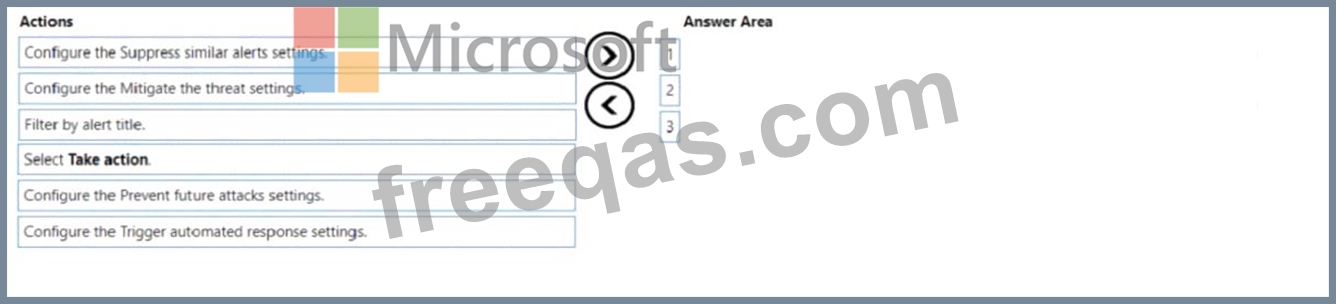
Correct Answer:

Explanation
A. Configure the Trigger automated response settings in the Azure Security Center or Azure Logic App,
B. Filter by alert title (e.g. "Suspicious process executed").
C. Select "Take action" (e.g. "Mitigate the threat").
insert code

Question 100

You have an Azure subscription named Sub1 and a Microsoft 365 subscription. Sub1 is linked to an Azure Active Directory (Azure AD) tenant named contoso.com.
You create an Azure Sentinel workspace named workspace1. In workspace1, you activate an Azure AD connector for contoso.com and an Office 365 connector for the Microsoft 365 subscription.
You need to use the Fusion rule to detect multi-staged attacks that include suspicious sign-ins to contoso.com followed by anomalous Microsoft Office 365 activity.
Which two actions should you perform? Each correct answer present part of the solution NOTE: Each correct selection is worth one point.


Correct Answer: A,B
To use the Fusion rule to detect multi-staged attacks that include suspicious sign-ins to contoso.com followed by anomalous Microsoft Office 365 activity, you should perform the following two actions:
Create an Azure AD Identity Protection connector. This will allow you to monitor suspicious activities in your Azure AD tenant and detect malicious sign-ins.
Create a custom rule based on the Office 365 connector templates. This will allow you to monitor and detect anomalous activities in the Microsoft 365 subscription. Reference: https://docs.microsoft.com/en-us/azure/sentinel/fusion-rules
insert code
  • ««
  • «
  • …
  • 16
  • 17
  • 18
  • 19
  • 20
  • 21
  • 22
  • 23
  • 24
  • 25
  • …
  • »
  • »»
[×]

Download PDF File

Enter your email address to download Microsoft.SC-200.v2025-06-05.q297 Dumps

Email:

FreeQAs

Our website provides the Largest and the most Latest vendors Certification Exam materials around the world.

Using dumps we provide to Pass the Exam, we has the Valid Dumps with passing guranteed just which you need.

  • DMCA
  • About
  • Contact Us
  • Privacy Policy
  • Terms & Conditions
©2026 FreeQAs

www.freeqas.com materials do not contain actual questions and answers from Cisco's certification exams.