You have an Azure Active Directory (Azure AD) tenant named contoso.com that contains a user named User1.
User1 has the devices shown in the following table.
On November 5, 2020, you create and enforce terms of use in contoso.com that has the following settings:
Name: Terms1
Display name: Contoso terms of use
Require users to expand the terms of use: On
Require users to consent on every device: On
Expire consents: On
Expire starting on: December 10, 2020
Frequency: Monthly
On November 15, 2020, User1 accepts Terms1 on Device3.
For each of the following statements, select Yes if the statement is true. Otherwise, select No.
NOTE: Each correct selection is worth one point.

You have a Microsoft Exchange organization that uses an SMTP' address space of contoso.com.
Several users use their contoso.com email address for self-service sign up to Azure Active Directory (Azure AD).
You gain global administrator privileges to the Azure AD tenant that contains the self-signed users.
You need to prevent the users from creating user accounts in the contoso.com Azure AD tenant for self-service sign-up to Microsoft 365 services.
Which PowerShell cmdlet should you run?
You have a Microsoft 36S tenant.
You create a named location named HighRiskCountries that contains a list of high-risk countries.
You need to limit the amount of time a user can stay authenticated when connecting from a high-risk country.
What should you configure in a conditional access policy? To answer, select the appropriate options in the answer area.
NOTE: Each correct selection is worth one point.


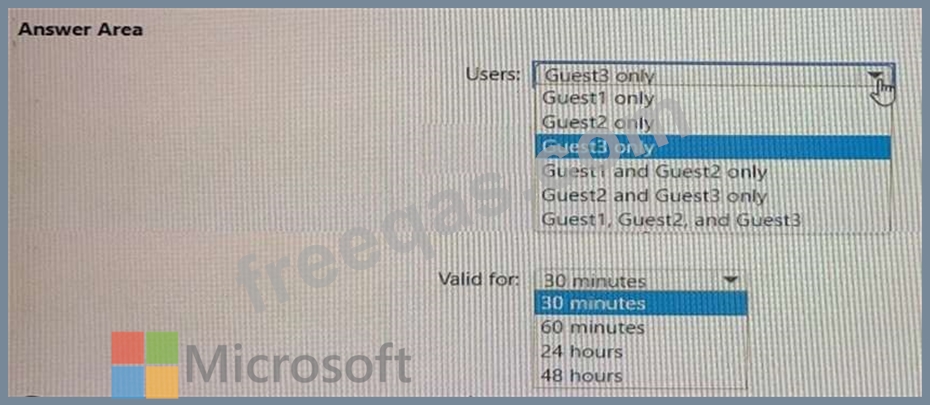
You have an Azure AD tenant named contoso.com that has Email one-time passcode for guests set to Yes.
You invite the guest users shown in the following table.
Which users will receive a one-time passcode, and how long will the passcode be valid? To answer, select the appropriate options in the answer area.
NOTE: Each correct selection is worth one point.