The AnyAirline organization's passenger reservations center is designing an integration solution that combines invocations of three different System APIs (bookFlight, bookHotel, and bookCar) in a business transaction. Each System API makes calls to a single database.
The entire business transaction must be rolled back when at least one of the APIs fails.
What is the most idiomatic (used for its intended purpose) way to integrate these APIs in near real-time that provides the best balance of consistency, performance, and reliability?
A mule application uses an HTTP request operation to involve an external API.
The external API follows the HTTP specification for proper status code usage.
What is possible cause when a 3xx status code is returned to the HTTP Request operation from the external API?
An integration Mute application is being designed to process orders by submitting them to a backend system for offline processing. Each order will be received by the Mute application through an HTTPS POST and must be acknowledged immediately. Once acknowledged, the order will be submitted to a backend system. Orders that cannot be successfully submitted due to rejections from the backend system will need to be processed manually (outside the backend system).
The Mule application will be deployed to a customer-hosted runtime and is able to use an existing ActiveMQ broker if needed.
The backend system has a track record of unreliability both due to minor network connectivity issues and longer outages.
What idiomatic (used for their intended purposes) combination of Mule application components and ActiveMQ queues are required to ensure automatic submission of orders to the backend system, while minimizing manual order processing?
Refer to the exhibit.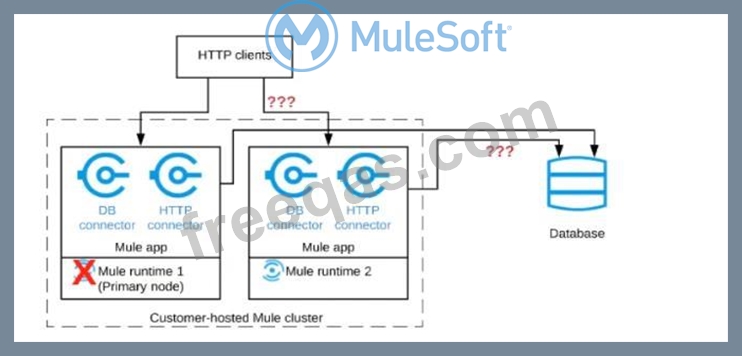
A Mule application is deployed to a cluster of two customer-hosted Mute runtimes. TheMute application has a flow that polls a database and another flow with an HTTP Listener.
HTTP clients send HTTP requests directly to individual cluster nodes.
What happens to database polling and HTTP request handling in the time after the primary (master) node of the cluster has railed, but before that node is restarted?
Refer to the exhibit.
Ashopping cart checkout process consists of a web store backend sending a sequence of API invocations to an Experience API, which in turn invokes a Process API. All API invocations are over HTTPS POST. The Java web store backend executes in a Java EE application server, while all API implementations are Mule applications executing in a customer -hosted Mule runtime.
End-to-end correlation of all HTTP requests and responses belonging to each individual checkout Instance is required. This is to be done througha common correlation ID, so that all log entries written by the web store backend, Experience API implementation, and Process API implementation include the same correlation ID for all requests and responses belonging to the same checkout instance.
What is the most efficient way (using the least amount of custom coding or configuration) for the web store backend and the implementations of the Experience API and Process API to participate in end-to-end correlation of the API invocations for each checkout instance?
A)
The web store backend, being a Java EE application, automatically makes use of the thread-local correlation ID generated by the Java EE application server and automatically transmits that to the Experience API using HTTP-standard headers No special code or configuration is included in the web store backend, Experience API, and Process API implementations to generate and manage the correlation ID
B)
The web store backend generates a new correlation ID value at the start of checkout and sets it on the X-CORRELATlON-lt HTTP request header In each API invocation belonging to that checkout No special code or configuration is included in the Experience API and Process API implementations to generate and manage the correlation ID
C)
The Experience API implementation generates a correlation ID for each incoming HTTP request and passes it to the web store backend in the HTTP response, which includes it in all subsequent API invocations to the Experience API.
The Experience API implementation must be coded to also propagate the correlation ID to the Process API in a suitable HTTP request header
D)
The web store backend sends a correlation ID value in the HTTP request body In the way required by the Experience API The Experience API and Process APIimplementations must be coded to receive the custom correlation ID In the HTTP requests and propagate It in suitable HTTP request headers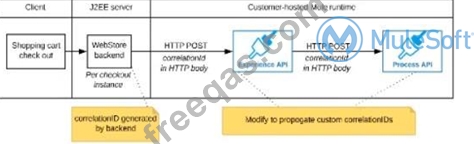
Enter your email address to download MuleSoft.MCIA-Level-1.v2022-09-22.q120 Dumps

