FreeQAs
 Request Exam  Contact
  • Home
  • View All Exams
  • New QA's
  • Upload
PRACTICE EXAMS:
  • Oracle
  • Fortinet
  • Juniper
  • Microsoft
  • Cisco
  • Citrix
  • CompTIA
  • VMware
  • ISC
  • SAP
  • EMC
  • PMI
  • HP
  • Salesforce
  • Other
  • Oracle
    Oracle
  • Fortinet
    Fortinet
  • Juniper
    Juniper
  • Microsoft
    Microsoft
  • Cisco
    Cisco
  • Citrix
    Citrix
  • CompTIA
    CompTIA
  • VMware
    VMware
  • ISC
    ISC
  • SAP
    SAP
  • EMC
    EMC
  • PMI
    PMI
  • HP
    HP
  • Salesforce
    Salesforce
  1. Home
  2. MuleSoft Certification
  3. MCIA-Level-1 Exam
  4. MuleSoft.MCIA-Level-1.v2023-04-22.q108 Dumps
  • ««
  • «
  • …
  • 10
  • 11
  • 12
  • 13
  • 14
  • 15
  • 16
  • 17
  • 18
  • 19
  • …
  • »
  • »»
Download Now

Question 66

An API implementation is being designed that must invoke an Order API which is known to repeatedly experience downtime. For this reason a fallback API is to be called when the Order API is unavailable. What approach to designing invocation of the fallback API provides the best resilience?

Correct Answer: A
* Resilience testing is a type of software testing that observes how applications act under stress. It's meant to ensure the product's ability to perform in chaotic conditions without a loss of core functions or data; it ensures a quick recovery after unforeseen, uncontrollable events.
* In case an API invocation fails - even after a certain number of retries - it might be adequate to invoke a different API as a fallback. A fallback API, by definition, will never be ideal for the purpose of the API client, otherwise it would be the primary API.
* Here are some examples for fallback APIs:
- An old, deprecated version of the same API.
- An alternative endpoint of the same API and version (e.g. API in another CloudHub region).
- An API doing more than required, and therefore not as performant as the primary API.
- An API doing less than required and therefore forcing the API Client to offer a degraded service, which is still better than no service at all.
* API clients implemented as Mule applications offer the 'Until Successful Scope and Exception' strategies at their disposal, which together allow configuring fallback actions such as a fallback API invocation.
* All HTTP response status codes within the 3xx category are considered redirection messages. These codes indicate to the user agent (i.e. your web browser) that an additional action is required in order to complete the request and access the desired resource

Hence correct answer is Redirect client requests through an HTTP 303 temporary redirect status code to the fallback API whenever the Order API is unavailable
insert code

Question 67

A stock broking company makes use of CloudHub VPC to deploy Mule applications. Mule application needs to connect to a database application in the customers on-premises corporate data center and also to a Kafka cluster running in AWS VPC.
How is access enabled for the API to connect to the database application and Kafka cluster securely?

Correct Answer: B
insert code

Question 68

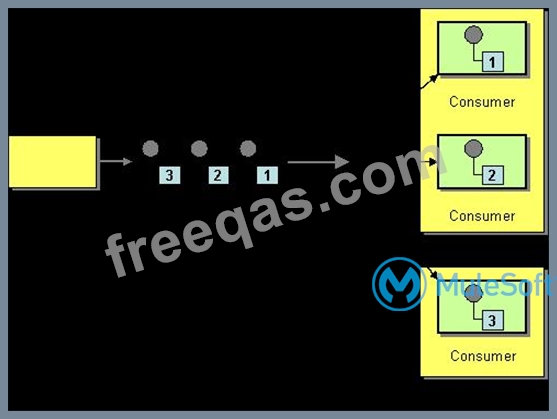
Refer to the exhibit.

A Mule application is deployed to a multi-node Mule runtime cluster. The Mule application uses the competing consumer pattern among its cluster replicas to receive JMS messages from a JMS queue. To process each received JMS message, the following steps are performed in a flow:
Step l: The JMS Correlation ID header is read from the received JMS message.
Step 2: The Mule application invokes an idempotent SOAP webservice over HTTPS, passing the JMS Correlation ID as one parameter in the SOAP request.
Step 3: The response from the SOAP webservice also returns the same JMS Correlation ID.
Step 4: The JMS Correlation ID received from the SOAP webservice is validated to be identical to the JMS Correlation ID received in Step 1.
Step 5: The Mule application creates a response JMS message, setting the JMS Correlation ID message header to the validated JMS Correlation ID and publishes that message to a response JMS queue.
Where should the Mule application store the JMS Correlation ID values received in Step 1 and Step 3 so that the validation in Step 4 can be performed, while also making the overall Mule application highly available, fault-tolerant, performant, and maintainable?
Correct Answer: C
* If we store Correlation id value in step 1 as Mule event variables/attributes, the values will be cleared after server restart and we want system to be fault tolerant.
* The Correlation ID value in Step 1 should be stored in a persistent object store.
* We don't need to store Correlation ID value in Step 3 to persistent object store. We can store it but as we also need to make application performant. We can avoid this step of accessing persistent object store.
* Accessing persistent object stores slow down the performance as persistent object stores are by default stored in shared file systems.
* As the SOAP service is idempotent in nature. In case of any failures , using this Correlation ID saved in first step we can make call to SOAP service and validate the Correlation ID.
Top of Form
Additional Information:
* Competing Consumers are multiple consumers that are all created to receive messages from a single Point-to-Point Channel. When the channel delivers a message, any of the consumers could potentially receive it. The messaging system's implementation determines which consumer actually receives the message, but in effect the consumers compete with each other to be the receiver. Once a consumer receives a message, it can delegate to the rest of its application to help process the message.

* In case you are unaware about term idempotent re is more info:
Idempotent operations means their result will always same no matter how many times these operations are invoked.

Bottom of Form
insert code

Question 69

Refer to the exhibit.


A business process involves two APIs that interact with each other asynchronously over HTTP. Each API is implemented as a Mule application. API 1 receives the initial HTTP request and invokes API 2 (in a fire and forget fashion) while API 2, upon completion of the processing, calls back into API l to notify about completion of the asynchronous process.
Each API Is deployed to multiple redundant Mule runtimes and a separate load balancer, and is deployed to a separate network zone.
In the network architecture, how must the firewall rules be configured to enable the above Interaction between API 1 and API 2?

Correct Answer: B
* If your API implementation involves putting a load balancer in front of your APIkit application, configure the load balancer to redirect URLs that reference the baseUri of the application directly. If the load balancer does not redirect URLs, any calls that reach the load balancer looking for the application do not reach their destination.
* When you receive incoming traffic through the load balancer, the responses will go out the same way. However, traffic that is originating from your instance will not pass through the load balancer. Instead, it is sent directly from the public IP address of your instance out to the Internet. The ELB is not involved in that scenario.
* The question says "each API is deployed to multiple redundant Mule runtimes", that seems to be a hint for self hosted Mule runtime cluster. Set Inbound allowed for the LB, outbound allowed for runtime to request out.
* Hence correct way is to enable communication from each API's Mule Runtimes and Network zone to the load balancer of the other API. Because communication is asynchronous one
insert code

Question 70

An integration Mute application is being designed to process orders by submitting them to a backend system for offline processing. Each order will be received by the Mute application through an HTTPS POST and must be acknowledged immediately. Once acknowledged, the order will be submitted to a backend system. Orders that cannot be successfully submitted due to rejections from the backend system will need to be processed manually (outside the backend system).
The Mule application will be deployed to a customer-hosted runtime and is able to use an existing ActiveMQ broker if needed.
The backend system has a track record of unreliability both due to minor network connectivity issues and longer outages.
What idiomatic (used for their intended purposes) combination of Mule application components and ActiveMQ queues are required to ensure automatic submission of orders to the backend system, while minimizing manual order processing?

Correct Answer: D
Correct answer is using below set of activities Until Successful component ActiveMQ long retry Queue ActiveMQ Dead Letter Queue for manual processing We will see why this is correct answer but before that lets understand few of the concepts which we need to know. Until Successful Scope The Until Successful scope processes messages through its processors until the entire operation succeeds. Until Successful repeatedly retries to process a message that is attempting to complete an activity such as: - Dispatching to outbound endpoints, for example, when calling a remote web service that may have availability issues. - Executing a component method, for example, when executing on a Spring bean that may depend on unreliable resources. - A sub-flow execution, to keep re-executing several actions until they all succeed, - Any other message processor execution, to allow more complex scenarios. How this will help requirement : Using Until Successful Scope we can retry sending the order to backend systems in case of error to avoid manual processing later. Retry values can be configured in Until Successful Scope Apache ActiveMQ It is an open source message broker written in Java together with a full Java Message Service client ActiveMQ has the ability to deliver messages with delays thanks to its scheduler. This functionality is the base for the broker redelivery plug-in. The redelivery plug-in can intercept dead letter processing and reschedule the failing messages for redelivery. Rather than being delivered to a DLQ, a failing message is scheduled to go to the tail of the original queue and redelivered to a message consumer. How this will help requirement : If backend application is down for a longer duration where Until Successful Scope wont work, then we can make use of ActiveMQ long retry Queue. The redelivery plug-in can intercept dead letter processing and reschedule the failing messages for redelivery. Mule Reference: https://docs.mulesoft.com/mule-runtime/4.3/migration-core-until-successful
insert code
  • ««
  • «
  • …
  • 10
  • 11
  • 12
  • 13
  • 14
  • 15
  • 16
  • 17
  • 18
  • 19
  • …
  • »
  • »»
[×]

Download PDF File

Enter your email address to download MuleSoft.MCIA-Level-1.v2023-04-22.q108 Dumps

Email:

FreeQAs

Our website provides the Largest and the most Latest vendors Certification Exam materials around the world.

Using dumps we provide to Pass the Exam, we has the Valid Dumps with passing guranteed just which you need.

  • DMCA
  • About
  • Contact Us
  • Privacy Policy
  • Terms & Conditions
©2026 FreeQAs

www.freeqas.com materials do not contain actual questions and answers from Cisco's certification exams.
