Which is NOT considered a security resource within Oracle Cloud Infrastructure?
Correct Answer: B
Question 2
Which three components are part of Oracle Cloud Infrastructure (OCI) identity and access management service?
Correct Answer: B,C,E
Explanation Components of IAMIAM uses the components described in this section. To better understand how the components fit together, see Example Scenario. RESOURCE The cloud objects that your company's employees create and use when interacting with Oracle Cloud Infrastructure. For example: compute instances, block storage volumes, virtual cloud networks (VCNs), subnets, route tables, etc. USER An individual employee or system that needs to manage or use your company's Oracle Cloud Infrastructure resources. Users might need to launch instances, manage remote disks, work with your virtual cloud network, etc. End users of your application are not typically IAM users. Users have one or more IAM credentials (see User Credentials). GROUP A collection of users who all need the same type of access to a particular set of resources or compartment. DYNAMIC GROUP A special type of group that contains resources (such as compute instances) that match rules that you define (thus the membership can change dynamically as matching resources are created or deleted). These instances act as "principal" actors and can make API calls to services according to policies that you write for the dynamic group. NETWORK SOURCE A group of IP addresses that are allowed to access resources in your tenancy. The IP addresses can be public IP addresses or IP addresses from a VCN within your tenancy. After you create the network source, you use policy to restrict access to only requests that originate from the IPs in the network source. COMPARTMENT A collection of related resources. Compartments are a fundamental component of Oracle Cloud Infrastructure for organizing and isolating your cloud resources. You use them to clearly separate resources for the purposes of measuring usage and billing, access (through the use of policies), and isolation (separating the resources for one project or business unit from another). A common approach is to create a compartment for each major part of your organization. For more information, see Setting Up Your Tenancy. TENANCY The root compartment that contains all of your organization's Oracle Cloud Infrastructure resources. Oracle automatically creates your company's tenancy for you. Directly within the tenancy are your IAM entities (users, groups, compartments, and some policies; you can also put policies into compartments inside the tenancy). You place the other types of cloud resources (e.g., instances, virtual networks, block storage volumes, etc.) inside the compartments that you create. POLICY A document that specifies who can access which resources, and how. Access is granted at the group and compartment level, which means you can write a policy that gives a group a specific type of access within a specific compartment, or to the tenancy itself. If you give a group access to the tenancy, the group automatically gets the same type of access to all the compartments inside the tenancy. For more information, see Example Scenario and How Policies Work. The word "policy" is used by people in different ways: to mean an individual statement written in the policy language; to mean a collection of statements in a single, named "policy" document (which has an Oracle Cloud ID (OCID) assigned to it); and to mean the overall body of policies your organization uses to control access to resources. HOME REGION The region where your IAM resources reside. All IAM resources are global and available across all regions, but the master set of definitions reside in a single region, the home region. You must make changes to your IAM resources in your home region. The changes will be automatically propagated to all regions. For more information, see Managing Regions. FEDERATION A relationship that an administrator configures between an identity provider and a service provider. When you federate Oracle Cloud Infrastructure with an identity provider, you manage users and groups in the identity provider. You manage authorization in Oracle Cloud Infrastructure's IAM service. Oracle Cloud Infrastructure tenancies are federated with Oracle Identity Cloud Service by default. https://docs.cloud.oracle.com/en-us/iaas/Content/Identity/Concepts/overview.htm
Question 3
Which statement is correct regarding the oracle cloud infrastructure Compute services?
Correct Answer: C
Explanation Oracle Cloud Infrastructure offers both bare metal and virtual machine instances: Bare Metal: A bare metal compute instance gives you dedicated physical server access for highest performance and strong isolation. Virtual Machine: A virtual machine (VM) is an independent computing environment that runs on top of physical bare metal hardware. The virtualization makes it possible to run multiple VMs that are isolated from each other. VMs are ideal for running applications that do not require the performance and resources (CPU, memory, network bandwidth, storage) of an entire physical machine. An Oracle Cloud Infrastructure VM compute instance runs on the same hardware as a bare metal instance, leveraging the same cloud-optimized hardware, firmware, software stack, and networking infrastructure.
Question 4
A customer wants a dedicated connection with minimal network latency from their on-premises data center to Oracle Cloud Infrastructure (OCI). Which service should they choose?
Correct Answer: C
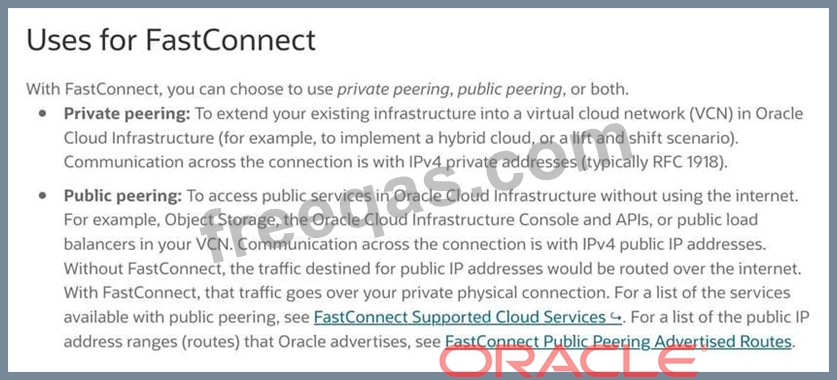
Explanation Oracle Cloud Infrastructure FastConnect provides an easy way to create a dedicated, private connection between your data center and Oracle Cloud Infrastructure. FastConnect provides higher-bandwidth options, and a more reliable and consistent networking experience compared to internet-based connections.
Question 5
What does compute instance horizonal scaling mean?