FreeQAs
 Request Exam  Contact
  • Home
  • View All Exams
  • New QA's
  • Upload
PRACTICE EXAMS:
  • Oracle
  • Fortinet
  • Juniper
  • Microsoft
  • Cisco
  • Citrix
  • CompTIA
  • VMware
  • SAP
  • EMC
  • PMI
  • HP
  • Salesforce
  • Other
  • Oracle
    Oracle
  • Fortinet
    Fortinet
  • Juniper
    Juniper
  • Microsoft
    Microsoft
  • Cisco
    Cisco
  • Citrix
    Citrix
  • CompTIA
    CompTIA
  • VMware
    VMware
  • SAP
    SAP
  • EMC
    EMC
  • PMI
    PMI
  • HP
    HP
  • Salesforce
    Salesforce
  1. Home
  2. Oracle Certification
  3. 1z0-1054-25 Exam
  4. Oracle.1z0-1054-25.v2025-12-06.q62 Dumps
  • «
  • 1
  • 2
  • 3
  • 4
  • 5
  • 6
  • 7
  • 8
  • 9
  • 10
  • …
  • »
  • »»
Download Now

Question 1

You entered across-validation ruleto prevent thebalance sheet cost center (000)from being used withProfit and Loss Accounts (4000-ZZZZ).
The following combinations exist in theCode Combination table:
01-000-4110-00
01-000-5299-000
01-000-5105-000
01-000-7640-00
Which two statements aretrueregardingcross-validation rules?

Correct Answer: C,D
insert code

Question 2

Your ledger currency is USD. At month end, you have a balance on the Accounts Payable Liability Account of 100,000 Euros, which is equivalent to 136,550 USD. This balance needs to be revalued. The month-end exchange rate for revaluation is 1 Euro = 1.3755 USD.
What two statements are true about the resulting revaluation run?

Correct Answer: B,D
The revaluation process is used to adjust account balances denominated in a foreign currency. Revaluation adjustments represent the difference in account balances due to changes in conversion rates between the date of the original journal and the revaluation date. These adjustments are posted through journal entries to the underlying account with the offset posted to an unrealized gain or loss account. The two statements that are true about the resulting revaluation run are:
* You have an unrealized exchange loss recorded: Since the ledger currency (USD) has depreciated against the foreign currency (Euro) from the date of the original journal to the revaluation date, the account balance in USD has increased. This means that you have a loss on the
insert code

Question 3

You need to have invoices generated for certain intercompany transactions.
Where do you enable invoicing?

Correct Answer: D
insert code

Question 4

When will Intercompany processing balance a journal using the accounts identified here for the UK Ledger?
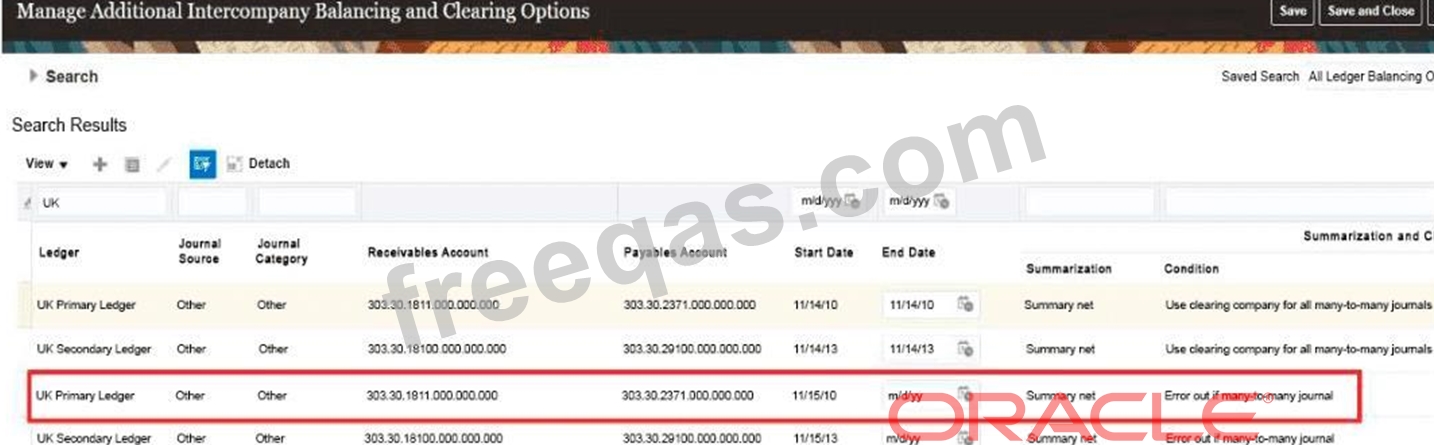
Correct Answer: C
Intercompany processing will balance a journal using the accounts identified here for the UK Ledger when the journal is balanced by the primary balancing segment value (BSV) but not by second or third BSV. A BSV is a segment in the chart of accounts that identifies a legal entity or business unit for which financial statements are prepared and balanced. A primary BSV is required for every ledger and is used to balance journal entries within a ledger. A secondary or tertiary BSV is optional and is used to balance journal entries across different dimensions other than the primary BSV, such as fund or region. Intercompany processing is a feature that enables intercompany transactions between different legal entities or business units within the same enterprise. Intercompany processing uses intercompany balancing rules to generate intercompany receivables and payables accounts for cross-ledger or cross-BSV journals. Intercompany processing will balance a journal using the accounts identified here for the UK Ledger when the journal is balanced by the primary BSV but not by second or third BSV, as this indicates that there is an intercompany transaction between different legal entities or business units within the UK Ledger that requires intercompany balancing.
Intercompany processing will not balance a journal using the accounts identified here for the UK Ledger when there is a many-to-many journal and you want to use a clearing company, as this is a scenario that involves multiple legal entities or business units across different ledgers that requires a separate clearing company ledger to perform intercompany balancing. Intercompany processing will not balance a journal using the accounts identified here for the UK Ledger when the journal is not balanced by the primary BSV, as this is an invalid scenario that violates the accounting rules and prevents posting of the journal. Intercompany processing will not balance a journal using the accounts identified here for the UK Ledger when the journal is balanced by second balancing segment value, as this is an incomplete scenario that does not specify whether the journal is also balanced by primary and third BSV. Reference: Oracle Financials Cloud: General Ledger
2022 Implementation Professional Objectives - Configure and Process Intercompany 12
insert code

Question 5

What are two uses of the Column Flattening and Row Flattening features? (Choose two.)

Correct Answer: A,C
The two uses of the Column Flattening and Row Flattening features are to set the status of a tree to active and to verify correctness of trees. Column Flattening and Row Flattening are features that optimize parent-child information for run-time performance by storing additional rows or columns in a table for instantly finding all descendants or ancestors of a node without initiating a recursive query. Column Flattening and Row Flattening are required to set the status of a tree to active, as they ensure that the tree data is consistent and accurate. Column Flattening and Row Flattening are also useful to verify correctness of trees, as they allow users to view and analyze the flattened hierarchy data using various tools such as Oracle Analytics Publisher or Oracle Transactional Business Intelligence. You do not use Column Flattening and Row Flattening to create additional versions of a tree, as this is a feature that allows users to copy an existing tree version and make changes to it without affecting the original version. You do not use Column Flattening and Row Flattening to view information for runtime performance, as this is a feature that allows users to monitor and measure the performance of various processes or tasks in Oracle Fusion Applications. You do not use Column Flattening and Row Flattening to optimize parent/child relationships, as this is a feature that allows users to define rules and constraints for how nodes can be related to each other in a tree structure. Reference: Oracle Financials Cloud: General Ledger 2022 Implementation Professional Objectives - Define Chart of Accounts 12
insert code
  • «
  • 1
  • 2
  • 3
  • 4
  • 5
  • 6
  • 7
  • 8
  • 9
  • 10
  • …
  • »
  • »»
[×]

Download PDF File

Enter your email address to download Oracle.1z0-1054-25.v2025-12-06.q62 Dumps

Email:

FreeQAs

Our website provides the Largest and the most Latest vendors Certification Exam materials around the world.

Using dumps we provide to Pass the Exam, we has the Valid Dumps with passing guranteed just which you need.

  • DMCA
  • About
  • Contact Us
  • Privacy Policy
  • Terms & Conditions
©2025 FreeQAs

www.freeqas.com materials do not contain actual questions and answers from Cisco's certification exams.
