FreeQAs
 Request Exam  Contact
  • Home
  • View All Exams
  • New QA's
  • Upload
PRACTICE EXAMS:
  • Oracle
  • Fortinet
  • Juniper
  • Microsoft
  • Cisco
  • Citrix
  • CompTIA
  • VMware
  • SAP
  • EMC
  • PMI
  • HP
  • Salesforce
  • Other
  • Oracle
    Oracle
  • Fortinet
    Fortinet
  • Juniper
    Juniper
  • Microsoft
    Microsoft
  • Cisco
    Cisco
  • Citrix
    Citrix
  • CompTIA
    CompTIA
  • VMware
    VMware
  • SAP
    SAP
  • EMC
    EMC
  • PMI
    PMI
  • HP
    HP
  • Salesforce
    Salesforce
  1. Home
  2. Oracle Certification
  3. 1z0-997-21 Exam
  4. Oracle.1z0-997-21.v2022-02-25.q48 Dumps
  • ««
  • «
  • …
  • 2
  • 3
  • 4
  • 5
  • 6
  • 7
  • 8
  • 9
  • 10
  • 11
  • »
Download Now

Question 31

Give this compartment structure:
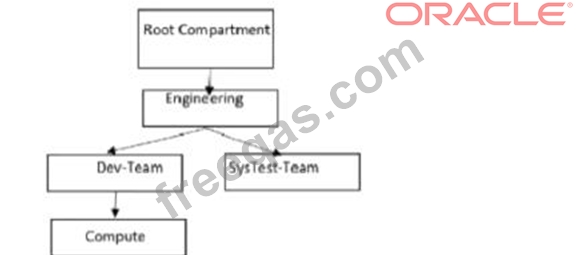
You want to move a compute instance that is in 'Compute' compartment to 'SysTes-Team'.
You login to your Oracle Cloud Infrastructure (OCI)account and use the 'Move Resource' option.
What will happen when you attempt moving the compute resource?

Correct Answer: D
Moving Resources to a Different Compartment
Most resources can be moved after they are created. There are a few resources that you can't move from one compartment to another. Some resources have attached resource dependencies and some don't.
Not all attached dependencies behave the same way when the parent resource moves.
For some resources, the attached dependencies move with the parent resource to the new compartment.
The parent resource moves immediately, but in some cases attached dependencies move asynchronously and are not visible in the new compartment until the move is complete.
For other resources, the attached resource dependencies do not move to the new compartment. You can move these attached resources independently.
You can move Compute resources such as instances, instance pools, and custom images from one compartment to another. When you move a Compute resource to a new compartment, associated resources such as boot volumes and VNICs are not moved.
You can move a VCN from one compartment to another. When you move a VCN, its associated VNICs, private IPs, and ephemeral IPs move with it to the new compartment.
insert code

Question 32

Your security team has informed you that there are a number of malicious requests for your web application coming from a set of IP addresses originating from a country in Europe.
Which of the following methods can be used to mitigate these type of unauthorized requests?

Correct Answer: C
insert code

Question 33

A civil engineering company is running an online portal In which engineers can upload there constructions photos, videos, and other digital files.
There is a new requirement for you to implement: the online portal must offload the digital content to an Object Storage bucket for a period of 72 hours. After the provided time limit has elapsed, the portal will hold all the digital content locally and wait for the next offload period.
Which option fulfills this requirement?

Correct Answer: D
Pre-authenticated requests provide a way to let users access a bucket or an object without having their own credentials, as long as the request creator has permission to access those objects.
For example, you can create a request that lets operations support user upload backups to a bucket without owning API keys. Or, you can create a request that lets a business partner update shared data in a bucket without owning API keys.
When creating a pre-authenticated request, you have the following options:
You can specify the name of a bucket that a pre-authenticated request user has write access to and can upload one or more objects to.
You can specify the name of an object that a pre-authenticated request user can read from, write to, or read from and write to.
Scope and Constraints
Understand the following scope and constraints regarding pre-authenticated requests:
Users can't list bucket contents.
You can create an unlimited number of pre-authenticated requests.
There is no time limit to the expiration date that you can set.
You can't edit a pre-authenticated request. If you want to change user access options in response to changing requirements, you must create a new pre-authenticated request.
The target and actions for a pre-authenticated request are based on the creator's permissions. The request is not, however, bound to the creator's account login credentials. If the creator's login credentials change, a pre-authenticated request is not affected.
You cannot delete a bucket that has a pre-authenticated request associated with that bucket or with an object in that bucket.
insert code

Question 34

You are designing the network infrastructure for two application servers: appserver-1 and appserver-2 running in two different subnets inside the same Virtual Cloud Network (VCN) Oracle Cloud Infrastructure (OCI). You have a requirement where your end users will access appserver-1 from the internet and appserver-2 from the on-premises network. The on-premises network is connected to your VCN over a FastConnect virtual circuit.
How should you design your routing configuration to meet these requirements?

Correct Answer: B
insert code

Question 35

You work for a German company as the Lead Oracle Cloud Infrastructure architect. You have designed a highly scalable architecture for your company's business critical application which uses the Load Balancer service auto which uses the Load Balancer service, autoscaling configuration for the application servers and a 2 Node VM Oracle RAC database. During the peak utilization period of the- application yon notice that the application is running slow and customers are complaining. This is resulting in support tickets being created for API timeouts and negative sentiment from the customer base.
What are two possible reasons for this application slowness?


Correct Answer: C,D
Autoscaling
Autoscaling enables you to automatically adjust the number of Compute instances in an instance pool based on performance metrics such as CPU utilization. This helps you provide consistent performance for your end users during periods of high demand, and helps you reduce your costs during periods of low demand.
Prerequisites
- You have an instance pool. Optionally, you can attach a load balancer to the instance pool. For steps to create an instance pool and attach a load balancer, see Creating an Instance Pool.
- Monitoring is enabled on the instances in the instance pool. For steps to enable monitoring, see Enabling Monitoring for Compute Instances.
- The instance pool supports the maximum number of instances that you want to scale to. This limit is determined by your tenancy's service limits.
About Service Limits and Usage
When you sign up for Oracle Cloud Infrastructure, a set of service limits are configured for your tenancy.
The service limit is the quota or allowance set on a resource. For example, your tenancy is allowed a maximum number of compute instances per availability domain. These limits are generally established with your Oracle sales representative when you purchase Oracle Cloud Infrastructure.
Compartment Quotas
Compartment quotas are similar to service limits; the biggest difference is that service limits are set by Oracle, and compartment quotas are set by administrators, using policies that allow them to allocate resources with a high level of flexibility.
insert code
  • ««
  • «
  • …
  • 2
  • 3
  • 4
  • 5
  • 6
  • 7
  • 8
  • 9
  • 10
  • 11
  • »
[×]

Download PDF File

Enter your email address to download Oracle.1z0-997-21.v2022-02-25.q48 Dumps

Email:

FreeQAs

Our website provides the Largest and the most Latest vendors Certification Exam materials around the world.

Using dumps we provide to Pass the Exam, we has the Valid Dumps with passing guranteed just which you need.

  • DMCA
  • About
  • Contact Us
  • Privacy Policy
  • Terms & Conditions
©2025 FreeQAs

www.freeqas.com materials do not contain actual questions and answers from Cisco's certification exams.