View the exhibit and examine the data in ORDERS_MASTERand MONTHLY_ORDERStables.
Evaluate the following MERGEstatement:
MERGE_INTO orders_master o
USING monthly_orders m
ON (o.order_id = m.order_id)
WHEN MATCHED THEN
UPDATE SET o.order_total = m.order_total
DELETE WHERE (m.order_total IS NULL)
WHEN NOT MATCHED THEN
INSERT VALUES (m.order_id, m.order_total)
What would be the outcome of the above statement?
View the exhibit and examine the data in ORDERS_MASTER and MONTHLY_ORDERS tables.
Evaluate the following MERGE statement:
MERGE_INTO orders_master o
USING monthly_orders m
ON (o.order_id = m.order_id)
WHEN MATCHED THEN
UPDATE SET o.order_total = m.order_total
DELETE WHERE (m.order_total IS NULL)
WHEN NOT MATCHED THEN
INSERT VALUES (m.order_id, m.order_total);
What would be the outcome of the above statement?
View the Exhibit and examine the structure of the ORDERS table. (Choose the best answer.)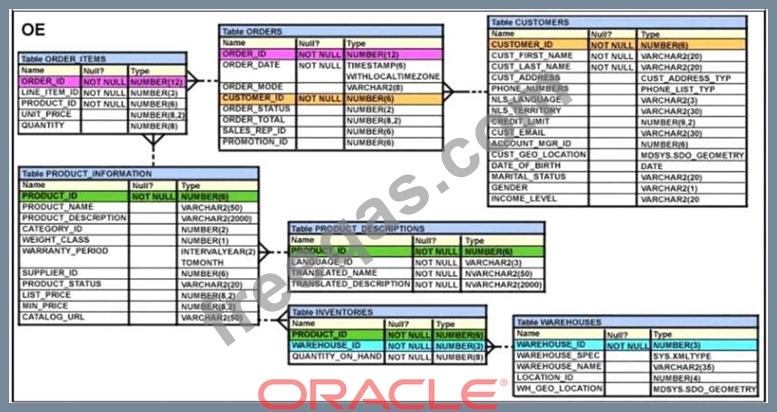
You must select ORDER_ID and ORDER_DATE for all orders that were placed after the last order placed by CUSTOMER_ID 101.
Which query would give you the desired result?
View the exhibit and examine the description of the PRODUCT_INFORMATIONtable.
Which SQL statement would retrieve from the table the number of products having LIST_PRICEas NULL?
SELECT COUNT (DISTINCT list_price)
View the Exhibit and examine the structure of the EMP table which is not partitioned and not an index-organized table. (Choose two.) Evaluate this SQL statement:
ALTER TABLE emp
DROP COLUMN first_name;
Which two statements are true?

