FreeQAs
 Request Exam  Contact
  • Home
  • View All Exams
  • New QA's
  • Upload
PRACTICE EXAMS:
  • Oracle
  • Fortinet
  • IBM
  • Juniper
  • Microsoft
  • Cisco
  • Citrix
  • CompTIA
  • VMware
  • ISC
  • SAP
  • EMC
  • PMI
  • HP
  • Salesforce
  • Other
  • Oracle
    Oracle
  • Fortinet
    Fortinet
  • IBM
    IBM
  • Juniper
    Juniper
  • Microsoft
    Microsoft
  • Cisco
    Cisco
  • Citrix
    Citrix
  • CompTIA
    CompTIA
  • VMware
    VMware
  • ISC
    ISC
  • SAP
    SAP
  • EMC
    EMC
  • PMI
    PMI
  • HP
    HP
  • Salesforce
    Salesforce
  1. Home
  2. PECB Certification
  3. ISO-9001-Lead-Auditor Exam
  4. PECB.ISO-9001-Lead-Auditor.v2025-09-24.q107 Dumps
  • ««
  • «
  • …
  • 14
  • 15
  • 16
  • 17
  • 18
  • 19
  • 20
  • 21
  • 22
  • 23
  • »
Download Now

Question 91

An audit team leader arrives at a printing company to carry out a Stage 2 audit for a certification body. At a meeting with the Quality Manager, she is told that they have won their biggest contract from a computer manufacturer to print and compile computer documentation packages. The Quality Manager wants the ISO
9001 certificate to cover the new contract.
During the audit, a team member found that some print jobs had been rejected by several clients over some months due to spelling errors in the print run. The Print Manager blames the new employees they had to take on because of a big contract.
The auditor finds that the responsibility for checking spelling errors is placed on the printer that sets up the print run.
In line with the policy of the certification body, the audit team raise improvement opportunities in the audit report. Which three of the following options would represent acceptable opportunities for improvement in the report?

Correct Answer: A,C,E
According to the ISO 9001 Auditing Practices Group Guidance on Improvement Opportunities1, an improvement opportunity is a suggestion made by the auditor for the auditee to consider that, if implemented, may enhance the performance of the QMS. Improvement opportunities are not mandatory, but they should be based on objective evidence and aligned with the audit criteria and objectives. Improvement opportunities should also be realistic, feasible, and beneficial for the auditee. In this case, the evidence statements that represent acceptable improvement opportunities in the report are A, C, and E, because they address the potential causes and effects of the spelling errors in the print run, and propose possible actions that may improve the quality of the products and services, and the effectiveness of the QMS. These options are consistent with the requirements and principles of ISO 9001, such as clause 6.1 on actions to address risks and opportunities, clause 8.1 on operational planning and control, clause 8.5.1 on control of production and service provision, and clause 10.2 on nonconformity and corrective action. The other options are not appropriate improvement opportunities, because they are either irrelevant, unrealistic, or unhelpful for the auditee. For example, option B may contradict the audit objective and scope, option D may imply a lack of auditor competence or impartiality, option F may not address the root cause of the problem, option G may not be applicable or effective, and option H may not be feasible or justified. References: ISO 9001 Auditing Practices Group Guidance on Improvement Opportunities, ISO 9001:2015, ISO 9001 Auditing Practices Group Guidance on Audit Evidence
insert code

Question 92

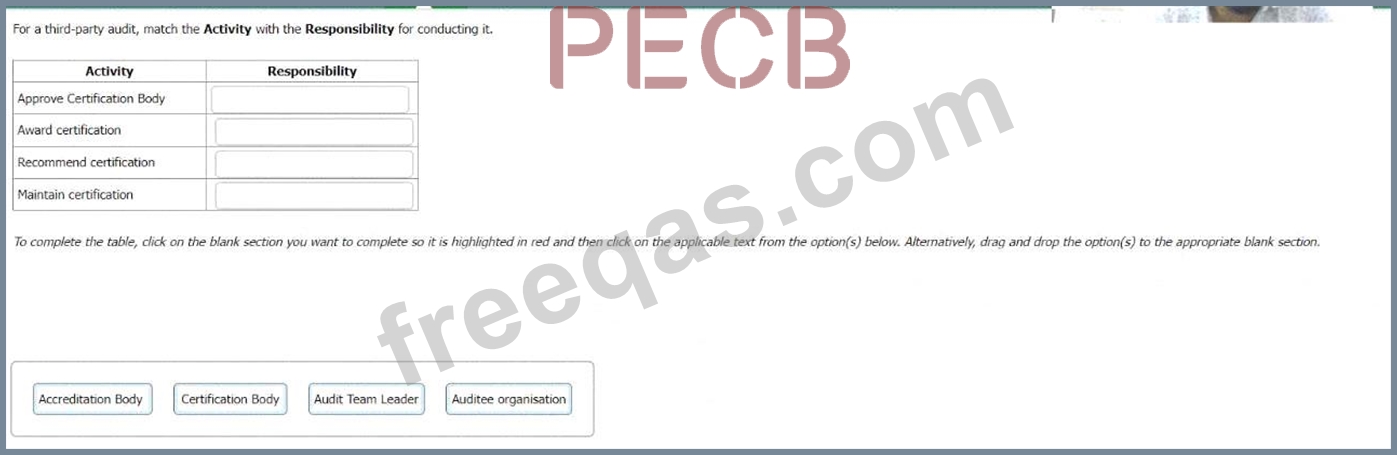
For a third-party, match the Activity with the Responsibility for conducting it.
Correct Answer:

Explanation:

* Approve Certification Body: Accreditation Body
* Award certification: Certification Body
* Recommend certification: Audit Team Leader
* Maintain certification:
Comprehensive Detailed ExplanationIn the context of a third-party ISO 9001 audit, different entities play specific roles in the certification process. Here's a detailed explanation of the responsibilities:
* Approve Certification Body: Accreditation BodyThe Accreditation Body is responsible for approving Certification Bodies. Accreditation Bodies are independent entities that evaluate the competence of Certification Bodies, ensuring they meet international standards like ISO/IEC 17021, which sets out the criteria for bodies providing audit and certification of management systems. In this role, they confirm that the Certification Body is capable of conducting ISO 9001 audits and granting certifications in accordance with international guidelines.
* Award Certification: Certification BodyThe Certification Body is the entity that ultimately awards the certification to an organization after verifying that it meets the ISO 9001 standards. Certification Bodies conduct audits, either directly or through a team of auditors, and based on the audit outcomes, they issue the certification, indicating that the organization complies with ISO 9001.
* Recommend Certification: Audit Team LeaderThe Audit Team Leader is responsible for leading the audit and making a recommendation to the Certification Body. This recommendation is based on the audit findings-whether the organization meets the ISO 9001 requirements or if there are areas of non- compliance that need corrective action. The final decision on certification is not made by the Audit Team Leader but by the Certification Body.
* Maintain Certification: Certification BodyMaintaining certification refers to the ongoing process of ensuring that an organization continues to comply with ISO 9001 requirements. The Certification Body conducts regular surveillance audits (e.g., annually) and may also perform recertification audits (typically every three years). This ongoing monitoring ensures that the certified organization continues to adhere to the quality management standards over time.
This breakdown clearly assigns responsibility based on the defined roles of Accreditation Bodies, Certification Bodies, and Audit Teams in the ISO 9001 certification process.
insert code

Question 93

How can an organization ensure the objectivity and impartiality of the internal audit function?

Correct Answer: B
Comprehensive and Detailed In-Depth Explanation:According to ISO 19011:2018, Clause 5.1 (Impartiality):
* Internal auditors must not audit areas where they have direct responsibilities to avoid conflicts of interest.
* Outsourcing (C) is not required, as long as impartiality is maintained internally.
Thus, B is the correct answer.
insert code

Question 94

Scenario 5: Mechanical-Electro (ME) Audit Stages
Mechanical-Electro, better known as ME, is an American company that provides mechanical and electrical services in China. Their services range from air-conditioning systems, ventilation systems, plumbing, to installation of electrical equipment in automobile plants, electronic manufacturing facilities, and food processing plants.
Due to the fierce competition from local Chinese companies and failing to meet customer requirements, ME's revenue dropped significantly. In addition, customers' trust and confidence in the company decreased, and the reputation of the company was damaged.
In light of these developments, the top management of ME decided to implement a quality management system (QMS) based on ISO 9001. After having an effective QMS in place for over a year, they applied for a certification audit.
A team of four auditors was appointed for the audit, including Li Na as the audit team leader. Initially, the audit team conducted a general review of ME's documents, including the quality policy, operational procedures, inventory lists, QMS scope, process documentation, training records, and previous audit reports.
Li Na stated that this would allow the team to maintain a systematic and structured approach to gathering documents for all audit stages. While reviewing the documented information, the team observed some minor issues but did not identify any major nonconformities. Therefore, Li Na claimed that it was not necessary to prepare a report or conduct a meeting with ME's representatives at that stage of the audit. She stated that all areas of concern would be discussed in the next phase of the audit.
Following the on-site activities and the opening meeting with ME's top management, the audit team structured an audit test plan to verify whether ME's QMS conformed to Clause 8.2.1 (Customer Communication) of ISO 9001.
To do so, they gathered information through group interviews and sampling. Li Na conducted interviews with departmental managers in the first group and then with top management. In addition, she chose a sampling method that sufficiently represented customer complaints from both areas of ME' s operations.
The team members were responsible for the sampling procedure. They selected a sample size of 4 out of
45 customer complaints received weekly for electrical services and 2 out of 10 complaints for mechanical services.
Afterward, the audit team evaluated the evidence against the audit criteria and generated the audit findings.
Which stages of the audit were performed?

Correct Answer: B
Comprehensive and Detailed In-Depth Explanation:
Understanding Audit Stages Based on ISO/IEC 17021-1:2015
ISO certification audits consist of two main stages:
* Stage 1 Audit (Readiness Review)
* The organization's documented information is reviewed to assess readiness for Stage 2.
* This ensures that the QMS is developed, implemented, and prepared for full assessment.
* Stage 2 Audit (On-Site Evaluation)
* Auditors assess process implementation and effectiveness through interviews, observations, and evidence collection.
* The audit team verifies if the organization meets ISO 9001 requirements in practice.
Why is the Correct Answer B?
* The audit team reviewed ME's documents, which is a Stage 1 activity.
* The audit team performed interviews, sampling, and on-site verification, which is a Stage 2 activity.
* There was no mention of an audit follow-up or a surveillance audit, which occur post-certification.
Why are the Other Options Incorrect?
* A (Audit follow-up and Stage 1 Audit) # Follow-up audits occur after certification, which was not the case here.
* C (Stage 2 Audit and Surveillance Audit) # Surveillance audits are post-certification audits and were not conducted yet.
Reference:
ISO/IEC 17021-1:2015, Clause 9.3.1 - Initial Certification Audit (Stage 1 & 2)
insert code

Question 95

You are leading a Stage 2 certification audit of a multi-site organisation and have received the audit schedule below; Head Office and Site 1 - Day 1 Site 2 (150 Km from HQ) - Days 2 and 3 During Day 1 of the audit, the dient informs you that the laboratory at Site 2 has been dosed for decontamination due to a serious outbreak of an infectious disease among workers. In Site 2, all other functions could be audited as planned.
As the audit team leader, what would you do?
Choose the best acceptable action you could take:
Ask the audit Programme Manager for direction.
Complete the audit on day 3 and report back to the certification body for a certification decision.
Continue the audit on days 2 and 3 and return later to audit the Site 2 laboratory.
Immediately cancel the audit since the audit plan cannot be completed.
Who has the responsibility for assigning work to the audit team?

Correct Answer: A
In the context of ISO 9001:2015 audits, it is the audit team leader who holds the responsibility for assigning work to the audit team. According to ISO 19011:2018 (Guidelines for auditing management systems, which complements ISO 9001:2015), the audit team leader is responsible for the organization and direction of the audit, including assigning specific roles and responsibilities to audit team members. This includes preparation of the audit plan, leading the audit, and ensuring that each team member understands their tasks.
insert code
  • ««
  • «
  • …
  • 14
  • 15
  • 16
  • 17
  • 18
  • 19
  • 20
  • 21
  • 22
  • 23
  • »
[×]

Download PDF File

Enter your email address to download PECB.ISO-9001-Lead-Auditor.v2025-09-24.q107 Dumps

Email:

FreeQAs

Our website provides the Largest and the most Latest vendors Certification Exam materials around the world.

Using dumps we provide to Pass the Exam, we has the Valid Dumps with passing guranteed just which you need.

  • DMCA
  • About
  • Contact Us
  • Privacy Policy
  • Terms & Conditions
©2026 FreeQAs

www.freeqas.com materials do not contain actual questions and answers from Cisco's certification exams.