FreeQAs
 Request Exam  Contact
  • Home
  • View All Exams
  • New QA's
  • Upload
PRACTICE EXAMS:
  • Oracle
  • Fortinet
  • IBM
  • Juniper
  • Microsoft
  • Cisco
  • Citrix
  • CompTIA
  • VMware
  • ISC
  • SAP
  • EMC
  • PMI
  • HP
  • Salesforce
  • Other
  • Oracle
    Oracle
  • Fortinet
    Fortinet
  • IBM
    IBM
  • Juniper
    Juniper
  • Microsoft
    Microsoft
  • Cisco
    Cisco
  • Citrix
    Citrix
  • CompTIA
    CompTIA
  • VMware
    VMware
  • ISC
    ISC
  • SAP
    SAP
  • EMC
    EMC
  • PMI
    PMI
  • HP
    HP
  • Salesforce
    Salesforce
  1. Home
  2. PECB Certification
  3. ISO-IEC-27001-Lead-Auditor Exam
  4. PECB.ISO-IEC-27001-Lead-Auditor.v2026-01-12.q371 Dumps
  • ««
  • «
  • …
  • 12
  • 13
  • 14
  • 15
  • 16
  • 17
  • 18
  • 19
  • 20
  • 21
  • …
  • »
  • »»
Download Now

Question 76

Scenario 3: NightCore is a multinational technology company based in the United States that focuses on e-commerce, cloud computing, digital streaming, and artificial intelligence. After having an information security management system (ISMS) implemented for over 8 months, they contracted a certification body to conduct a third party audit in order to get certified against ISO/IEC 27001.
The certification body set up a team of seven auditors. Jack, the most experienced auditor, was assigned as the audit team leader. Over the years, he received many well known certifications, such as the ISO/IEC 27001 Lead Auditor, CISA, CISSP, and CISM.
Jack conducted thorough analyses on each phase of the ISMS audit, by studying and evaluating every information security requirement and control that was implemented by NightCore. During stage 2 audit. Jack detected several nonconformities. After comparing the number of purchased invoices for software licenses with the software inventory, Jack found out that the company has been using the illegal versions of a software for many computers. He decided to ask for an explanation from the top management about this nonconformity and see whether they were aware about this. His next step was to audit NightCore's IT Department. The top management assigned Tom, NightCore's system administrator, to act as a guide and accompany Jack and the audit team toward the inner workings of their system and their digital assets infrastructure.
While interviewing a member of the Department of Finance, the auditors discovered that the company had recently made some unusual large transactions to one of their consultants. After gathering all the necessary details regarding the transactions. Jack decided to directly interview the top management.
When discussing about the first nonconformity, the top management told Jack that they willingly decided to use a copied software over the original one since it was cheaper. Jack explained to the top management of NightCore that using illegal versions of software is against the requirements of ISO/IEC 27001 and the national laws and regulations. However, they seemed to be fine with it.
Several months after the audit, Jack sold some of NightCore's information that he collected during the audit for a huge amount of money to competitors of NightCore.
Based on this scenario, answer the following question:
Based on scenario 3. which ISO/IEC 27001 control has NightCore ignored when they used an illegal version of software?

Correct Answer: C
By using illegal versions of software, NightCore ignored the control about intellectual property rights under Annex A.8.1.1 of ISO/IEC 27001, which requires the protection of organizational records to include intellectual property and personal information held in the form of data or software.
References: ISO/IEC 27001:2013 Standard, Annex A.8.1.1 (Responsibility for assets)
insert code

Question 77

You are performing an ISMS audit at a European-based residential
nursing home called ABC that provides healthcare services. You find all nursing home residents wear an electronic wristband for monitoring their location, heartbeat, and blood pressure always. You learned that the electronic wristband automatically uploads all data to the artificial intelligence (AI) cloud server for healthcare monitoring and analysis by healthcare staff.
The next step in your audit plan is to verify that the information security policy and objectives have been established by top management.
During the audit, you found the following audit evidence.
Match the audit evidence to the corresponding requirement in ISO/IEC 27001:2022.
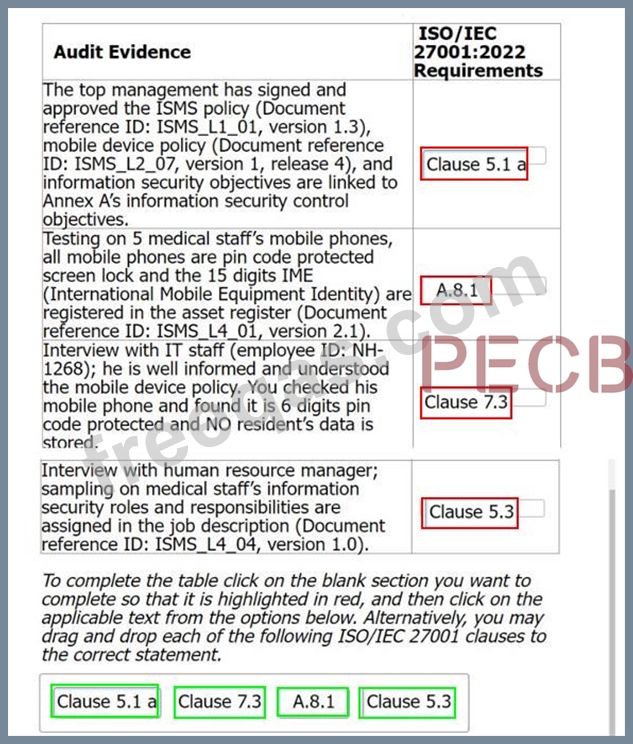
Correct Answer:
insert code

Question 78

You are conducting an ISMS audit in the despatch department of an international logistics organisation that provides shipping services to large organisations including local hospitals and government offices. Parcels typically contain pharmaceutical products, biological samples, and documents such as passports and driving licences. You note that the company records show a very large number of returned items with causes including mis-addressed labels and, in 15% of company cases, two or more labels for different addresses for the one package. You are interviewing the Shipping Manager (SM).
You: Are items checked before being dispatched?
SH: Any obviously damaged items are removed by the duty staff before being dispatched, but the small profit margin makes it uneconomic to implement a formal checking process.
You: What action is taken when items are returned?
SM: Most of these contracts are relatively low value, therefore it has been decided that it is easier and more convenient to simply reprint the label and re-send individual parcels than it is to implement an investigation.
You raise a nonconformity. Referencing the scenario, which six of the following Appendix A controls would you expect the auditee to have implemented when you conduct the follow-up audit?

Correct Answer: B,D,E,F,I,J
Explanation
B: 8.12 Data leakage protection. This is true because the auditee should have implemented measures to prevent unauthorized disclosure of sensitive information, such as personal data, medical records, or official documents, that are contained in the parcels. Data leakage protection could include encryption, authentication, access control, logging, and monitoring of data transfers12.
D: 6.3 Information security awareness, education, and training. This is true because the auditee should have ensured that all employees and contractors involved in the shipping process are aware of the information security policies and procedures, and have received appropriate training on how to handle and protect the information assets in their custody. Information security awareness, education, and training could include induction programmes, periodic refreshers, awareness campaigns, e-learning modules, and feedback mechanisms13.
E: 7.10 Storage media. This is true because the auditee should have implemented controls to protect the storage media that contain information assets from unauthorized access, misuse, theft, loss, or damage. Storage media could include paper documents, optical disks, magnetic tapes, flash drives, or hard disks14. Storage media controls could include physical locks, encryption, backup, disposal, or destruction14.
F: 8.3 Information access restriction. This is true because the auditee should have implemented controls to restrict access to information assets based on the principle of least privilege and the need-to-know basis. Information access restriction could include identification, authentication, authorization, accountability, and auditability of users and systems that access information assets15.
I: 7.4 Physical security monitoring. This is true because the auditee should have implemented controls to monitor the physical security of the premises where information assets are stored or processed. Physical security monitoring could include CCTV cameras, alarms, sensors, guards, or patrols16. Physical security monitoring could help detect and deter unauthorized physical access or intrusion attempts16.
J: 5.13 Labelling of information. This is true because the auditee should have implemented controls to label information assets according to their classification level and handling instructions. Labelling of information could include markings, tags, stamps, stickers, or barcodes1 . Labelling of information could help identify and protect information assets from unauthorized disclosure or misuse1 .
References :=
ISO/IEC 27002:2022 Information technology - Security techniques - Code of practice for information security controls ISO/IEC 27001:2022 Information technology - Security techniques - Information security management systems - Requirements ISO/IEC 27003:2022 Information technology - Security techniques - Information security management systems - Guidance ISO/IEC 27004:2022 Information technology - Security techniques - Information security management systems - Monitoring measurement analysis and evaluation ISO/IEC 27005:2022 Information technology - Security techniques - Information security risk management ISO/IEC 27006:2022 Information technology - Security techniques - Requirements for bodies providing audit and certification of information security management systems
[ISO/IEC 27007:2022 Information technology - Security techniques - Guidelines for information security management systems auditing]
insert code

Question 79

Which of the following is not a type of Information Security attack?

Correct Answer: B
Vehicular incidents are not a type of information security attack. A vehicular incident is an event that involves a vehicle or its driver causing damage or injury to people or property. A vehicular incident may have an impact on information security if it affects the availability or integrity of information or systems that are transported or accessed by vehicles, but it is not an intentional or malicious attack on information security.
Legal incidents are a type of information security attack that involve legal actions or disputes that may compromise the confidentiality or integrity of information or systems. Technical vulnerabilities are a type of information security attack that exploit weaknesses or flaws in software or hardware that may compromise the confidentiality, integrity, or availability of information or systems. Privacy incidents are a type of information security attack that involve unauthorized access or disclosure of personal or sensitive information that may compromise the confidentiality or integrity of information or systems. References: : CQI & IRCA ISO
27001:2022 Lead Auditor Course Handbook, page 25. : [ISO/IEC 27001 LEAD AUDITOR - PECB], page 13.
insert code

Question 80

Which six of the following actions are the individual(s) managing the audit programme responsible for?

Correct Answer: A,B,C,D,E,F
According to ISO 19011:2018, which provides guidelines for auditing management systems, an audit programme is a set of one or more audits planned for a specific time frame and directed towards a specific purpose1. The individual(s) managing the audit programme are responsible for establishing, implementing and maintaining the audit programme in accordance with the organization's policies and objectives1. This includes defining the extent of the audit programme based on strategic direction, risks and opportunities; establishing the audit programme by defining its objectives, scope and criteria; determining the resources necessary for the audit programme; selecting competent auditors and assigning them to appropriate audits; defining the objectives, scope and criteria for each individual audit; defining the plan of each individual audit; retaining documented information of the audit results; reviewing and improving the performance of the audit programme1. Therefore, these six actions are part of the responsibilities of the individual(s) managing the audit programme. The other option, communicating with the auditee during the audit, is not a responsibility of the individual(s) managing the audit programme, but rather a responsibility of the audit team leader1. References: ISO 19011:2018 - Guidelines for auditing management systems
insert code
  • ««
  • «
  • …
  • 12
  • 13
  • 14
  • 15
  • 16
  • 17
  • 18
  • 19
  • 20
  • 21
  • …
  • »
  • »»
[×]

Download PDF File

Enter your email address to download PECB.ISO-IEC-27001-Lead-Auditor.v2026-01-12.q371 Dumps

Email:

FreeQAs

Our website provides the Largest and the most Latest vendors Certification Exam materials around the world.

Using dumps we provide to Pass the Exam, we has the Valid Dumps with passing guranteed just which you need.

  • DMCA
  • About
  • Contact Us
  • Privacy Policy
  • Terms & Conditions
©2026 FreeQAs

www.freeqas.com materials do not contain actual questions and answers from Cisco's certification exams.
