What is the expected output of the following code?
Correct Answer: C
Explanation The code snippet that you have sent is a conditional statement that checks if a variable "counter" is less than 0, greater than or equal to 42, or neither. The code is as follows: if counter < 0: print("") elif counter >= 42: print("") else: print("") The code starts with checking if the value of "counter" is less than 0. If yes, it prints a single asterisk () to the screen and exits the statement. If no, it checks if the value of "counter" is greater than or equal to 42. If yes, it prints three asterisks () to the screen and exits the statement. If no, it prints two asterisks () to the screen and exits the statement. The expected output of the code depends on the value of "counter". If the value of "counter" is 10, as shown in the image, the code will print two asterisks (**) to the screen, because 10 is neither less than 0 nor greater than or equal to 42. Therefore, the correct answer is C. * *
Question 7
Python Is an example of which programming language category?
Correct Answer: A
Explanation Python is an interpreted programming language, which means that the source code is translated into executable code by an interpreter at runtime, rather than by a compiler beforehand. Interpreted languages are more flexible and portable than compiled languages, but they are also slower and less efficient. Assembly and machine languages are low-level languages that are directly executed by the hardware, while compiled languages are high-level languages that are translated into machine code by a compiler before execution.
Question 8
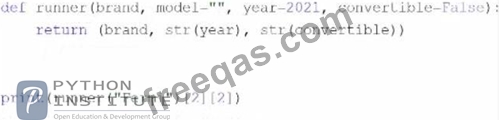
What is the expected output of the following code?
Correct Answer: D
Explanation The code snippet that you have sent is defining and calling a function in Python. The code is as follows: def runner(brand, model, year): return (brand, model, year) print(runner("Fermi")) The code starts with defining a function called "runner" with three parameters: "brand", "model", and "year". The function returns a tuple with the values of the parameters. A tuple is a data type in Python that can store multiple values in an ordered and immutable way. A tuple is created by using parentheses and separating the values with commas. For example, (1, 2, 3) is a tuple with three values. Then, the code calls the function "runner" with the value "Fermi" for the "brand" parameter and prints the result. However, the function expects three arguments, but only one is given. This will cause a TypeError exception, which is an error that occurs when a function or operation receives an argument that has the wrong type or number. The code does not handle the exception, and therefore it will terminate with an error message. However, if the code had handled the exception, or if the function had used default values for the missing parameters, the expected output of the code would be ('Fermi ', '2021', 'False'). This is because the function returns a tuple with the values of the parameters, and the print function displays the tuple to the screen. Therefore, the correct answer is D. ('Fermi ', '2021', 'False').
Question 9
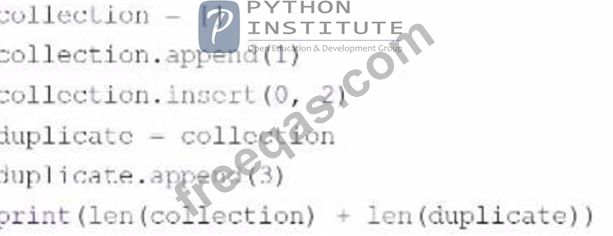
What is the expected output of the following code?
Correct Answer: D
Explanation The code snippet that you have sent is trying to print the combined length of two lists, "collection" and "duplicate". The code is as follows: collection = [] collection.append(1) collection.insert(0, 2) duplicate = collection duplicate.append(3) print(len(collection) + len(duplicate)) The code starts with creating an empty list called "collection" and appending the number 1 to it. The list now contains [1]. Then, the code inserts the number 2 at the beginning of the list. The list now contains [2, 1]. Then, the code creates a new list called "duplicate" and assigns it the value of "collection". However, this does not create a copy of the list, but rather a reference to the same list object. Therefore, any changes made to "duplicate" will also affect "collection", and vice versa. Then, the code appends the number 3 to "duplicate". The list now contains [2, 1, 3], and so does "collection". Finally, the code tries to print the sum of the lengths of "collection" and "duplicate". However, this causes an exception, because the len function expects a single argument, not two. The code does not handle the exception, and therefore outputs nothing. The expected output of the code is nothing, because the code raises an exception and terminates. Therefore, the correct answer is D. The code raises an exception and outputs nothing.