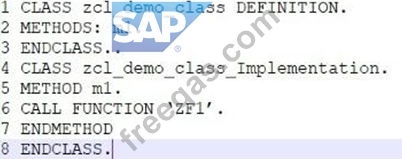
Given the following code in an SAP S/4HANA Cloud private edition tenant: The class zcl_demo_class is in a software component with the language version set to "ABAP Cloud". The function module ZF1' is in a different software component with the language version set to "Standard ABAP". Both the class and function module are customer created. Regarding line #6, which of the following are valid statements? Note: There are 2 correct answers to this question.
Correct Answer: A,B
The ABAP Cloud Development Model requires that only public SAP APIs and extension points are used to access SAP functionality and data. These APIs and extension points are released by SAP and documented in the SAP API Business Hub1. Customer-created function modules are not part of the public SAP APIs and are not released for cloud development. Therefore, calling a function module directly from an ABAP Cloud class is not allowed and will result in a syntax error. However, there are two possible ways to call a function module indirectly from an ABAP Cloud class: Create a wrapper class or interface for the function module and release it for cloud development. A wrapper is a class or interface that encapsulates the function module and exposes its functionality through public methods or attributes. The wrapper must be created in a software component with the language version set to "Standard ABAP" and must be marked as released for cloud development using the annotation @EndUserText.label. The wrapper can then be called from an ABAP Cloud class using the public methods or attributes2. Use the ABAP Cloud Connector to call the function module as a remote function call (RFC) from an ABAP Cloud class. The ABAP Cloud Connector is a service that enables the secure and reliable communication between SAP BTP, ABAP environment and on-premise systems. The function module must be exposed as an RFC-enabled function module in the on-premise system and must be registered in the ABAP Cloud Connector. The ABAP Cloud class can then use the class cl_rfc_destination_service to get the destination name and the class cl_abap_system to create a proxy object for the function module. The proxy object can then be used to call the function module3.
Question 57
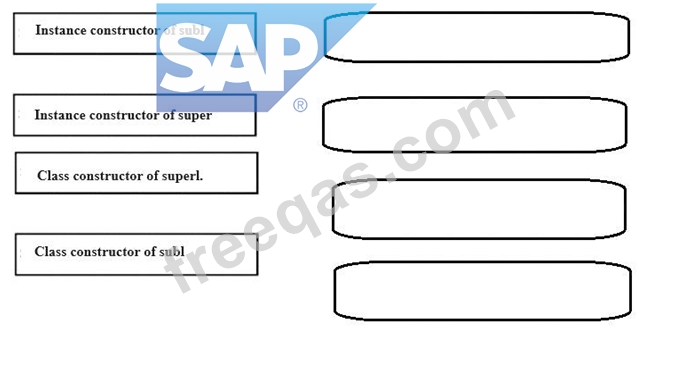
You have a superclass superl and a subclass subl of superl. Each class has an instance constructor and a static constructor. The first statement of your program creates an instance of subl. In which sequence will the constructors be executed?
Correct Answer:
Explanation The sequence in which the constructors will be executed is as follows: Class constructor of superl. This is because the class constructor is a static method that is executed automatically before the class is accessed for the first time. The class constructor is used to initialize the static attributes and components of the class. The class constructor of the superclass is executed before the class constructor of the subclass, as the subclass inherits the static components of the superclass12 Class constructor of subl. This is because the class constructor is a static method that is executed automatically before the class is accessed for the first time. The class constructor is used to initialize the static attributes and components of the class. The class constructor of the subclass is executed after the class constructor of the superclass, as the subclass inherits the static components of the superclass12 Instance constructor of superl. This is because the instance constructor is an instance method that is executed automatically when an instance of the class is created using the statement CREATE OBJECT. The instance constructor is used to initialize the instance attributes and components of the class. The instance constructor of the superclass is executed before the instance constructor of the subclass, as the subclass inherits the instance components of the superclass. The instance constructor of the subclass must call the instance constructor of the superclass explicitly using super->constructor, unless the superclass is the root node object12 Instance constructor of subl. This is because the instance constructor is an instance method that is executed automatically when an instance of the class is created using the statement CREATE OBJECT. The instance constructor is used to initialize the instance attributes and components of the class. The instance constructor of the subclass is executed after the instance constructor of the superclass, as the subclass inherits the instance components of the superclass. The instance constructor of the subclass must call the instance constructor of the superclass explicitly using super->constructor, unless the superclass is the root node object12 References: Constructors of Classes - ABAP Keyword Documentation, METHODS - constructor - ABAP Keyword Documentation
Question 58
What RESTful Application Programming feature is used to ensure the uniqueness of a semantic key?
Correct Answer: C
The RESTful Application Programming feature that is used to ensure the uniqueness of a semantic key is determination. A determination is a type of behavior implementation that defines a logic that is executed automatically when certain events occur, such as create, update, delete, or activate. A determination can be used to calculate or derive values for certain fields, such as semantic keys, based on other fields or external sources. A determination can also be used to check the uniqueness of a semantic key by comparing it with the existing values in the database or the transaction buffer. A determination can use the ABAP SQL or the EML syntax to access and manipulate data. A determination can be defined using the DETERMINE action clause in the behavior definition of a CDS view entity or a projection view. A determination can also be annotated with the @ObjectModel.determination annotation to specify the event, the timing, and the scope of the determination12 The other RESTful Application Programming features are not used to ensure the uniqueness of a semantic key, but have different purposes and effects. These features are: Validation: A validation is a type of behavior implementation that defines a logic that is executed automatically when certain events occur, such as create, update, delete, or activate. A validation can be used to check the consistency and correctness of the data, such as mandatory fields, data types, value ranges, or business rules. A validation can use the ABAP SQL or the EML syntax to access and manipulate data. A validation can be defined using the VALIDATE action clause in the behavior definition of a CDS view entity or a projection view. A validation can also be annotated with the @ObjectModel.validation annotation to specify the event, the timing, and the scope of the validation12 Action: An action is a type of behavior implementation that defines a logic that is executed explicitly by the user or the application. An action can be used to perform a specific business operation, such as creating, updating, deleting, or activating an entity instance, or triggering a workflow or a notification. An action can use the ABAP SQL or the EML syntax to access and manipulate data. An action can be defined using the ACTION clause in the behavior definition of a CDS view entity or a projection view. An action can also be annotated with the @ObjectModel.action annotation to specify the name, the description, the parameters, and the visibility of the action12
Question 59
What are the effects of this annotation? Note: There are 2 correct answers to this question.
Correct Answer: A,B
Explanation The annotation @Environment.systemField: #LANGUAGE is used to assign the ABAP system field sy-langu to an input parameter of a CDS view or a CDS table function. This enables the implicit parameter passing in Open SQL, which means that the value of sy-langu will be automatically passed to the CDS view without explicitly specifying it in the WHERE clause. This also applies to the CDS views that use the annotated CDS view as a data source, which means that the value of sy-langu will be propagated to the nested CDS views (view on view)12. For example: The following code snippet defines a CDS view ZI_FLIGHT_TEXTS with an input parameter p_langu that is annotated with @Environment.systemField: #LANGUAGE: define view ZI_FLIGHT_TEXTS with parameters p_langu : syst_langu @<Environment.systemField: #LANGUAGE as select from sflight left outer join scarr on sflight.carrid = scarr.carrid left outer join stext on scarr.carrid = stext.carrid { sflight.carrid, sflight.connid, sflight.fldate, scarr.carrname, stext.text as carrtext } where stext.langu = :p_langu The following code snippet shows how to use the CDS view ZI_FLIGHT_TEXTS in ABAP without specifying the value of p_langu in the WHERE clause. The value of sy-langu will be automatically passed to the CDS view: SELECT carrid, connid, fldate, carrname, carrtext FROM zi_flight_texts INTO TABLE @DATA(lt_flights). The following code snippet shows how to use the CDS view ZI_FLIGHT_TEXTS in another CDS view ZI_FLIGHT_REPORT. The value of sy-langu will be automatically passed to the nested CDS view ZI_FLIGHT_TEXTS: define view ZI_FLIGHT_REPORT with parameters p_langu : syst_langu @<Environment.systemField: #LANGUAGE as select from zi_flight_texts(p_langu) { carrid, connid, fldate, carrname, carrtext, count(*) as flight_count } group by carrid, connid, fldate, carrname, carrtext The annotation @Environment.systemField: #LANGUAGE does not prevent the possibility of overriding the default value with a value of your own. You can still specify a different value for the input parameter p_langu in the WHERE clause, either in ABAP or in another CDS view. This will override the value of sy-langu and pass the specified value to the CDS view12. For example: The following code snippet shows how to use the CDS view ZI_FLIGHT_TEXTS in ABAP with a specified value of p_langu in the WHERE clause. The value 'E' will be passed to the CDS view instead of the value of sy-langu: SELECT carrid, connid, fldate, carrname, carrtext FROM zi_flight_texts WHERE p_langu = 'E' INTO TABLE @DATA(lt_flights). The following code snippet shows how to use the CDS view ZI_FLIGHT_TEXTS in another CDS view ZI_FLIGHT_REPORT with a specified value of p_langu in the WHERE clause. The value 'E' will be passed to the nested CDS view ZI_FLIGHT_TEXTS instead of the value of sy-langu: define view ZI_FLIGHT_REPORT with parameters p_langu : syst_langu @<Environment.systemField: #LANGUAGE as select from zi_flight_texts(p_langu) { carrid, connid, fldate, carrname, carrtext, count(*) as flight_count } where p_langu = 'E' group by carrid, connid, fldate, carrname, carrtext References: 1: ABAP CDS - parameter_annot - ABAP Keyword Documentation - SAP Online Help 2: ABAP CDS - session_variable - ABAP Keyword Documentation - SAP Online Help
Question 60
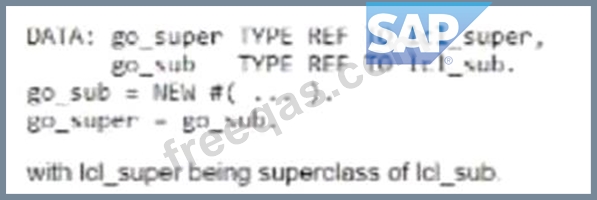
When accessing the subclass instance through go_super, what can you do? Note: There are 2 correct answers to this question.
Correct Answer: A,B
Explanation When accessing the subclass instance through go_super, you can do both of the following: Access the inherited private components: A subclass inherits all the private attributes and methods of its superclass, unless they are explicitly overridden by the subclass. Therefore, you can access the inherited private componentsof the superclass through go_super, as long as they are not hidden by other attributes or methods in the subclass12. Access the inherited public components: A subclass inherits all the public attributes and methods of its superclass, unless they are explicitly overridden by the subclass. Therefore, you can access the inherited public components of the superclass through go_super, as long as they are not hidden by other attributes or methods in the subclass12. You cannot do any of the following: Call a subclass specific public method: A subclass does not have any public methods that are not inherited from its superclass. Therefore, you cannot call a subclass specific public method through go_super12. Call inherited public redefined methods: A subclass does not have any public methods that are redefined from its superclass. Therefore, you cannot call inherited public redefined methods through go_super12. References: 1: Object Oriented - ABAP Development - Support Wiki 2: Inheritance and Instantiation - ABAP Keyword Documentation