
FreeQAs
 Request Exam  Contact
  • Home
  • View All Exams
  • New QA's
  • Upload
PRACTICE EXAMS:
  • Oracle
  • Fortinet
  • IBM
  • Juniper
  • Microsoft
  • Cisco
  • Citrix
  • CompTIA
  • VMware
  • ISC
  • SAP
  • EMC
  • PMI
  • HP
  • Salesforce
  • Other
  • Oracle
    Oracle
  • Fortinet
    Fortinet
  • IBM
    IBM
  • Juniper
    Juniper
  • Microsoft
    Microsoft
  • Cisco
    Cisco
  • Citrix
    Citrix
  • CompTIA
    CompTIA
  • VMware
    VMware
  • ISC
    ISC
  • SAP
    SAP
  • EMC
    EMC
  • PMI
    PMI
  • HP
    HP
  • Salesforce
    Salesforce
  1. Home
  2. SAP Certification
  3. C_ABAPD_2309 Exam
  4. SAP.C_ABAPD_2309.v2025-08-28.q91 Dumps
  • ««
  • «
  • …
  • 11
  • 12
  • 13
  • 14
  • 15
  • 16
  • 17
  • 18
  • 19
  • 20
  • »
Download Now

Question 81


The class zcl_demo_class is in a software component with the language version set to "Standard ABAP". The function module "ZF11 is in a software component with the language version set to "ABAP Cloud". Both the class and function module are customer created. Regarding line #6, which of the following is a valid statement?

Correct Answer: B
Explanation
The function module ZF1 is in a software component with the language version set to "ABAP Cloud". This means that it follows the ABAP Cloud Development Model, which requires the usage of public SAP APIs and extension points to access SAP functionality and data. These APIs and extension points are released by SAP and documented in the SAP API Business Hub1. Customer-created function modules are not part of the public SAP APIs and are not released for cloud development. Therefore, calling a function module directly from a class with the language version set to "Standard ABAP" is not allowed and will result in a syntax error.
However, there is a possible way to call a function module indirectly from a class with the language version set to "Standard ABAP":
Create a wrapper class or interface for the function module and release it for cloud development. A wrapper is a class or interface that encapsulates the function module and exposes its functionality through public methods or attributes. The wrapper must be created in a software component with the language version set to "ABAP Cloud" and must be marked as released for cloud development using the annotation @EndUserText.label. The wrapper can then be called from a class with the language version set to "Standard ABAP" using the public methods or attributes2.
For example, the following code snippet shows how to create a wrapper class for the function module ZF1 and call it from the class zcl_demo_class:
@EndUserText.label: 'Wrapper for ZF1' CLASS zcl_wrapper_zf1 DEFINITION PUBLIC FINAL CREATE PUBLIC. PUBLIC SECTION. CLASS-METHODS: call_zf1 IMPORTING iv_a TYPE i iv_b TYPE i EXPORTING ev_result TYPE i. ENDCLASS.
CLASS zcl_wrapper_zf1 IMPLEMENTATION. METHOD call_zf1. CALL FUNCTION 'ZF1' EXPORTING a = iv_a b = iv_b IMPORTING result = ev_result. ENDMETHOD. ENDCLASS.
CLASS zcl_demo_class DEFINITION. METHODS: m1. ENDCLASS.
CLASS zcl_demo_class IMPLEMENTATION. METHOD m1. DATA(lv_result) =
zcl_wrapper_zf1=>call_zf1( iv_a = 2 iv_b = 3 ). WRITE: / lv_result. ENDMETHOD. ENDCLASS.
The output of this code is:
5
References: 1: SAP API Business Hub 2: Creating an ABAP Cloud Project | SAP Help Portal
insert code

Question 82

Given the following code in an SAP S/4HANA Cloud private edition tenant:
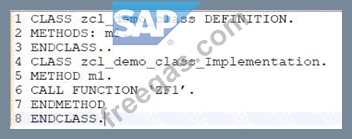
The class zcl_demo_class is in a software component with the language version set to "ABAP Cloud". The function module ZF1' is in a different software component with the language version set to "Standard ABAP".
Both the class and function module are customer created.
Regarding line #6, which of the following are valid statements? Note: There are 2 correct answers to this question.

Correct Answer: A,B
The ABAP Cloud Development Model requires that only public SAP APIs and extension points are used to access SAP functionality and data. These APIs and extension points are released by SAP and documented in the SAP API Business Hub1. Customer-created function modules are not part of the public SAP APIs and are not released for cloud development. Therefore, calling a function module directly from an ABAP Cloud class is not allowed and will result in a syntax error. However, there are two possible ways to call a function module indirectly from an ABAP Cloud class:
* Create a wrapper class or interface for the function module and release it for cloud development. A wrapper is a class or interface that encapsulates the function module and exposes its functionality through public methods or attributes. The wrapper must be created in a software component with the language version set to "Standard ABAP" and must be marked as released for cloud development using the annotation @EndUserText.label. The wrapper can then be called from an ABAP Cloud class using the public methods or attributes2.
* Use the ABAP Cloud Connector to call the function module as a remote function call (RFC) from an ABAP Cloud class. The ABAP Cloud Connector is a service that enables the secure and reliable communication between SAP BTP, ABAP environment and on-premise systems. The function module must be exposed as an RFC-enabled function module in the on-premise system and must be registered in the ABAP Cloud Connector. The ABAP Cloud class can then use the class cl_rfc_destination_service to get the destination name and the class cl_abap_system to create a proxy object for the function module. The proxy object can then be used to call the function module3.
References: 1: SAP API Business Hub 2: Creating an ABAP Cloud Project | SAP Help Portal 3: Calling Remote Function Modules | SAP Help Portal
insert code

Question 83

In ABAP SQL, which of the following retneves the association field _Airline-Name of a CDS view?

Correct Answer: A
insert code

Question 84

In the following ABAP SQL code, what are valid case distinctions? Note: There are 2 correct answers to this question.

Correct Answer: A,C
insert code

Question 85

You have a superclass superl and a subclass subl of superl. Each class has an instance constructor and a static constructor. The first statement of your program creates an instance of subl. In which sequence will the constructors be executed?

Correct Answer:

Explanation
The sequence in which the constructors will be executed is as follows:
Class constructor of superl. This is because the class constructor is a static method that is executed automatically before the class is accessed for the first time. The class constructor is used to initialize the static attributes and components of the class. The class constructor of the superclass is executed before the class constructor of the subclass, as the subclass inherits the static components of the superclass12 Class constructor of subl. This is because the class constructor is a static method that is executed automatically before the class is accessed for the first time. The class constructor is used to initialize the static attributes and components of the class. The class constructor of the subclass is executed after the class constructor of the superclass, as the subclass inherits the static components of the superclass12 Instance constructor of superl. This is because the instance constructor is an instance method that is executed automatically when an instance of the class is created using the statement CREATE OBJECT.
The instance constructor is used to initialize the instance attributes and components of the class. The instance constructor of the superclass is executed before the instance constructor of the subclass, as the subclass inherits the instance components of the superclass. The instance constructor of the subclass must call the instance constructor of the superclass explicitly using super->constructor, unless the superclass is the root node object12 Instance constructor of subl. This is because the instance constructor is an instance method that is executed automatically when an instance of the class is created using the statement CREATE OBJECT.
The instance constructor is used to initialize the instance attributes and components of the class. The instance constructor of the subclass is executed after the instance constructor of the superclass, as the subclass inherits the instance components of the superclass. The instance constructor of the subclass must call the instance constructor of the superclass explicitly using super->constructor, unless the superclass is the root node object12 References: Constructors of Classes - ABAP Keyword Documentation, METHODS - constructor - ABAP Keyword Documentation
insert code
  • ««
  • «
  • …
  • 11
  • 12
  • 13
  • 14
  • 15
  • 16
  • 17
  • 18
  • 19
  • 20
  • »
[×]

Download PDF File

Enter your email address to download SAP.C_ABAPD_2309.v2025-08-28.q91 Dumps

Email:

FreeQAs

Our website provides the Largest and the most Latest vendors Certification Exam materials around the world.

Using dumps we provide to Pass the Exam, we has the Valid Dumps with passing guranteed just which you need.

  • DMCA
  • About
  • Contact Us
  • Privacy Policy
  • Terms & Conditions
©2026 FreeQAs

www.freeqas.com materials do not contain actual questions and answers from Cisco's certification exams.
