
Service Consumer A sends a message to Service A. There are currently three duplicate implementations of Service A (Implementation 1, Implementation 2 and Implementation 3). The message sent by Service Consumer A is intercepted by Service Agent A (1), which determines at runtime which implementation of Service A to forward the message to. All three implementations of Service A reside on the same physical server.
You are told that despite the fact that duplicate implementations of Service A exist, performance is still poor at times. You are also informed that a new service capability will soon need to be added to Service A to introduce functionality that will require access to a shared database being used by many other clients and applications in the IT enterprise. This is expected to add further performance demands on Service A.
How can this service architecture be changed to improve performance in preparation for the addition of the new service capability?
Refer to Exhibit.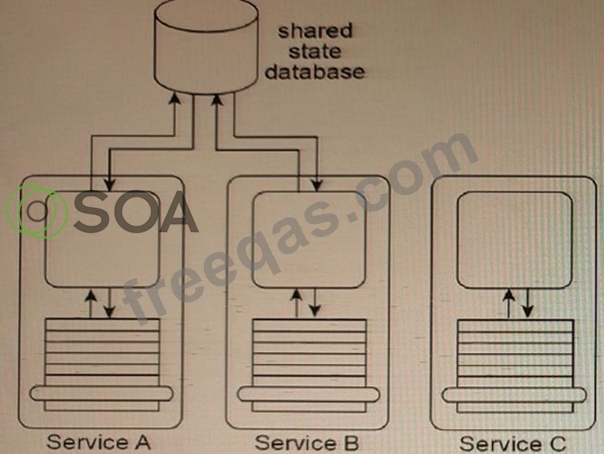
Services A, B, and C are non-agnostic task services. Service A and Service B use the same shared state database to defer their state data at runtime.
An assessment of the three services reveals that each contains some agnostic logic that cannot be made available for reuse because it is bundled together with non-agnostic logic.
The assessment also determines that because Service A, Service B and the shared state database are each located in physically separate environments, the remote communication required for Service A and Service B to interact with the shared state database is causing an unreasonable decrease in runtime performance.
How can the application of the Orchestration pattern improve this architecture?
Refer to Exhibit.
Service Consumer A and Service A reside in Service Inventory A. Service B and Service C reside in Service Inventory B. Service D is a public service that can be openly accessed via the World Wide Web. The service is also available for purchase so that it can be deployed independently within IT enterprises. Due to the rigorous application of the Service Abstraction principle within Service Inventory B, the only information that is made available about Service B and Service C are the published service contracts. For Service D, the service contract plus a service level agreement (SLA) are made available. The SLA indicates that Service D has a planned outage every night from 11:00pm to midnight.
You are an architect with a project team that is building services for Service Inventory A. You are told that the owners of Service Inventory A and Service Inventory B are not generally cooperative or communicative. Cross-inventory service composition is tolerated, but not directly supported. As a result, no SLAs for Service B and Service C are available and you have no knowledge about how available these services are. Based on the service contracts you can determine that the services in Service Inventory B use different data models and a different transport protocol than the services in Service Inventory A. Furthermore, recent testing results have shown that the performance of Service D is highly unpredictable due to the heavy amount of concurrent access it receives from service consumers from other organizations. You are also told that there is a concern over how long Service Consumer A will need to remain stateful while waiting for a response from Service A.
What steps can be taken to solve these problems?
Refer to Exhibit.
When Service A receives a message from Service Consumer A (1), the message is processed by Component A.
This component first invokes Component B (2), which uses values from the message to query Database A in order to retrieve additional data. Component B then returns the additional data to Component A. Component A then invokes Component C (3), which interacts with the API of a legacy system to retrieve a new data value. Component C then returns the data value back to Component A.
Next, Component A sends some of the data It has accumulated to Component D (4), which writes the data to a text file that is placed in a specific folder. Component D then waits until this file is imported into a different system via a regularly scheduled batch import. Upon completion of the import, Component D returns a success or failure code back to Component A. Component A finally sends a response to Service Consumer A (5) containing all of the data collected so far and Service Consumer A writes all of the data to Database B (6).
Components A, B, C, and D belong to the Service A service architecture. Database A, the legacy system and the file folders are shared resources within the IT enterprise.
Service A is an entity service with a service architecture that has grown over the past few years. As a result of a service inventory-wide redesign project, you are asked to revisit the Service A service architecture in order to separate the logic provided by Components B, C, and D into three different utility services without disrupting the behavior of Service A as it relates to Service Consumer A.
What steps can be taken to fulfill these requirements?
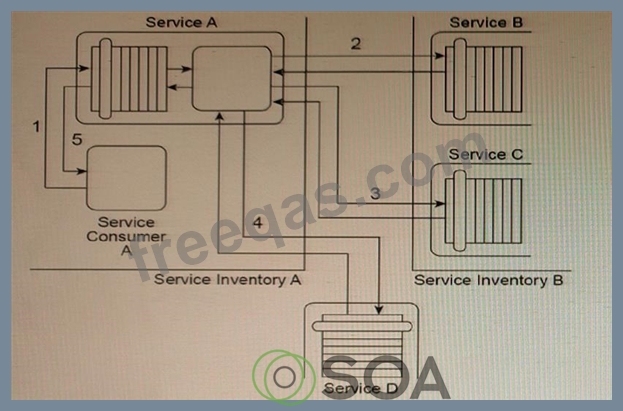
Service Consumer A and Service A reside in Service Inventory A. Service B and Service C reside in Service Inventory B. Service D is a public service that can be openly accessed via the World Wide Web. The service is also available for purchase so that it can be deployed independently within IT enterprises. Due to the rigorous application of the Service Abstraction principle within Service Inventory B, the only information that is made available about Service B and Service C are the published service contracts. For Service D, the service contract plus a service level agreement (SLA) are made available. The SLA indicates that Service D has a planned outage every night from 11:00pm to midnight.
You are an architect with a project team that is building services for Service Inventory A. You are told that the owners of Service Inventory A and Service Inventory B are not generally cooperative or communicative.
Cross-inventory service composition is tolerated, but not directly supported. As a result, no SLAs for Service B and Service C are available and you have no knowledge about how available these services are. Based on the service contracts you can determine that the services in Service Inventory B use different data models and a different transport protocol than the services in Service Inventory A. Furthermore, recent testing results have shown that the performance of Service D is highly unpredictable due to the heavy amount of concurrent access it receives from service consumers from other organizations. You are also told that there is a concern over how long Service Consumer A will need to remain stateful while waiting for a response from Service A.
What steps can be taken to solve these problems?

