FreeQAs
 Request Exam  Contact
  • Home
  • View All Exams
  • New QA's
  • Upload
PRACTICE EXAMS:
  • Oracle
  • Fortinet
  • IBM
  • Juniper
  • Microsoft
  • Cisco
  • Citrix
  • CompTIA
  • VMware
  • ISC
  • SAP
  • EMC
  • PMI
  • HP
  • Salesforce
  • Other
  • Oracle
    Oracle
  • Fortinet
    Fortinet
  • IBM
    IBM
  • Juniper
    Juniper
  • Microsoft
    Microsoft
  • Cisco
    Cisco
  • Citrix
    Citrix
  • CompTIA
    CompTIA
  • VMware
    VMware
  • ISC
    ISC
  • SAP
    SAP
  • EMC
    EMC
  • PMI
    PMI
  • HP
    HP
  • Salesforce
    Salesforce
  1. Home
  2. Salesforce Certification
  3. MuleSoft-Integration-Architect-I Exam
  4. Salesforce.MuleSoft-Integration-Architect-I.v2026-03-30.q190 Dumps
  • ««
  • «
  • …
  • 8
  • 9
  • 10
  • 11
  • 12
  • 13
  • 14
  • 15
  • 16
  • 17
  • …
  • »
  • »»
Download Now

Question 56

An API client makes an HTTP request to an API gateway with an Accept header containing the value'' application''.
What is a valid HTTP response payload for this request in the client requested data format?

Correct Answer: B
When an API client makes an HTTP request to an API gateway with an Accept header containing the value
"application/json", the valid HTTP response payload should be in JSON format. The correct JSON format for indicating a healthy status is {"status": "healthy"}. This format uses a JSON object with a key-value pair where the key is "status" and the value is "healthy".
Other options provided are not valid JSON responses:
* <status>healthy</status> is XML format.
* status('healthy') and status: healthy are not valid JSON syntax.
References
* HTTP Content Negotiation and Accept Headers
* JSON Formatting and Syntax Rules
insert code

Question 57

A marketing organization is designing a Mule application to process campaign data. The Mule application will periodically check for a file in a SFTP location and process the records in the file. The size of the file can vary from 10MB to 5GB. Due to the limited availabiltty of vCores, the Mule application is deployed to a single CloudHub worker configured with vCore size 0.2.
The application must transform and send different formats of this file to three different downstream SFTP locations.
What is the most idiomatic (used for its intended purpose) and performant way to configure the SFTP operations or event sources to process the large files to support these deployment requirements?

Correct Answer: A
Reference: https://docs.mulesoft.com/mule-runtime/4.4/streaming-about
insert code

Question 58

A travel company wants to publish a well-defined booking service API to be shared with its business partners. These business partners have agreed to ONLY consume SOAP services and they want to get the service contracts in an easily consumable way before they start any development. The travel company will publish the initial design documents to Anypoint Exchange, then share those documents with the business partners. When using an API-led approach, what is the first design document the travel company should deliver to its business partners?

Correct Answer: A
SOAP API specifications are provided as WSDL. Design center doesn't provide the functionality to create WSDL file. Hence WSDL needs to be created using XML editor
insert code

Question 59

What aspects of a CI/CD pipeline for Mute applications can be automated using MuleSoft-provided Maven plugins?

Correct Answer: A
insert code

Question 60

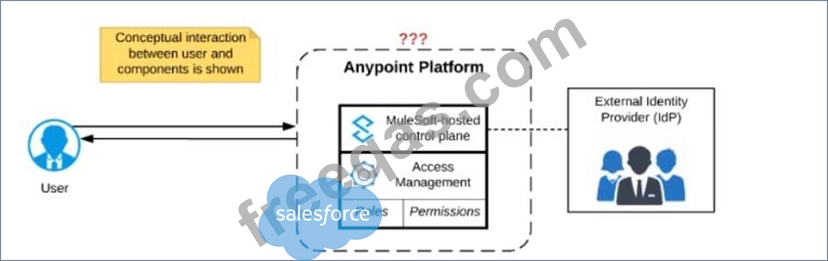
Refer to the exhibit.

Anypoint Platform supports role-based access control (RBAC) to features of the platform. An organization has configured an external Identity Provider for identity management with Anypoint Platform.
What aspects of RBAC must ALWAYS be controlled from the Anypoint Platform control plane and CANNOT be controlled via the external Identity Provider?

Correct Answer: B
* By default, Anypoint Platform performs its own user management
- For user management, one external IdP can be integrated with the Anypoint Platform organization (note: not at business group level)
- Permissions and access control are still enforced inside Anypoint Platform and CANNOT be controlled via the external Identity Provider * As the Anypoint Platform organization administrator, you can configure identity management in Anypoint Platform to set up users for single sign-on (SSO). * You can map users in a federated organization's group to a role which also gives the flexibility of controlling the business group within Anypoint Platform to which the user belongs to. Also user can nbe removed from external identity management system when they no longer work for the organization. So they wont be able to authenticate using SSO to login to Anypoint Platform. * Using external identity we can no change permissions of a particular role in Mulesoft Anypoint platform.
* So Correct answer is Assigning Anypoint Platform permissions to a role
insert code
  • ««
  • «
  • …
  • 8
  • 9
  • 10
  • 11
  • 12
  • 13
  • 14
  • 15
  • 16
  • 17
  • …
  • »
  • »»
[×]

Download PDF File

Enter your email address to download Salesforce.MuleSoft-Integration-Architect-I.v2026-03-30.q190 Dumps


Email:

FreeQAs

Our website provides the Largest and the most Latest vendors Certification Exam materials around the world.

Using dumps we provide to Pass the Exam, we has the Valid Dumps with passing guranteed just which you need.

  • DMCA
  • About
  • Contact Us
  • Privacy Policy
  • Terms & Conditions
©2026 FreeQAs

www.freeqas.com materials do not contain actual questions and answers from Cisco's certification exams.