FreeQAs
 Request Exam  Contact
  • Home
  • View All Exams
  • New QA's
  • Upload
PRACTICE EXAMS:
  • Oracle
  • Fortinet
  • Juniper
  • Microsoft
  • Cisco
  • Citrix
  • CompTIA
  • VMware
  • ISC
  • SAP
  • EMC
  • PMI
  • HP
  • Salesforce
  • Other
  • Oracle
    Oracle
  • Fortinet
    Fortinet
  • Juniper
    Juniper
  • Microsoft
    Microsoft
  • Cisco
    Cisco
  • Citrix
    Citrix
  • CompTIA
    CompTIA
  • VMware
    VMware
  • ISC
    ISC
  • SAP
    SAP
  • EMC
    EMC
  • PMI
    PMI
  • HP
    HP
  • Salesforce
    Salesforce
  1. Home
  2. Salesforce Certification
  3. MuleSoft-Integration-Architect-I Exam
  4. Salesforce.MuleSoft-Integration-Architect-I.v2026-07-22.q100 Dumps
  • ««
  • «
  • …
  • 3
  • 4
  • 5
  • 6
  • 7
  • 8
  • 9
  • 10
  • 11
  • 12
  • …
  • »
  • »»
Download Now

Question 31

What is an example of data confidentiality?

Correct Answer: B
Data confidentiality involves protecting information from unauthorized access and disclosure. Encrypting a file containing personally identifiable information (PII) is a prime example of ensuring data confidentiality.
Encryption transforms the data into a format that is unreadable without the appropriate decryption key, thereby safeguarding sensitive information such as PII from being accessed by unauthorized parties. This measure is essential for compliance with data protection regulations and maintaining the privacy and security of personal data.
References
* MuleSoft Security Best Practices
* Data Protection and Encryption Standards Documentation
insert code

Question 32

An insurance company is using a CIoudHub runtime plane. As a part of requirement, email alert should be sent to internal operations team every time of policy applied to an API instance is deleted As an integration architect suggest on how this requirement be met?

Correct Answer: D
* Requirement Analysis: The organization needs to send email alerts to the internal operations team whenever a policy applied to an API instance is deleted in the CloudHub runtime plane.
* Solution: The most effective approach is to implement a new Mule application that uses the Audit Log REST API to detect when a policy is deleted and then sends an email using the SMTP connector.
* Implementation Steps:
* Access Audit Logs:
* Use the Anypoint Platform's Audit Log REST API to monitor and detect policy deletion events.
* Example of accessing the Audit Log REST API:
GET /accounts/api/v2/organizations/{orgId}/audit-logs
* This endpoint will provide logs, including events related to policy deletions.
* Create Email Notification Application:
* Create a Mule application that periodically polls the Audit Log REST API to check for policy deletion events.
* Use the SMTP connector to send email notifications to the operations team.
* Example Mule flow:
<flow name="policy-deletion-alert-flow"> <scheduler frequency="60000" /> <http:request config-ref=" AuditLogAPIConfig" path="/audit-logs" method="GET"> <http:request-builder> <http:uri-params> <http:uri- param key="orgId" value="your-org-id" /> </http:uri-params> <http:query-params> <http:query-param key=" eventType" value="PolicyDeleted" /> </http:query-params> </http:request-builder> </http:request> <choice>
<when expression="#[payload contains 'PolicyDeleted']"> <smtp:send config-ref="SMTP_Config" to=" [email protected]" subject="Policy Deletion Alert"> <smtp:body>Policy deletion detected: #
[payload]</smtp:body> </smtp:send> </when> </choice> </flow>
* Scheduler: Configures the application to check the audit logs at regular intervals (e.g., every minute).
* HTTP Request: Makes a GET request to the Audit Log REST API to fetch the logs.
* Choice Router: Checks if the payload contains a policy deletion event.
* SMTP Connector: Sends an email to the operations team with details about the policy deletion.
* Advantages:
* Automation: Automates the detection of policy deletions and the notification process, reducing manual monitoring efforts.
* Timeliness: Ensures the operations team is promptly informed of any policy deletions, enabling them to take immediate action if necessary.
References
* MuleSoft Documentation on Audit Log REST API
* MuleSoft Documentation on SMTP Connector
* MuleSoft Documentation on MuleSoft Scheduler Component
insert code

Question 33

An API implementation is being designed that must invoke an Order API which is known to repeatedly experience downtime. For this reason a fallback API is to be called when the Order API is unavailable. What approach to designing invocation of the fallback API provides the best resilience?
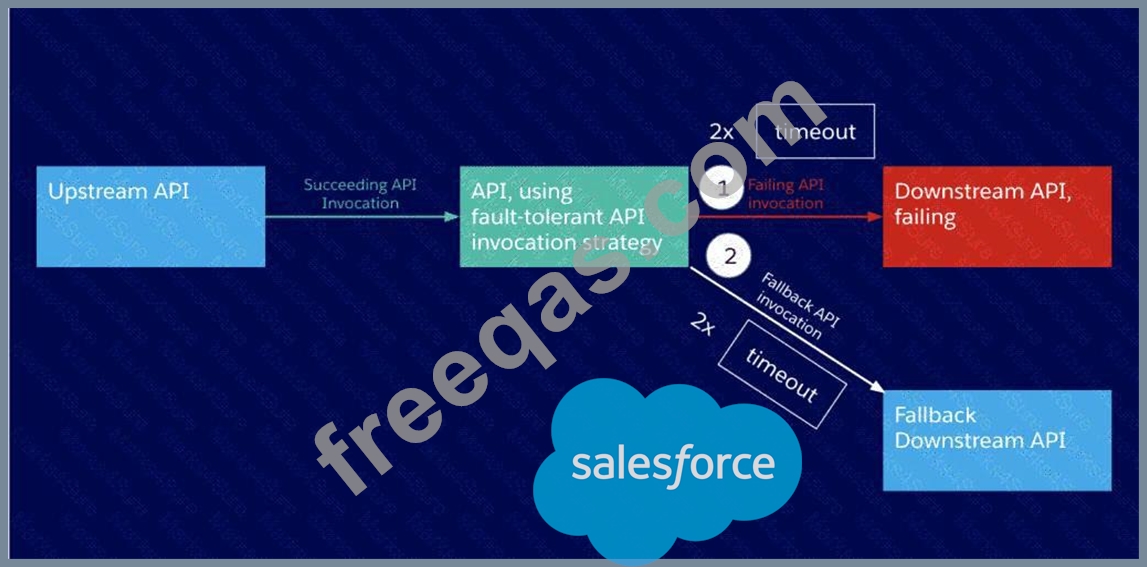
Correct Answer: A
* Resilience testing is a type of software testing that observes how applications act under stress. It's meant to ensure the product's ability to perform in chaotic conditions without a loss of core functions or data; it ensures a quick recovery after unforeseen, uncontrollable events.
* In case an API invocation fails - even after a certain number of retries - it might be adequate to invoke a different API as a fallback. A fallback API, by definition, will never be ideal for the purpose of the API client, otherwise it would be the primary API.
* Here are some examples for fallback APIs:
- An old, deprecated version of the same API.
- An alternative endpoint of the same API and version (e.g. API in another CloudHub region).
- An API doing more than required, and therefore not as performant as the primary API.
- An API doing less than required and therefore forcing the API Client to offer a degraded service, which is still better than no service at all.
* API clients implemented as Mule applications offer the 'Until Successful Scope and Exception' strategies at their disposal, which together allow configuring fallback actions such as a fallback API invocation.
* All HTTP response status codes within the 3xx category are considered redirection messages. These codes indicate to the user agent (i.e. your web browser) that an additional action is required in order to complete the request and access the desired resource Diagram Description automatically generated

Hence correct answer is Redirect client requests through an HTTP 303 temporary redirect status code to the fallback API whenever the Order API is unavailable
insert code

Question 34

An organization is in the process of building automated deployments using a CI/CD process. As a part of automated deployments, it wants to apply policies to API Instances.
What tool can the organization use to promote and deploy API Manager policies?

Correct Answer: D
insert code

Question 35

An organization is designing multiple new applications to run on CloudHub in a single Anypoint VPC and that must share data using a common persistent Anypoint object store V2 (OSv2).
Which design gives these mule applications access to the same object store instance?

Correct Answer: C
Object Store v2 (OSv2) in MuleSoft allows multiple applications within the same Anypoint Virtual Private Cloud (VPC) to share data. To achieve this, the OSv2 connector must be configured in each application to access the common persistent object store instance. This configuration enables the applications to read from and write to the same object store, facilitating data sharing. Object Store v2 is designed to be persistent and reliable, making it suitable for scenarios where data needs to be retained and shared across multiple applications.
MuleSoft Documentation on Object Store v2
insert code
  • ««
  • «
  • …
  • 3
  • 4
  • 5
  • 6
  • 7
  • 8
  • 9
  • 10
  • 11
  • 12
  • …
  • »
  • »»
[×]

Download PDF File

Enter your email address to download Salesforce.MuleSoft-Integration-Architect-I.v2026-07-22.q100 Dumps


Email:

FreeQAs

Our website provides the Largest and the most Latest vendors Certification Exam materials around the world.

Using dumps we provide to Pass the Exam, we has the Valid Dumps with passing guranteed just which you need.

  • DMCA
  • About
  • Contact Us
  • Privacy Policy
  • Terms & Conditions
©2026 FreeQAs

www.freeqas.com materials do not contain actual questions and answers from Cisco's certification exams.