A media company needs a data pipeline that will ingest customer review data into a Snowflake table, and apply some transformations. The company also needs to use Amazon Comprehend to do sentiment analysis and make the de-identified final data set available publicly for advertising companies who use different cloud providers in different regions.
The data pipeline needs to run continuously and efficiently as new records arrive in the object storage leveraging event notifications. Also, the operational complexity, maintenance of the infrastructure, including platform upgrades and security, and the development effort should be minimal.
Which design will meet these requirements?
A company is designing high availability and disaster recovery plans and needs to maximize redundancy and minimize recovery time objectives for their critical application processes. Cost is not a concern as long as the solution is the best available. The plan so far consists of the following steps:
1. Deployment of Snowflake accounts on two different cloud providers.
2. Selection of cloud provider regions that are geographically far apart.
3. The Snowflake deployment will replicate the databases and account data between both cloud provider accounts.
4. Implementation of Snowflake client redirect.
What is the MOST cost-effective way to provide the HIGHEST uptime and LEAST application disruption if there is a service event?
A Data Engineer is designing a near real-time ingestion pipeline for a retail company to ingest event logs into Snowflake to derive insights. A Snowflake Architect is asked to define security best practices to configure access control privileges for the data load for auto-ingest to Snowpipe.
What are the MINIMUM object privileges required for the Snowpipe user to execute Snowpipe?
An Architect runs the following SQL query: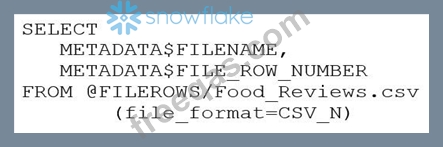
How can this query be interpreted?
Which Snowflake data modeling approach is designed for BI queries?

