Which cache type is used to cache data output from SQL queries?
Correct Answer: A
Question 42
What are potential impacts of storing non-native values like dates and timestamps in a variant column in Snowflake?
Correct Answer: B
Storing non-native values, such as dates and timestamps, in a VARIANT column in Snowflake can lead to slower query performance and increased storage consumption. VARIANT is a semi-structured data type that allows storing JSON, AVRO, ORC, Parquet, or XML data in a single column. When non-native data types are stored as VARIANT, Snowflake must perform implicit conversion to process these values, which can slow down query execution. Additionally, because the VARIANT data type is designed to accommodate a wide variety of data formats, it often requires more storage space compared to storing data in native, strongly-typed columns that are optimized for specific data types. The performance impact arises from the need to parse and interpret the semi-structured data on the fly during query execution, as opposed to directly accessing and operating on optimally stored data in its native format. Furthermore, the increased storage consumption is a result of the overhead associated with storing data in a format that is less space-efficient than the native formats optimized for specific types of data. References: * Snowflake Documentation on Semi-Structured Data: Semi-Structured Data
Question 43
How would a user run a multi-cluster warehouse in maximized mode?
Correct Answer: C
To run a multi-cluster warehouse in maximized mode, a user should set the minimum and maximum number of clusters to the same value. This ensures that all clusters are available when thewarehouse is started, providing maximum resources for query execution. References: Snowflake Documentation2.
Question 44
Which Snowflake mechanism is used to limit the number of micro-partitions scanned by a query?
Correct Answer: C
Question 45
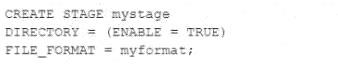
A user creates a stage using the following command: What will be the outcome?