FreeQAs
 Request Exam  Contact
  • Home
  • View All Exams
  • New QA's
  • Upload
PRACTICE EXAMS:
  • Oracle
  • Fortinet
  • Juniper
  • Microsoft
  • Cisco
  • Citrix
  • CompTIA
  • VMware
  • SAP
  • EMC
  • PMI
  • HP
  • Salesforce
  • Other
  • Oracle
    Oracle
  • Fortinet
    Fortinet
  • Juniper
    Juniper
  • Microsoft
    Microsoft
  • Cisco
    Cisco
  • Citrix
    Citrix
  • CompTIA
    CompTIA
  • VMware
    VMware
  • SAP
    SAP
  • EMC
    EMC
  • PMI
    PMI
  • HP
    HP
  • Salesforce
    Salesforce
  1. Home
  2. Snowflake Certification
  3. COF-C02 Exam
  4. Snowflake.COF-C02.v2026-01-13.q618 Dumps
  • ««
  • «
  • …
  • 100
  • 101
  • 102
  • 103
  • 104
  • 105
  • 106
  • 107
  • 108
  • 109
  • …
  • »
  • »»
Download Now

Question 516

What Snowflake recommendation is designed to ensure that staged data is only loaded once"?

Correct Answer: C
Snowflake recommends removing data files from the staging area after they have been loaded into the target table. This practice ensures that the data is only loaded once and prevents accidental reloading of the same data. By removing the files, you eliminate the risk of duplicate data loads.
* Stage the Data: Upload the data files to a Snowflake stage (internal or external).
* Load the Data: Use the COPY INTO command to load the data from the stage into the Snowflake table.
* Remove the Data Files: After successfully loading the data, remove the data files from the stage using the REMOVE command.
References:
* Snowflake Documentation: Loading Data into Snowflake
* Snowflake Documentation: Staging Data Files
* Snowflake Documentation: COPY INTO Command
insert code

Question 517

Who can grant object privileges in a regular schema?

Correct Answer: A
In a regular schema within Snowflake, the object owner has the privilege to grant object privileges. The object owner is typically the role that created the object or to whom the ownership of the object has been transferred78.
Reference = [COF-C02] SnowPro Core Certification Exam Study Guide
insert code

Question 518

What consideration should be made when loading data into Snowflake?

Correct Answer: D
When loading data into Snowflake, one critical consideration is the parallel processing capability of the virtual warehouse used for the data loading operation. The number of data files that can be processed in parallel during a loading operation is determined by the size and resources of the virtual warehouse. A larger warehouse can process more files simultaneously, improving the efficiency and speed of data loading operations. Optimizing the size of the virtual warehouse according to the data loading needs and the size and number of files to be loaded can significantly impact the overall performance of the data loading process.
References:
* Snowflake Documentation: Optimizing Data Loading
insert code

Question 519

Which types of subqueries does Snowflake support? (Select TWO).

Correct Answer: B,E
Snowflake supports a variety of subquery types, including both correlated and uncorrelated subqueries. The correct answers are B and E, which highlight Snowflake's flexibility in handling subqueries within SQL queries.
* Uncorrelated Scalar Subqueries: These are subqueries that can execute independently of the outer query. They return a single value and can be used anywhere a value expression is allowed, offering great flexibility in SQL queries.
* EXISTS, ANY/ALL, and IN Subqueries: These subqueries are used in WHERE clauses to filter the results of the main query based on the presence or absence of matching rows in a subquery. Snowflake supports both correlated and uncorrelated versions of these subqueries, providing powerful tools for complex data analysis scenarios.
* Examples and Usage:
* Uncorrelated Scalar Subquery:
SELECT * FROM employees WHERE salary > (SELECT AVG(salary) FROM employees);
* Correlated EXISTS Subquery:
SELECT * FROM orders o WHERE EXISTS (SELECT 1 FROM customer c WHERE c.id = o.customer_id AND c.region = 'North America'); Reference: For comprehensive details on the types of subqueries supported by Snowflake and examples of their usage, consult the Snowflake documentation on subqueries: https://docs.snowflake.com/en/sql-reference
/constructs/subqueries.html
insert code

Question 520

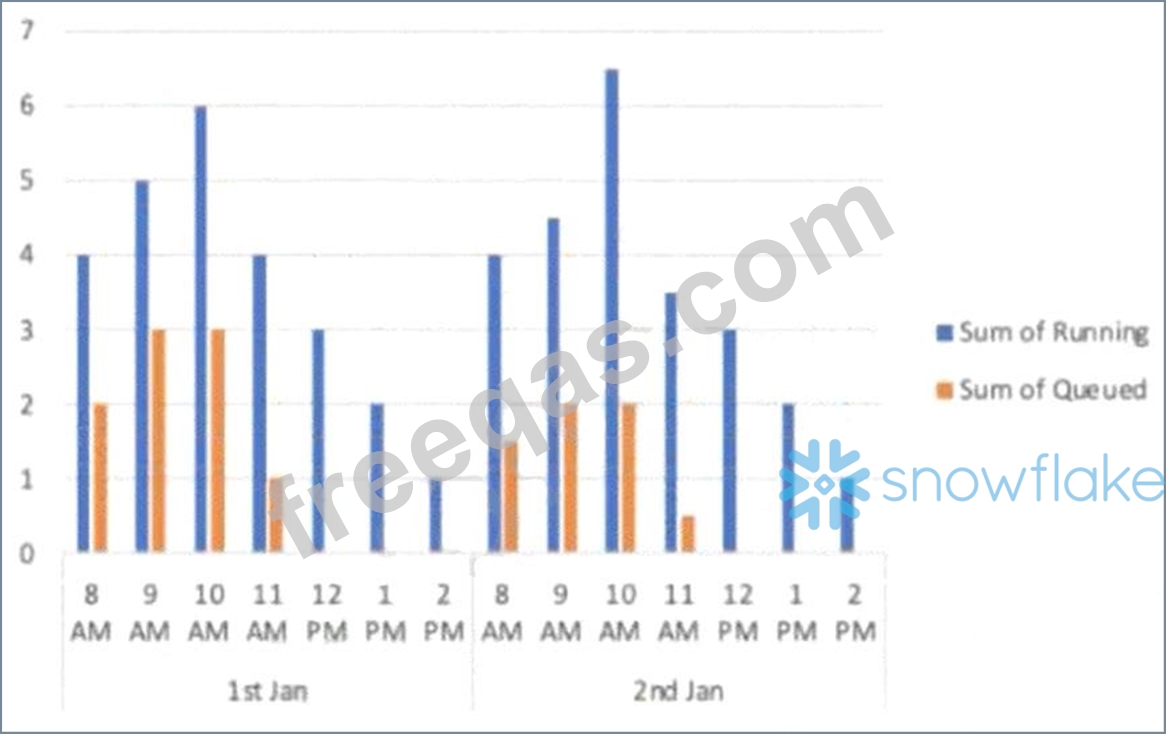
A virtual warehouse is created using the following command:
Create warehouse my_WH with
warehouse_size = MEDIUM
min_cluster_count = 1
max_cluster_count = 1
auto_suspend = 60
auto_resume = true;
The image below is a graphical representation of the warehouse utilization across two days.
What action should be taken to address this situation?

Correct Answer: C
The graphical representation of warehouse utilization indicates periods of significant queuing, suggesting that the current single cluster cannot efficiently handle all incoming queries. Configuring the warehouse to a multi- cluster warehouse will distribute the load among multiple clusters, reducing queuing times and improving overall performance1.
References = Snowflake Documentation on Multi-cluster Warehouses1
insert code
  • ««
  • «
  • …
  • 100
  • 101
  • 102
  • 103
  • 104
  • 105
  • 106
  • 107
  • 108
  • 109
  • …
  • »
  • »»
[×]

Download PDF File

Enter your email address to download Snowflake.COF-C02.v2026-01-13.q618 Dumps

Email:

FreeQAs

Our website provides the Largest and the most Latest vendors Certification Exam materials around the world.

Using dumps we provide to Pass the Exam, we has the Valid Dumps with passing guranteed just which you need.

  • DMCA
  • About
  • Contact Us
  • Privacy Policy
  • Terms & Conditions
©2026 FreeQAs

www.freeqas.com materials do not contain actual questions and answers from Cisco's certification exams.
