Which of the following statements apply to Snowflake in terms of security? (Choose two.)
Correct Answer: A,C
Snowflake uses a Role-Based Access Control (RBAC) model to manage access to data and resources. Additionally, Snowflake ensures that all data is encrypted, both at rest and in transit, to provide a high level of security for data stored within the platform. References: [COF-C02] SnowPro Core Certification Exam Study Guide
Question 92
When using the ALLOW CLIENT_MFA_CACHING parameter, how long is a cached Multi-Factor Authentication (MFA) token valid for?
Correct Answer: C
When using the ALLOW_CLIENT_MFA_CACHING parameter, a cached Multi-Factor Authentication (MFA) token is valid for up to 4 hours. This allows for continuous, secure connectivity without users needing to respond to an MFA prompt at the start of each connection attempt to Snowflake within this timeframe2.
Question 93
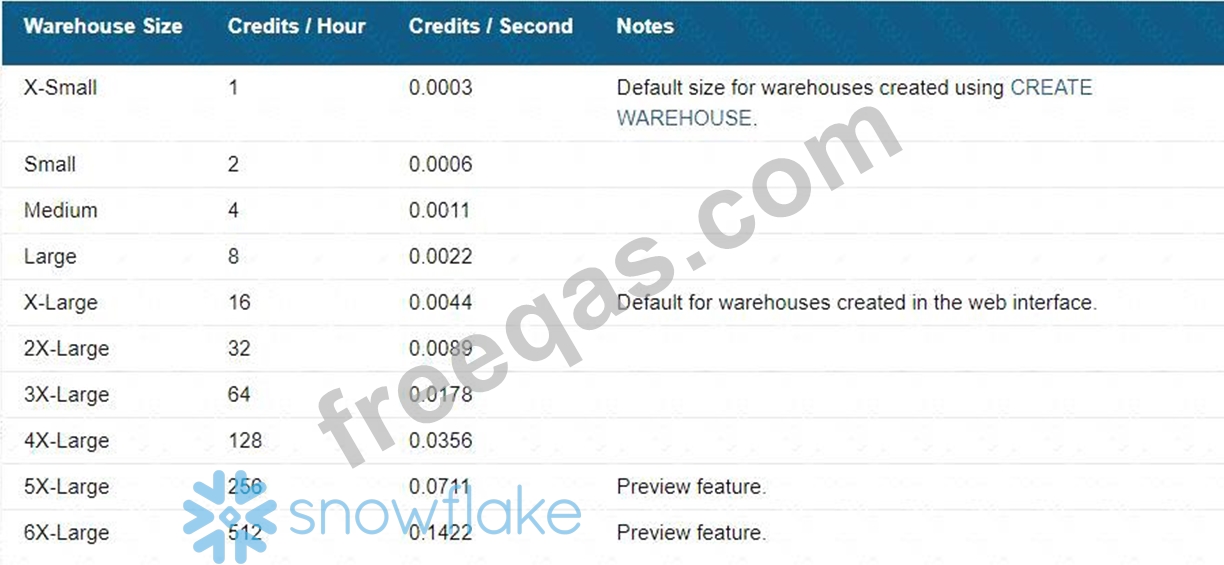
If 3 size Small virtual warehouse is made up of two servers, how many servers make up a Large warehouse?
Correct Answer: B
In Snowflake, each size increase in virtual warehouses doubles the number of servers. Therefore, if a size Small virtual warehouse is made up of two servers, a Large warehouse, which is two sizes larger, would be made up of eight servers (2 servers for Small, 4 for Medium, and 8 for Large)2. Size specifies the amount of compute resources available per cluster in a warehouse. Snowflake supports the following warehouse sizes: https://docs.snowflake.com/en/user-guide/warehouses-overview.html
Question 94
Which Snowflake privilege is required on a pipe object to pause or resume pipes?
Correct Answer: A
OPERATE. In Snowflake, to pause or resume a pipe, the OPERATE privilege is required on the pipe object. The OPERATE privilege allows users to perform operational tasks on specific objects such as pipes, tasks, and streams. Specifically, for a pipe, the OPERATE privilege enables the user to execute the ALTER PIPE ... SET PIPE_EXECUTION_PAUSED=TRUE or ALTER PIPE ... SET PIPE_EXECUTION_PAUSED=FALSE commands, which are used to pause or resume the pipe, respectively. Here's a step-by-step explanation and reference: Understanding Pipe Operations: Pipes in Snowflake are used for continuous data loading from staging areas into Snowflake tables. Managing pipes involves operations such as creating, monitoring, pausing, and resuming. Privileges for Pipe Operations: The OPERATE privilege is essential for pausing and resuming pipes. This privilege is more specific than general object access privileges like SELECT or USAGE and is tailored for operational control. Granting the OPERATE Privilege: To grant the OPERATE privilege on a pipe, an administrator or a user with the necessary grants can execute the SQL command: GRANT OPERATE ON PIPE <pipe_name> TO ROLE <role_name>; Pausing and Resuming Pipes: Once the OPERATE privilege is granted, the user or role can pause the pipe using: ALTER PIPE <pipe_name> SET PIPE_EXECUTION_PAUSED=TRUE; To resume the pipe, they use: ALTER PIPE <pipe_name> SET PIPE_EXECUTION_PAUSED=FALSE;
Question 95
Which command is used to unload data from a Snowflake table into a file in a stage?