FreeQAs
 Request Exam  Contact
  • Home
  • View All Exams
  • New QA's
  • Upload
PRACTICE EXAMS:
  • Oracle
  • Fortinet
  • Juniper
  • Microsoft
  • Cisco
  • Citrix
  • CompTIA
  • VMware
  • SAP
  • EMC
  • PMI
  • HP
  • Salesforce
  • Other
  • Oracle
    Oracle
  • Fortinet
    Fortinet
  • Juniper
    Juniper
  • Microsoft
    Microsoft
  • Cisco
    Cisco
  • Citrix
    Citrix
  • CompTIA
    CompTIA
  • VMware
    VMware
  • SAP
    SAP
  • EMC
    EMC
  • PMI
    PMI
  • HP
    HP
  • Salesforce
    Salesforce
  1. Home
  2. The Open Group Certification
  3. OGBA-101 Exam
  4. TheOpenGroup.OGBA-101.v2024-04-16.q15 Dumps
  • «
  • 1
  • 2
  • 3
  • 4
Download Now

Question 11

What component of the Architecture Repository is an architectural representation of SBBs supporting the Architecture Landscape?

Correct Answer: C
The component of the Architecture Repository that is an architectural representation of SBBs supporting the Architecture Landscape is the Solutions Landscape3. The Solutions Landscape presents an architectural representation of the Solution Building Blocks (SBBs) that support the Architecture Landscape and have been planned or deployed by the enterprise3. The Solutions Landscape shows how SBBs are mapped to Architecture Building Blocks (ABBs) in different architecture domains and levels3. The Solutions Landscape can help to ensure consistency and alignment between the Architecture Landscape and the solutions that implement it.
insert code

Question 12

Which statement best describes iteration and the ADM?

Correct Answer: C
The statement that best describes iteration and the ADM is that the ADM is iterative, over the whole process, between phases, and within phases4. Iteration is a key concept in managing the complexity of developing an Enterprise Architecture and managing its lifecycle4. The ADM supports several forms of iteration as follows:
Iteration over the whole process: Projects will iterate through the entire ADM cycle, commencing with Phase A (Architecture Vision) and ending with Phase H (Architecture Change Management)4. Each cycle of the ADM will be bound by a Request for Architecture Work that defines the scope and objectives of the project4. The architecture output will populate or update the Architecture Landscape that describes the current and target states of the enterprise4.
Iteration between phases: Projects may cycle between ADM phases in planned cycles covering multiple phases4. Typically, this is used to converge on a detailed Target Architecture when higher-level architecture does not exist to provide context and constraint4. For example, a project may iterate between Phase B (Business Architecture), Phase C (Information Systems Architectures), and Phase D (Technology Architecture) until a satisfactory solution is achieved4.
Iteration within phases: Projects may return to previous activities within an ADM phase in order to circle back and update work products with new information4. Typically, this is used to manage the inter-relationship between different aspects of an architecture domain or viewpoint4. For example, a project may revisit Business Architecture models after developing Information Systems Architecture models to ensure alignment and consistency4.
insert code

Question 13

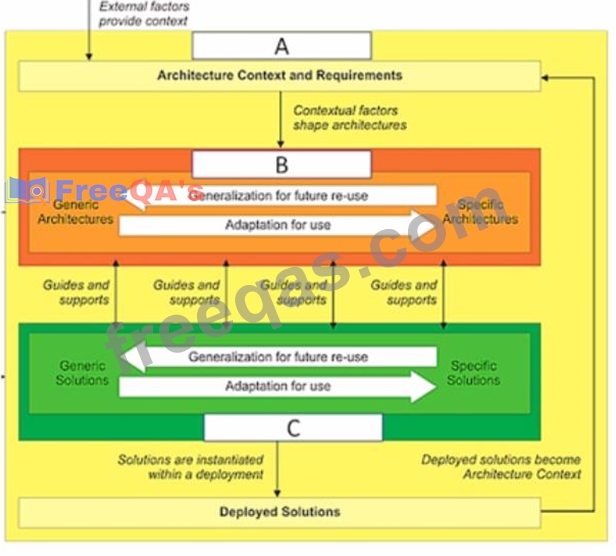
Consider the diagram.

What are the items labelled A, B and C?

Correct Answer: B
The diagram shows the Enterprise Continuum, which is a view of the Architecture Repository that provides methods for classifying architecture and solution artifacts as they evolve from generic Foundation Architectures to Organization-Specific Architectures4. The Enterprise Continuum comprises two complementary concepts: the Architecture Continuum and the Solutions Continuum. The Architecture Continuum shows the relationships among foundational frameworks, common system architectures, industry architectures, and enterprise architectures4. The Solutions Continuum shows the relationships among foundational solutions, common system solutions, industry solutions, and enterprise solutions4.
insert code

Question 14

Which of the following best describes the relationship between business models and business architecture?

Correct Answer: B
A business model describes how an organization creates, delivers, and captures value for its stakeholders3. A business architecture breaks a business model down into the core functional elements that describe how the business works, such as the value proposition, the customer segments, the channels, the revenue streams, the cost structure, the key resources, the key activities, and the key partnerships3.
insert code

Question 15

Which step during development of a business scenario ensures that each iteration is managed as a mini-project?

Correct Answer: A
The step during development of a business scenario that ensures that each iteration is managed as a mini-project is the Planning Step3. The Planning Step is a preparatory step that defines how to approach each iteration of developing a business scenario3. The Planning Step involves setting up a project team with clear roles and responsibilities, defining a project plan with milestones and deliverables, identifying stakeholders and their concerns, establishing communication channels and feedback mechanisms, and securing resources and budget3. The Planning Step can help to ensure that each iteration is managed as a mini-project with clear objectives, scope, schedule, quality criteria, risks, and issues.
insert code
  • «
  • 1
  • 2
  • 3
  • 4
[×]

Download PDF File

Enter your email address to download TheOpenGroup.OGBA-101.v2024-04-16.q15 Dumps

Email:

FreeQAs

Our website provides the Largest and the most Latest vendors Certification Exam materials around the world.

Using dumps we provide to Pass the Exam, we has the Valid Dumps with passing guranteed just which you need.

  • DMCA
  • About
  • Contact Us
  • Privacy Policy
  • Terms & Conditions
©2025 FreeQAs

www.freeqas.com materials do not contain actual questions and answers from Cisco's certification exams.