FreeQAs
 Request Exam  Contact
  • Home
  • View All Exams
  • New QA's
  • Upload
PRACTICE EXAMS:
  • Oracle
  • Fortinet
  • IBM
  • Juniper
  • Microsoft
  • Cisco
  • Citrix
  • CompTIA
  • VMware
  • ISC
  • SAP
  • EMC
  • PMI
  • HP
  • Salesforce
  • Other
  • Oracle
    Oracle
  • Fortinet
    Fortinet
  • IBM
    IBM
  • Juniper
    Juniper
  • Microsoft
    Microsoft
  • Cisco
    Cisco
  • Citrix
    Citrix
  • CompTIA
    CompTIA
  • VMware
    VMware
  • ISC
    ISC
  • SAP
    SAP
  • EMC
    EMC
  • PMI
    PMI
  • HP
    HP
  • Salesforce
    Salesforce
  1. Home
  2. The Open Group Certification
  3. OGEA-101 Exam
  4. TheOpenGroup.OGEA-101.v2026-04-16.q101 Dumps
  • ««
  • «
  • …
  • 9
  • 10
  • 11
  • 12
  • 13
  • 14
  • 15
  • 16
  • 17
  • 18
  • …
  • »
  • »»
Download Now

Question 61

Which one of the following classes of information within the Architecture Repository would typically contain a list of the applications in use within the enterprise?

Correct Answer: C
The Architecture Landscape is a class of information within the Architecture Repository that shows an architectural view of the building blocks that are in use within the organization today (the Baseline Architecture), as well as those that are planned for the future (the Target Architecture). The Architecture Landscape typically contains a list of the applications in use within the enterprise, along with their relationships and dependencies, as well as other relevant architectural information. The Architecture Landscape helps to identify opportunities for re-use, consolidation, or retirement of existing applications, as well as gaps or overlaps in the current or future architecture.
insert code

Question 62

Consider the following descriptions of deliverables consumed and produced across the TOGAF ADM cycle.
General rules and guidelines, intended to be enduring and seldom
amended, that inform and support the way in which an organization sets
about fulfilling its mission
The joint agreements between development partners and sponsors on the
deliverables, quality, and fitness-for-purpose of an architecture.
A document that is sent from the sponsoring organization to the
architecture organization to trigger the start of an architecture
development cycle
A set of quantitative statements that outline what an implementation
project must do in order to comply with the architecture.
Which deliverables match these descriptions?

Correct Answer: A
According to the TOGAF standard, the deliverables that match the descriptions are as follows:
1 Architecture Principles: These are general rules and guidelines, intended to be enduring and seldom amended, that inform and support the way in which an organization sets about fulfilling its mission1. They reflect a level of consensus among the various elements of the enterprise, and form the basis for making future IT decisions1.
2 Architecture Contracts: These are the joint agreements between development partners and sponsors on the deliverables, quality, and fitness-for-purpose of an architecture2. They are used to ensure that the architecture is implemented and governed according to the agreed-upon specifications and standards2.
3 Request for Architecture Work: This is a document that is sent from the sponsoring organization to the architecture organization to trigger the start of an architecture development cycle3. It defines the scope, schedule, budget, deliverables, and stakeholders of the architecture project3.
4 Architecture Requirements Specification: This is a set of quantitative statements that outline what an implementation project must do in order to comply with the architecture4. It defines the requirements for each architecture domain, as well as the relationships and dependencies among them4.
1: Architecture Principles 2: Architecture Contracts 3: Request for Architecture Work 4: Architecture Requirements Specification
insert code

Question 63

Consider the illustration.

What are the items labelled A, B and C?

Correct Answer: A
The illustration shows the relationship between the Enterprise Continuum, the Architecture Continuum, and the Solutions Continuum, which are key concepts in the TOGAF framework. The Enterprise Continuum is a view of the Architecture Repository that shows how generic foundation architectures can be leveraged and specialized to support the requirements of an individual organization. The Architecture Continuum specifies a structured classification for architectural artifacts, such as models, patterns, and descriptions, that can be reused and adapted across different domains and levels of abstraction. The Solutions Continuum identifies implemented solutions that support various stages of business and IT capability evolution, such as common systems, industry solutions, and organization-specific solutions. The illustration also shows how the architecture context and requirements are influenced by external factors, such as business drivers, stakeholders, and standards, and how they shape the generic and specific architectures and solutions. The illustration also shows how the deployed solutions become part of the architecture context for future iterations of the architecture development cycle. References:
*TOGAF Standard, 10th Edition, Part II: Architecture Development Method, Chapter 6: Architecture Repository, Section 6.2 Enterprise Continuum.
*TOGAF Standard, 10th Edition, Part IV: Architecture Content Framework, Chapter 35: Enterprise Continuum and Tools, Section 35.1 Introduction.
insert code

Question 64

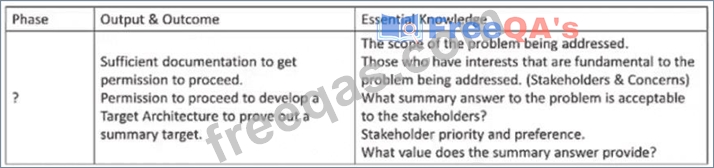
Refer to the table below:

Which ADM Phase does this describe?

Correct Answer: B
Phase B of the ADM cycle is the Business Architecture phase. It describes the development of a Business Architecture to support an agreed Architecture Vision. The objectives of this phase are to describe the baseline and target Business Architecture, identify candidate Architecture Roadmap components based on gaps between the baseline and target, and determine whether an incremental approach is required. Reference:
The TOGAF Standard | The Open Group Website, Section 3.2.2 Phase B: Business Architecture.
insert code

Question 65

Consider the following statement.
According to the TOGAF standard, a governed approach of a particular deliverable will ensure adherence to the principles, standards, and requirements of the existing or developing architectures.
Which deliverable does this refer to?

Correct Answer: C
According to the TOGAF Standard, 10th Edition, an architecture contract is "a formal agreement between a service provider and a service consumer that defines the mutual commitments and expectations for the delivery of an architecture" 1. An architecture contract is a governed approach of a particular deliverable that will ensure adherence to the principles, standards, and requirements of the existing or developing architectures, as it specifies the roles, responsibilities, deliverables, quality criteria, and acceptance criteria for the architecture work 1. The other options are not correct, as they are not governed approaches of a particular deliverable, but rather different types of deliverables within the architecture development process. An architecture vision is "a high-level, aspirational view of the target architecture" 1. A statement of architecture work is "a document that defines the scope and approach that will be used to complete an architecture project"
1. An architecture definition document is "a document that describes the baseline and target architectures for one or more domains" 1. References: 1: TOGAF Standard, 10th Edition, Part I: Introduction, Chapter 3:
Definitions.
insert code
  • ««
  • «
  • …
  • 9
  • 10
  • 11
  • 12
  • 13
  • 14
  • 15
  • 16
  • 17
  • 18
  • …
  • »
  • »»
[×]

Download PDF File

Enter your email address to download TheOpenGroup.OGEA-101.v2026-04-16.q101 Dumps

Email:

FreeQAs

Our website provides the Largest and the most Latest vendors Certification Exam materials around the world.

Using dumps we provide to Pass the Exam, we has the Valid Dumps with passing guranteed just which you need.

  • DMCA
  • About
  • Contact Us
  • Privacy Policy
  • Terms & Conditions
©2026 FreeQAs

www.freeqas.com materials do not contain actual questions and answers from Cisco's certification exams.