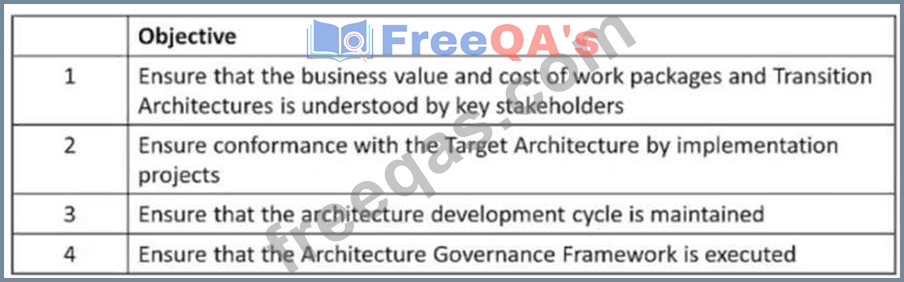
Consider the following ADM phases objectives. Which phase does each objective match?
Correct Answer: A
Explanation 1F: To define an Implementation and Migration Strategy that will achieve an orderly transition from the Baseline to Target Architectures 2G: To perform appropriate governance functions while the solution is being implemented 3G: To ensure conformance with the Target Architecture by implementation projects 4H: To establish procedures for continual monitoring and assessment of the performance of the solution in operation Reference: The TOGAF Standard | The Open Group Website, Section 3.2 ADM Phases.
Question 32
Which of the following best describes a purpose of the Gap Analysis technique?
Correct Answer: D
Explanation Gap analysis is a technique that is used to validate an architecture by highlighting the shortfall between the Baseline Architecture and the Target Architecture. One of the purposes of gap analysis is to identify missing functions that are either deliberately omitted, accidentally left out, or not yet defined in the Target Architecture. Missing functions are marked as gaps that need to be filled by developing or procuring the building blocks.
Question 33
Which of the following best describes a purpose of the Gap Analysis technique?
Correct Answer: D
Gap analysis is a technique that is used to validate an architecture by highlighting the shortfall between the Baseline Architecture and the Target Architecture. One of the purposes of gap analysis is to identify missing functions that are either deliberately omitted, accidentally left out, or not yet defined in the Target Architecture. Missing functions are marked as gaps that need to be filled by developing or procuring the building blocks.
Question 34
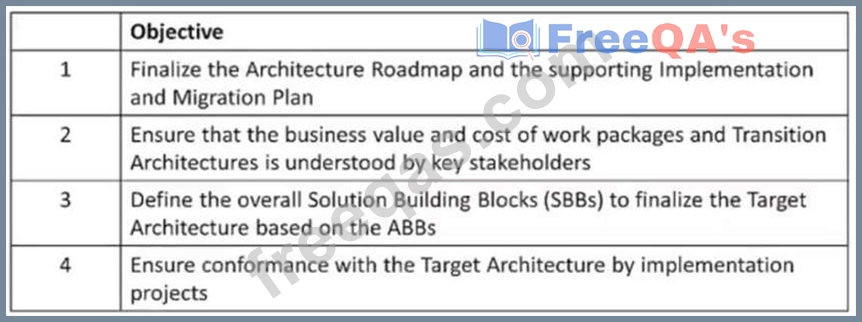
Consider the following ADM phases objectives. Which phase does each objective match?
Correct Answer: B
Explanation 1E: To identify delivery vehicles (projects programs portfolios) that will deliver the Target Architecture 2F: To confirm readiness and ability to undergo change 3E: To determine whether an incremental approach is required and if so identify Transition Architectures that will deliver continuous business value 4G: To perform appropriate governance functions while the solution is being implemented Reference: The TOGAF Standard | The Open Group Website, Section 3.2 ADM Phases.
Question 35
Please read this scenario prior to answering the question You are serving as the Lead Architect for an Enterprise Architecture team within a leading multinational biotechnology company. The company works in three major industries, including healthcare, crop production, and agriculture. Your team works within the healthcare division. The healthcare division is developing a new vaccine, and has to demonstrate its effectiveness and safety in a set of clinical trials that satisfy the regulatory requirements of the relevant health authorities. The clinical trials are undertaken by its research laboratories at multiple facilities worldwide. In addition to internal research and development activities, the healthcare division is also involved in publicly funded collaborative research projects with industrial and academic partners. The Enterprise Architecture team has been engaged in an architecture project to develop a secure system that will allow the healthcare researchers to share information more easily about their clinical trials, and work more collaboratively across the organization and also with its partners. This system will also connect with external partners. The Enterprise Architecture team uses the TOGAF ADM with extensions required to support healthcare manufacturing practices and laboratory practices. Due to the highly sensitive nature of the information that is managed, special care has been taken to ensure that each architecture domain considers the security and privacy issues that are relevant. The Vice President for Worldwide Clinical Research is the sponsor of the Enterprise Architecture activity. She has stated that disruptions must be minimized for the clinical trials, and that the rollout must be undertaken incrementally. Refer to the scenario You have been asked to recommend the approach to identify the work packages for an incremental rollout meeting the requirements. Based on the TOGAF standard which of the following is the best answer?
Correct Answer: B
A Consolidated Gaps, Solutions and Dependencies Matrix is a technique that can be used to create work packages for an incremental rollout of the architecture. A work package is a set of actions or tasks that are required to implement a specific part of the architecture. A work package can be associated with one or more Architecture Building Blocks (ABBs) or Solution Building Blocks (SBBs), which are reusable components of business, IT, or architectural capability. A work package can also be associated with one or more Capability Increments, which are defined, discrete portions of the overall capability that deliver business value. A Capability Increment can be realized by one or more Transition Architectures, which are intermediate states of the architecture that enable the transition from the Baseline Architecture to the Target Architecture123 The steps for creating work packages using this technique are: For each gap between the Baseline Architecture and the Target Architecture, identify a proposed solution and classify it as new development, purchased solution, or based on an existing product. A gap is a difference or deficiency in the current state of the architecture that needs to be addressed by the future state of the architecture. A solution is a way of resolving a gap by implementing one or more ABBs or SBBs. Group similar solutions together to define the work packages. Similar solutions are those that have common characteristics, such as functionality, technology, vendor, or location. Identify dependencies between work packages, such as logical, temporal, or resource dependencies. Dependencies indicate the order or priority of the work packages, and the constraints or risks that may affect their implementation. Regroup the work packages into a set of Capability Increments to transition to the Target Architecture. Capability Increments should be defined based on the business value, effort, and risk associated with each work package, and the schedule and objectives of the clinical trials. Capability Increments should also be aligned with the Architecture Vision and the Architecture Principles. Document the work packages and the Capability Increments in an Architecture Definition Increments Table, which shows the mapping between the work packages, the ABBs, the SBBs, and the Capability Increments. The table also shows the dependencies, assumptions, and issues related to each work package and Capability Increment. Therefore, the best answer is B, because it describes the approach to identify the work packages for an incremental rollout meeting the requirements, using the Consolidated Gaps, Solutions and Dependencies Matrix as a planning tool.