Complete the sentence Business Transformation Readiness Assessment is_________________.
Correct Answer: A
Explanation Business Transformation Readiness Assessment is a joint effort between corporate staff lines of business and IT planners to evaluate the readiness of the organization to undergo change. It involves assessing factors such as vision, commitment, capacity, capability, culture, and motivation that may influence the success of a business transformation initiative. Reference: The TOGAF Standard | The Open Group Website, Section 3.3.2 Business Transformation Readiness Assessment.
Question 42
Scenario You are working as an Enterprise Architect within an Enterprise Architecture (EA) team at a global company that sells consumer products. The company produces many products that buyers use and enjoy. The company has announced a major change to its products that will occur over a four-year period. This change includes the introduction of digital products and services. An architecture to support this strategy has been finished, along with a roadmap for a set of projects to implement this significant change. This will be a cross-functional effort between the product design and software teams. It is planned to be developed in phases. The company faces a challenge in presenting and providing access to different services through its products and digital platforms while ensuring compliance with data privacy laws. In some countries and regions, the data residency requirements mean that the company has to store certain data within the region where it is collected. As a result, the company's application portfolio and infrastructure must connect with various cloud services and data repositories in different countries. The EA team has inherited the architecture used by the current products, some of which can be carried over to the new products. The EA team has started to define which parts of the architecture to carry forward. Enough of the Business Architecture has been defined so that work can commence on the Information Systems and Technology Architectures. Those architectures need to be defined to support the key digital services that the company plans to provide. The company uses the TOGAF Standard as the foundation for its Enterprise Architecture framework, and architecture development follows the purpose-based EA Capability model outlined in the TOGAF Series Guide: A Practitioner's Approach to Developing Enterprise Architecture Following the TOGAF ADM. The EA team reports to the Chief Information Officer (CIO), who oversees the program. You have been asked how to decide and organize the work to deliver the requested architectures. Based on the TOGAF standard, which of the following is the best answer?
Correct Answer: A
Comprehensive and Detailed Step-by-Step Explanation Context of the Scenario The company is in the process of delivering requested architectures to support the introduction of digital products and services. The Business Architecture is sufficiently defined, and the focus is on developing the Information Systems and Technology Architectures. TOGAF emphasizes breaking down large, complex transformation programs into manageable projects, focusing on dependencies, risks, trade-offs, and sequencing of efforts. Based on the scenario, the company must deal with: Data privacy and residency compliance across different regions. Re-use of existing architecture for efficiency. Alignment of digital services with a global roadmap. The activity described aligns with ADM Phases B (Business Architecture), C (Information Systems Architecture), and D (Technology Architecture), with a focus on delivering architectures for implementation. Option Analysis Option A: Strengths: Refers to developing high-level architecture descriptions and identifying reference architectures and candidate building blocks, which align with ADM Phases B, C, and D. Addresses feasibility analysis, trade-offs, and stakeholder engagement, which are part of architecture development and decision-making in TOGAF. Ensures that the architecture descriptions are resource-conscious, including cost and value analysis, dependencies, risks, and synergies between projects. Conclusion: Correct, as it provides a complete approach to organizing the work to deliver architectures while adhering to TOGAF principles. Option B: Strengths: Suggests creating architecture descriptions for the Application, Data, and Technology Architectures, which are necessary for delivering requested architectures. Addresses readiness assessments and the fitness of solutions. Weaknesses: Emphasizes looking outside the company and studying other companies' models, which is not necessarily aligned with TOGAF unless justified by specific gaps. Skips essential TOGAF steps like feasibility analysis and detailed stakeholder engagement. Conclusion: Incorrect, as it places undue emphasis on external research instead of leveraging TOGAF's structured ADM. Option C: Strengths: Suggests reviewing the Architecture Vision and determining scope, which aligns with TOGAF principles. Proposes preparing an Architecture Roadmap and involving the Architecture Board for review. Weaknesses: Does not cover important elements such as candidate building blocks, feasibility analysis, or stakeholder engagement. Suggests starting the project prematurely without proper sequencing or risk trade-offs. Conclusion: Incorrect, as it skips key steps and lacks a structured approach to dependencies and resource management. Option D: Strengths: Suggests revising the Architecture Vision and conducting a Stakeholder Analysis, which aligns with Phase A of the ADM. Weaknesses: Returning to Phase A is not required here, as the Architecture Vision has already been defined. Revising the vision at this stage indicates a step backward. Lacks focus on feasibility analysis, dependencies, and sequencing, which are the immediate needs in this phase. Conclusion: Incorrect, as it unnecessarily revisits earlier ADM phases instead of progressing. TOGAF Reference ADM Phases B, C, D: Emphasizes developing detailed architectures, identifying candidate building blocks, and addressing dependencies, risks, and resource needs (TOGAF 9.2, Chapters 8-10). Architecture Roadmap and Feasibility Analysis: Guides sequencing and trade-offs for implementation (TOGAF 9.2, Section 12.4). Stakeholder Engagement: Critical for ensuring alignment and feasibility (TOGAF 9.2, Section 24.2). Decision-Making and Trade-offs: TOGAF emphasizes documenting risks and trade-offs as part of feasibility analysis (TOGAF 9.2, Section 6.4.1).
Question 43
Consider the image showing basic architectural concepts. What are items A and B?
Correct Answer: A
The image shows a diagram that illustrates the basic concepts of architecture description as defined by the ISO /IEC/IEEE 42010:2011 standard1, which is also adopted by the TOGAF standard2. According to the ISO/IEC/IEEE 42010:2011 standard, an architecture description is a work product used to express an architecture, and it consists of one or more architecture views1. An architecture view is a representation of a system from the perspective of a related set of concerns, and it conforms to an architecture viewpoint1. An architecture viewpoint is a specification of the conventions for constructing and using an architecture view to address specific stakeholder concerns1. Therefore, the correct answer is option A, which identifies the items labeled as "A" and "B" in the image as an architecture viewpoint and an architecture view, respectively. References: 1: ISO/IEC/IEEE 42010:2011 - Systems and software engineering - Architecture description1 2: TOGAF Standard, Version 9.2 - Part IV: Architecture Content Framework - 31. Architectural Artifacts2
Question 44
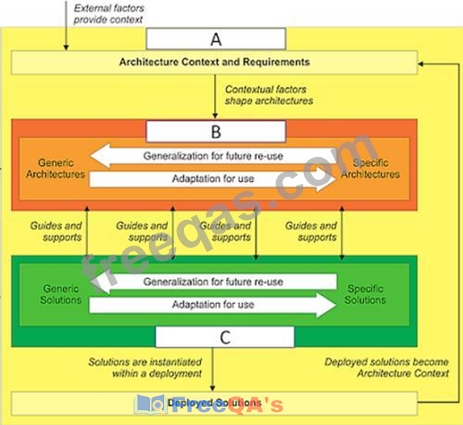
Consider the illustration. What are the items labelled A, B and C?
Correct Answer: A
The illustration shows the relationship between the Enterprise Continuum, the Architecture Continuum, and the Solutions Continuum, which are key concepts in the TOGAF framework. The Enterprise Continuum is a view of the Architecture Repository that shows how generic foundation architectures can be leveraged and specialized to support the requirements of an individual organization. The Architecture Continuum specifies a structured classification for architectural artifacts, such as models, patterns, and descriptions, that can be reused and adapted across different domains and levels of abstraction. The Solutions Continuum identifies implemented solutions that support various stages of business and IT capability evolution, such as common systems, industry solutions, and organization-specific solutions. The illustration also shows how the architecture context and requirements are influenced by external factors, such as business drivers, stakeholders, and standards, and how they shape the generic and specific architectures and solutions. The illustration also shows how the deployed solutions become part of the architecture context for future iterations of the architecture development cycle. References: *TOGAF Standard, 10th Edition, Part II: Architecture Development Method, Chapter 6: Architecture Repository, Section 6.2 Enterprise Continuum. *TOGAF Standard, 10th Edition, Part IV: Architecture Content Framework, Chapter 35: Enterprise Continuum and Tools, Section 35.1 Introduction.
Question 45
Which of the following best summarizes the purpose of Enterprise Architecture?
Correct Answer: B
Explanation EA applies architecture principles and practices to analyze, design, plan, and implement enterprise analysis that supports digital transformation, IT growth, and the modernization of IT2. EA also helps organizations improve the efficiency, timeliness, and reliability of business information, as well as the alignment, agility, and adaptability of the architecture to the changing needs and requirements3. Therefore, the best summary of the purpose of EA is to guide effective change. References: 1: Enterprise architecture - Wikipedia 2: What is enterprise architecture? A framework for transformation 3: 3 The Purpose of Enterprise Architecture - The Open Group