Which section of the TOGAF template for Architecture Principles should highlight the requirements for carrying out the principle?
Correct Answer: D
Explanation The Implications section describes the impact of adhering to the principle on the organization, the processes, the information systems, and the technology23. It also identifies the changes, costs, and risks that may result from applying the principle23. The Implications section helps to communicate the benefits and consequences of the principle to the stakeholders and to guide the implementation and governance of the architecture23. The other sections of the TOGAF template for Architecture Principles are1: *Name: This section provides a short and memorable name for the principle that represents its essence and purpose23. The name should not mention any specific technology or solution23. *Statement: This section provides a concise and formal definition of the principle that expresses the fundamental rule or constraint that the principle imposes23. The statement should be clear, unambiguous, and testable23. *Rationale: This section provides the reasoning and justification for the principle, explaining why it is important and how it supports the business goals and drivers23. The rationale should also link the principle to the higher-level enterprise or IT principles that it elaborates on23. References: 2: The TOGAF Standard, Version 9.2 - Architecture Principles 3: TOGAF 8.1.1 Online - Architecture Principles 1: Architecture Principles Template
Question 62
Which ADM phase focuses on defining the problem to be solved, identifying the stakeholders, their concerns, and requirements?
Correct Answer: D
Phase A: Architecture Vision is the first phase of the Architecture Development Method (ADM) cycle, which is the core of the TOGAF standard. The main purpose of this phase is to define the scope and approach of the architecture development, and to create the Architecture Vision, which is a high-level description of the desired outcomes and benefits of the proposed architecture. To achieve this purpose, this phase focuses on defining the problem to be solved, identifying the stakeholders, their concerns, and requirements, and establishing the business goals and drivers that motivate the architecture work. This phase also involves obtaining the approval and commitment of the sponsors and other key stakeholders, and initiating the Architecture Governance process. References: : The TOGAF Standard, Version 9.2, Part II: Architecture Development Method (ADM), Chapter 5: Introduction to the ADM : The TOGAF Standard, Version 9.2, Part II: Architecture Development Method (ADM), Chapter 18: Phase A: Architecture Vision : The TOGAF Standard, Version 9.2, Part II: Architecture Development Method (ADM), Chapter 18.3: Inputs : The TOGAF Standard, Version 9.2, Part II: Architecture Development Method (ADM), Chapter 18.4: Steps
Question 63
Exhibit: Consider the image showing basic architectural concepts. What are items A and B?
Correct Answer: C
Explanation In the context of TOGAF, a stakeholder is any individual, team, or organization who has interests in, or concerns relative to, the outcome of the architecture. Concerns are those interests which pertain to any aspect of the system's functioning, development or operation, including considerations such as performance, reliability, and security1. References: *The TOGAF Standard, Version 9.2 - Definitions - The Open Group
Question 64
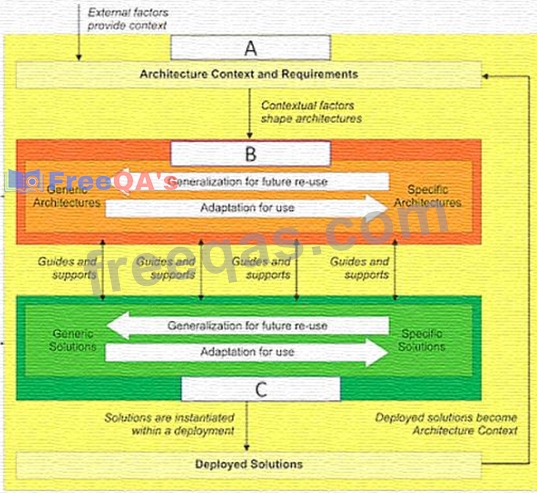
Consider the illustration. What are the items labelled A, B and C?
Correct Answer: A
The illustration shows the relationship between the Enterprise Continuum, the Architecture Continuum, and the Solutions Continuum, which are key concepts in the TOGAF framework. TheEnterprise Continuum is a view of the Architecture Repository that shows how generic foundation architectures can be leveraged and specialized to support the requirements of an individual organization. The Architecture Continuum specifies a structured classification for architectural artifacts, such as models, patterns, and descriptions, that can be reused and adapted across different domains and levels of abstraction. The Solutions Continuum identifies implemented solutions that support various stages of business and IT capability evolution, such as common systems, industry solutions, and organization-specific solutions. The illustration also shows how the architecture context and requirements are influenced by external factors, such as business drivers, stakeholders, and standards, and how they shape the generic and specific architectures and solutions. The illustration also shows how the deployed solutions become part of the architecture context for future iterations of the architecture development cycle. References: *TOGAF Standard, 10th Edition, Part II: Architecture Development Method, Chapter 6: Architecture Repository, Section 6.2 Enterprise Continuum. *TOGAF Standard, 10th Edition, Part IV: Architecture Content Framework, Chapter 35: Enterprise Continuum and Tools, Section 35.1 Introduction.
Question 65
Consider the following chart: Which important concept for Enterprise Architecture Practitioners does it illustrate?
Correct Answer: B
https://pubs.opengroup.org/architecture/togaf8-doc/arch/chap03.html The chart that you have provided is a Gantt chart that shows the tasks and timelines of a TOGAF project. It illustrates the concept of phased development of an Enterprise Architecture, which is one of the key principles of the TOGAF Architecture Development Method (ADM). The ADM is a cyclic process that consists of nine phases, from Preliminary to Architecture Change Management1. Each phase has a specific purpose, scope, inputs, steps, and outputs, and produces a part of the Enterprise Architecture. The phases are executed in a sequential order, with some iterations and feedback loops, to ensure that the architecture is consistent, complete, and aligned with the business requirements and objectives. The phases also have a limited fixed duration, which is determined by the complexity, scope, and resources of the project. This helps to manage the expectations, risks, and costs of the architecture development, and to deliver the architecture in a timely and effective manner23.