FreeQAs
 Request Exam  Contact
  • Home
  • View All Exams
  • New QA's
  • Upload
PRACTICE EXAMS:
  • Oracle
  • Fortinet
  • Juniper
  • Microsoft
  • Cisco
  • Citrix
  • CompTIA
  • VMware
  • SAP
  • EMC
  • PMI
  • HP
  • Salesforce
  • Other
  • Oracle
    Oracle
  • Fortinet
    Fortinet
  • Juniper
    Juniper
  • Microsoft
    Microsoft
  • Cisco
    Cisco
  • Citrix
    Citrix
  • CompTIA
    CompTIA
  • VMware
    VMware
  • SAP
    SAP
  • EMC
    EMC
  • PMI
    PMI
  • HP
    HP
  • Salesforce
    Salesforce
  1. Home
  2. UiPath Certification
  3. UiPath-ABAv1 Exam
  4. UiPath.UiPath-ABAv1.v2025-11-25.q104 Dumps
  • ««
  • «
  • …
  • 11
  • 12
  • 13
  • 14
  • 15
  • 16
  • 17
  • 18
  • 19
  • 20
  • …
  • »
  • »»
Download Now

Question 71

According to UiPath's best practices, when should the test scenarios and test cases be created?

Correct Answer: C
According to UiPath's best practices, test scenarios and test cases should be created during the Solution Design phase. This is crucial because it allows the design team to plan and prepare for various testing scenarios that can validate the automation's functionality and efficiency before moving into development and deployment.References: UiPath Documentation on Solution Design athttps://docs.uipath.com/.
insert code

Question 72

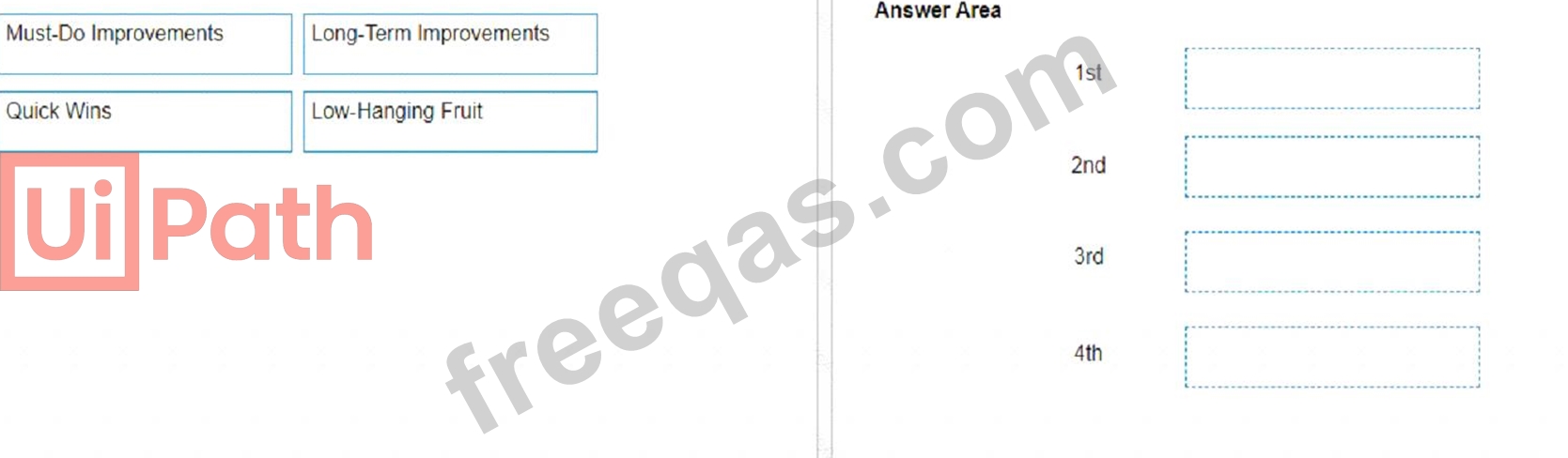
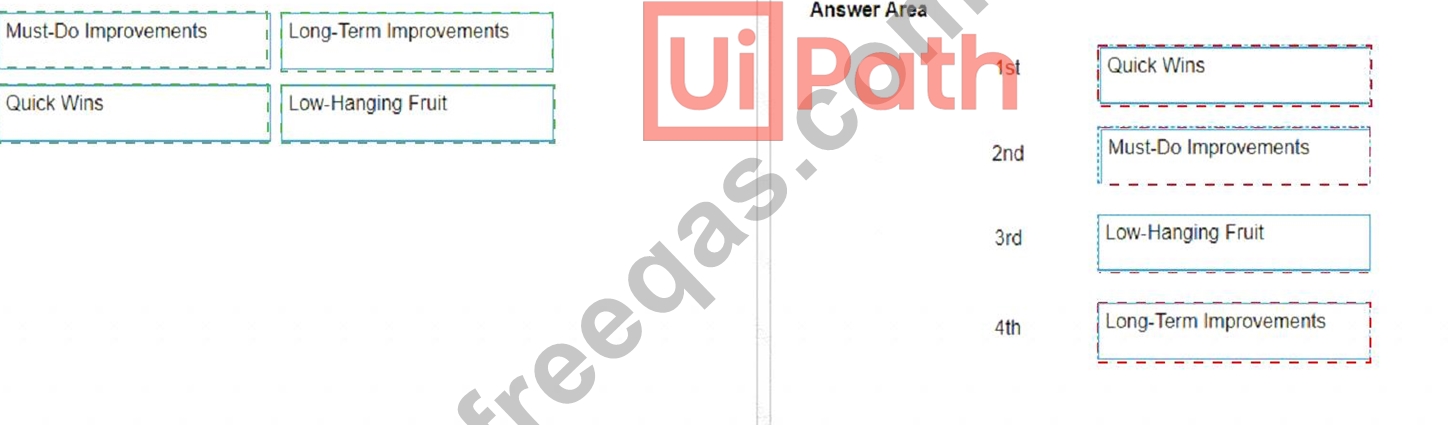
When deciding the priority of processes from a pipeline, what is the order in which the development should be done'?
Instructions: Drag and Drop the items on the left to the boxes on the right in a correct order
Correct Answer:

Explanation:
The correct order for prioritizing processes from a pipeline for development is:
* Quick Wins
* Must-Do Improvements
* Low-Hanging Fruit
* Long-Term Improvements
This prioritization strategy is designed to balance immediate impact with strategic development. Quick Wins are prioritized first because they typically require minimal effort and provide immediate benefits. Must-Do Improvements follow, as these are necessary changes that may require more effort but are essential for the processLow-Hanging Fruit are tasks that are relatively easy to implement and provide value, while Long-Term Improvements are placed last as they often involve significant changes that yield benefits over a longer period123.
References: The prioritization logic is based on common project management practices and is supported by discussions in the UiPath Community Forum, where similar strategies are recommended for process development and automation123.
insert code

Question 73

What is the aim of the performance assessment in the post-production phase of an RPA implementation?

Correct Answer: D
The aim of the performance assessment in the post-production phase of an RPA implementation is to monitor the performance of the automated process and compare it with the baseline metrics established at the beginning of the project. This assessment helps in understanding whether the automation is delivering the expected benefits, such as improved efficiency, reduced errors, and cost savings. It also provides insights into areas that may require optimization or further improvement1.
References: The purpose of performance assessment in RPA is outlined in resources such as the UiPath Community Forum, which discusses the importance of continuous improvement and performance monitoring in the lifecycle of RPA implementation1.
insert code

Question 74

UiPath Process Mining provides TemplateOne application that offers different generic dashboards containing information, KPIs, and analysis functionality focused on a specific process area What are the 3 standard KPIs part of the Automation Dashboard within the TemplateOne application?

Correct Answer: C
In the TemplateOne application provided by UiPath Process Mining, the Automation Dashboard includes the following three standard KPIs: Automation Rate, Total Manual Processing Time, and Total Manual Event Cost. These KPIs help in assessing the efficiency and cost-effectiveness of manual vs automated processes within an organization.
Reference: UiPath Documentation on Process Mining and TemplateOne at https://docs.uipath.com/.
insert code

Question 75

What does the Business Benefit of Flexibility refer to?

Correct Answer: C
The Business Benefit of Flexibility refers to the ability of robots to enable scaling up or down as required when there is an unexpected spike in volume. This flexibility in robotic process automation (RPA) allows businesses to respond dynamically to varying workload demands without the need for proportional increases in human resources or infrastructure.
Reference: UiPath Documentation on Business Benefits of Automation at https://docs.uipath.com/.
insert code
  • ««
  • «
  • …
  • 11
  • 12
  • 13
  • 14
  • 15
  • 16
  • 17
  • 18
  • 19
  • 20
  • …
  • »
  • »»
[×]

Download PDF File

Enter your email address to download UiPath.UiPath-ABAv1.v2025-11-25.q104 Dumps

Email:

FreeQAs

Our website provides the Largest and the most Latest vendors Certification Exam materials around the world.

Using dumps we provide to Pass the Exam, we has the Valid Dumps with passing guranteed just which you need.

  • DMCA
  • About
  • Contact Us
  • Privacy Policy
  • Terms & Conditions
©2026 FreeQAs

www.freeqas.com materials do not contain actual questions and answers from Cisco's certification exams.
