FreeQAs
 Request Exam  Contact
  • Home
  • View All Exams
  • New QA's
  • Upload
PRACTICE EXAMS:
  • Oracle
  • Fortinet
  • Juniper
  • Microsoft
  • Cisco
  • Citrix
  • CompTIA
  • VMware
  • ISC
  • SAP
  • EMC
  • PMI
  • HP
  • Salesforce
  • Other
  • Oracle
    Oracle
  • Fortinet
    Fortinet
  • Juniper
    Juniper
  • Microsoft
    Microsoft
  • Cisco
    Cisco
  • Citrix
    Citrix
  • CompTIA
    CompTIA
  • VMware
    VMware
  • ISC
    ISC
  • SAP
    SAP
  • EMC
    EMC
  • PMI
    PMI
  • HP
    HP
  • Salesforce
    Salesforce
  1. Home
  2. VMware Certification
  3. 3V0-24.25 Exam
  4. VMware.3V0-24.25.v2026-03-11.q63 Dumps
  • ««
  • «
  • …
  • 5
  • 6
  • 7
  • 8
  • 9
  • 10
  • 11
  • 12
  • 13
  • 14
  • »
Download Now

Question 56

A Platform Engineer is designing a multi-zone Supervisor architecture to support a high-availability requirement for a critical financial application. The design involves three vSphere Zones: Zone-A, Zone- B, and Zone-C.
The engineer needs to create a vSphere Namespace fin-app-ns that can tolerate the failure of any single zone.
Review the following proposed configuration snippet for the Namespace creation:
# Proposed Namespace Configuration Logic
Name: fin-app-ns
Placement:
Zones:
- Zone-A
- Zone-B
Storage Policies:
- gold-storage-policy (assigned to all zones)
Why is this proposed configuration insufficient to meet the "tolerate failure of any single zone" requirement for the Supervisor Control Plane and the workloads within this namespace? (Choose 2.)

Correct Answer: D,E
insert code

Question 57

An administrator is adding a kubernetes cluster to an existing namespace. Click where the administrator navigates to create the cluster.

Correct Answer:

Explanation:
Kubernetes Service
When adding a Kubernetes cluster to anexisting vSphere Namespace, the workflow is initiated from within that namespace's context in the vSphere Client. The administrator first opens the target namespace (as shown in the left navigation where the namespace is selected), then uses theKubernetes Servicearea to create and manage Kubernetes clusters associated with that namespace. In the namespaceSummaryview, theKubernetes Servicetile/card provides the entry point for cluster lifecycle actions, typically via an action link such asManage(and from thereCreate Cluster). This is because the Kubernetes cluster is anamespace-scoped resourcein the Supervisor environment: it inherits namespace-level policies and configuration such as permissions/RBAC, resource limits, storage policies, and networking selections that have already been defined for that namespace. Navigating to other areas likeStorageorNetworkis used to validate or adjust prerequisites (for example, storage policy availability or network settings), but the actual "create cluster" operation is launched fromKubernetes Servicewithin the namespace to ensure the cluster is created under the correct tenant boundary and governance model.
insert code

Question 58

Which two package management tools can be used to configure and install applications on VMware vSphere Kubernetes Service (VKS)? (Choose two.)

Correct Answer: C,E
VCF 9.0 positions VKS clusters as Kubernetes-native environments where platform teams install and manage
"standard packages" and add-ons. In VCF Automation's VKS overview, VMware states that a set of packages is automatically included with a VKS cluster, includingkapp-controllerandsecret-gen controller. These components are part of theCarveltoolchain used for packaging and deploying applications/configuration in a Kubernetes-friendly, declarative way.
In addition, the VCF 9.0 CLI "package" workflows explicitly supportytt overlaysduring package installation
/updates (for example, --ytt-overlay-file and --ytt-overlays), which are configuration mechanisms associated with Carvel-based packaging workflows.
Helmis the other widely used Kubernetes package manager for installing and configuring applications through charts and values, and is commonly used by DevOps teams on Kubernetes clusters such as VKS for app deployment and configuration management. By contrast, Fluent Bit is a log shipper, Multus is a CNI multiplexer, and Grafana is a visualization tool-none are package management tools.
insert code

Question 59

An administrator is tasked with enabling a Supervisor cluster in VMware Cloud Foundation (VCF).
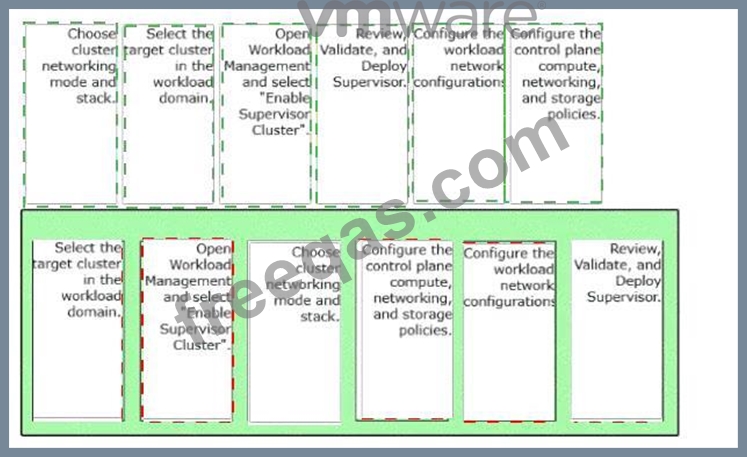
Arrange the steps below In the correct order to complete the process of enabling a Supervisor In the environment.
Correct Answer:

Explanation:
Answer (Correct Order):
* Select the target cluster in the workload domain.
* Open Workload Management and select "Enable Supervisor Cluster".
* Choose cluster networking mode and stack.
* Configure the control plane compute, networking, and storage policies.
* Configure the workload network configurations.
* Review, Validate, and Deploy Supervisor.
You start by selecting theexact vSphere cluster(in the workload domain) that will host the Supervisor, because Supervisor enablement is performedagainst a specific cluster. From there you launch the enablement workflow inWorkload Management("Enable Supervisor Cluster"). Early in the wizard you must decide thenetworking mode(for example, VDS-based vs NSX-backed) and theIP stack, because those choices drive the remaining configuration screens and what inputs are required. Next you define theSupervisor control plane settings-compute sizing and the core policies the Supervisor will use (including storage policy selections and related defaults). After the control plane foundation is defined, you configure theworkload networkingused by namespaces and Kubernetes workloads (IP ranges, routing/LB integration depending on the selected mode). Finally, youreview/validateall inputs anddeployso the platform can create and configure the Supervisor control plane and supporting components.
insert code

Question 60

An administrator is updating a VMware vSphere Kubernetes Service (VKS) cluster by editing the cluster manifest. When saving, there is no indication that the edit was successful.
Based on the scenario, what action should the administrator take to edit and apply changes to the manifest?


Correct Answer: A
The documented behavior of kubectl edit is that it opens the object manifest in a local text editor, and the editor it launches is controlled by environment variables. In the VCF 9.0 documentation (Workload Management / Supervisor operations), the procedure explicitly states: "The kubectl edit command opens the namespace manifest in the text editor defined by your KUBE_EDITOR or the EDITOR environment variable." If the administrator's environment does not have KUBE_EDITOR or EDITOR defined (or they point to an invalid/interactive-less editor in the current session), kubectl edit may not open the expected editor workflow, and the admin may not see the normal confirmation after saving and exiting. Setting KUBE_EDITOR (preferred for kubectl-specific behavior) or EDITOR ensures kubectl launches a known-good editor, allowing the manifest to be modified, saved, and then submitted back to the API server when the editor exits. The same documented requirement also applies to editing other Kubernetes objects (such as a VKS cluster manifest) because the kubectl edit mechanism is identical.
insert code
  • ««
  • «
  • …
  • 5
  • 6
  • 7
  • 8
  • 9
  • 10
  • 11
  • 12
  • 13
  • 14
  • »
[×]

Download PDF File

Enter your email address to download VMware.3V0-24.25.v2026-03-11.q63 Dumps

Email:

FreeQAs

Our website provides the Largest and the most Latest vendors Certification Exam materials around the world.

Using dumps we provide to Pass the Exam, we has the Valid Dumps with passing guranteed just which you need.

  • DMCA
  • About
  • Contact Us
  • Privacy Policy
  • Terms & Conditions
©2026 FreeQAs

www.freeqas.com materials do not contain actual questions and answers from Cisco's certification exams.