FreeQAs
 Request Exam  Contact
  • Home
  • View All Exams
  • New QA's
  • Upload
PRACTICE EXAMS:
  • Oracle
  • Fortinet
  • Juniper
  • Microsoft
  • Cisco
  • Citrix
  • CompTIA
  • VMware
  • ISC
  • SAP
  • EMC
  • PMI
  • HP
  • Salesforce
  • Other
  • Oracle
    Oracle
  • Fortinet
    Fortinet
  • Juniper
    Juniper
  • Microsoft
    Microsoft
  • Cisco
    Cisco
  • Citrix
    Citrix
  • CompTIA
    CompTIA
  • VMware
    VMware
  • ISC
    ISC
  • SAP
    SAP
  • EMC
    EMC
  • PMI
    PMI
  • HP
    HP
  • Salesforce
    Salesforce
  1. Home
  2. dbt Labs Certification
  3. dbt-Analytics-Engineering Exam
  4. dbtLabs.dbt-Analytics-Engineering.v2026-11-13.q153 Dumps
  • ««
  • «
  • …
  • 14
  • 15
  • 16
  • 17
  • 18
  • 19
  • 20
  • 21
  • 22
  • 23
  • …
  • »
  • »»
Download Now

Question 86

Dependency Break

Correct Answer: D
Proactive schema tests, dependency awareness, and failure monitoring enhance resilience.
insert code

Question 87

You inherit a project with a monolithic "super-model" performing many transformations. Why might refactoring this into smaller, interconnected models be beneficial?

Correct Answer: D
All of these are valid reasons for refactoring overly complex models in a dbt project!
insert code

Question 88

You want to trigger a dbt job immediately upon successful completion of an upstream ETL process. Which methods could achieve this?

Correct Answer: A,B
A and B establish event-driven, active triggering. C is a workaround that may be inefficient and introduce a lag. D is for sequential execution, not external event dependency.
insert code

Question 89

Examine model stg_customers_sales that exists in the main branch:
select
id as customer_id,
name as customer_name
from {{ source('my_data','my_source') }}
A developer creates a branch feature_a from main and modifies the model as:
select
id as customer_id,
name as customer_name,
country as customer_country
from {{ source('my_data','my_source') }}
A second developer also creates a branch feature_b from main and modifies the model as:
select
id as customer_id,
name as customer_name,
address as customer_address
from {{ source('my_data','my_source') }}
The first developer creates a PR and merges feature_a into main.
Then the second developer creates a PR and attempts to merge feature_b into main.
How will git combine the code from feature_b and the code from main, which now contains the changes from feature_a as well?
Statement:
"As feature_a is already approved and merged to main, the code for the model stg_customers_sales will stay as-is and the changes from feature_b won't be added."

Correct Answer: B
Git does not automatically reject or ignore changes from the second branch (feature_b). Instead, Git attempts to merge both sets of changes, and if they modify the same lines or nearby blocks of code, Git produces a merge conflict that must be manually resolved. In this scenario, both feature_a and feature_b introduce new columns into the same SELECT statement of the same model file, meaning Git must reconcile two different edits made in parallel on branches that diverged from the same commit.
Once feature_a is merged into main, the code in main contains the new column customer_country. When developer B then tries to merge feature_b, Git compares the modified file in feature_b with the updated file in main. Since both branches changed the same section of SQL, Git cannot automatically determine the correct combined output. It will not discard feature_b's changes; instead, Git requires the developer to manually merge both sets of additions, typically resulting in a combined SELECT clause with both customer_country and customer_address, unless the developer chooses otherwise.
This behavior is documented in Git fundamentals: when multiple developers modify the same file region, manual conflict resolution is required. Therefore, the statement claiming feature_b's changes "won't be added" is incorrect.
insert code

Question 90

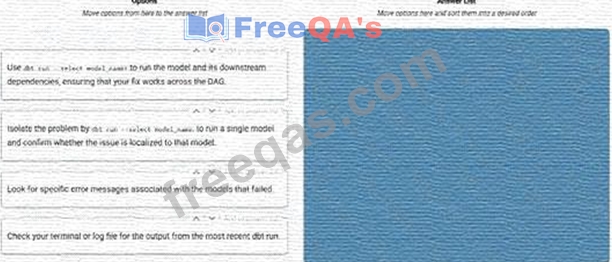
A dbt run failed with an error message.
Order these steps to fix your pipeline.
Correct Answer:

Explanation:
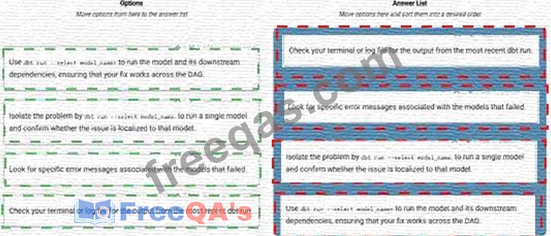
Check your terminal or log file for the output from the most recent dbt run.
Look for specific error messages associated with the models that failed.
3## Isolate the problem by dbt run --select model_name to run a single model and confirm whether the issue is localized to that model.
4## Use dbt run --select model_name+ to run the model and its downstream dependencies, ensuring that your fix works across the DAG.
Brief Explanation
* First, you always inspect the latest run output (step 1).
* Then, identify the exact failing models and error messages (step 2).
* Next, you reproduce the issue on the individual model to be sure the fix works locally (step 3).
* Finally, you re-run the model plus its downstream dependencies to validate the fix across the DAG (step 4).
insert code
  • ««
  • «
  • …
  • 14
  • 15
  • 16
  • 17
  • 18
  • 19
  • 20
  • 21
  • 22
  • 23
  • …
  • »
  • »»
[×]

Download PDF File

Enter your email address to download dbtLabs.dbt-Analytics-Engineering.v2026-11-13.q153 Dumps

Email:

FreeQAs

Our website provides the Largest and the most Latest vendors Certification Exam materials around the world.

Using dumps we provide to Pass the Exam, we has the Valid Dumps with passing guranteed just which you need.

  • DMCA
  • About
  • Contact Us
  • Privacy Policy
  • Terms & Conditions
©2026 FreeQAs

www.freeqas.com materials do not contain actual questions and answers from Cisco's certification exams.
