FreeQAs
 Request Exam  Contact
  • Home
  • View All Exams
  • New QA's
  • Upload
PRACTICE EXAMS:
  • Oracle
  • Fortinet
  • Juniper
  • Microsoft
  • Cisco
  • Citrix
  • CompTIA
  • VMware
  • ISC
  • SAP
  • EMC
  • PMI
  • HP
  • Salesforce
  • Other
  • Oracle
    Oracle
  • Fortinet
    Fortinet
  • Juniper
    Juniper
  • Microsoft
    Microsoft
  • Cisco
    Cisco
  • Citrix
    Citrix
  • CompTIA
    CompTIA
  • VMware
    VMware
  • ISC
    ISC
  • SAP
    SAP
  • EMC
    EMC
  • PMI
    PMI
  • HP
    HP
  • Salesforce
    Salesforce
  1. Home
  2. dbt Labs Certification
  3. dbt-Analytics-Engineering Exam
  4. dbtLabs.dbt-Analytics-Engineering.v2026-11-13.q153 Dumps
  • ««
  • «
  • …
  • 2
  • 3
  • 4
  • 5
  • 6
  • 7
  • 8
  • 9
  • 10
  • 11
  • …
  • »
  • »»
Download Now

Question 26

You want to display the runtime metrics (e.g., execution time) of each model directly on the DAG node. Which challenges might you face when implementing this?

Correct Answer: D
A: You might need to generate static summaries or find workarounds to display dynamic metrics. B. Collecting runtime metrics across all historical runs might require additional logging or integration with dbt artifacts (manifestjson, run_resultsjson)- C: The DAG visualization needs a balance between information and readability.
insert code

Question 27

Correct Answer:

Explanation:
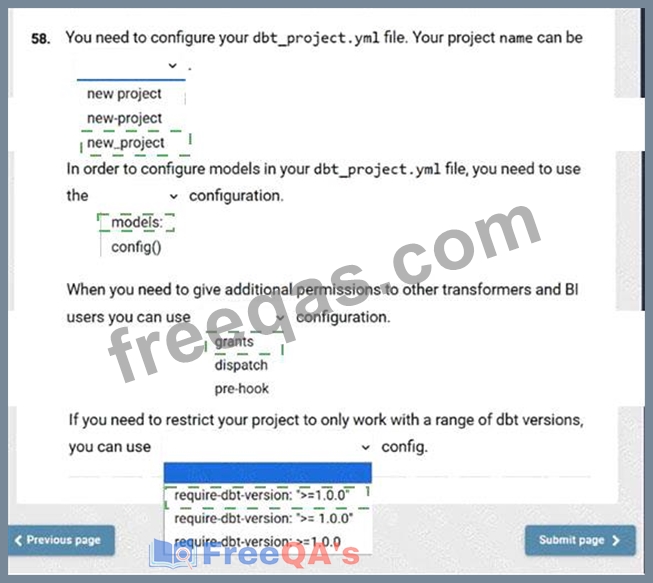
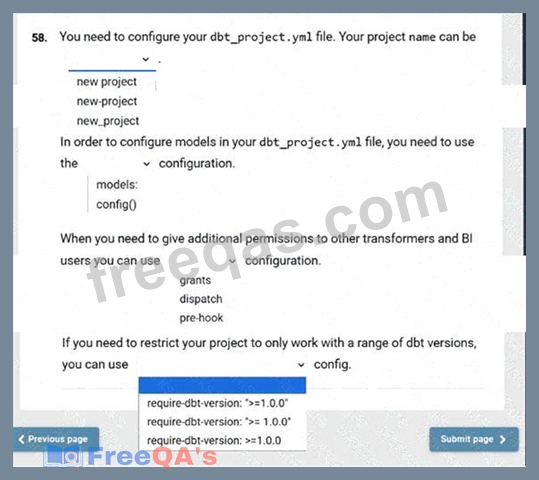
(new_project)
(models:)
(grants)
(require-dbt-version: '>= 1.0.0' )
The dbt_project.yml file acts as the configuration backbone for every dbt project. dbt requires that project names follow a strict naming convention, allowing only lowercase letters, numbers, and underscores.
Therefore, new_project is the only valid name among the choices. Names with spaces or hyphens, such as new project or new-project, violate dbt's project naming rules.
To configure how models behave-materializations, schemas, tags, or per-directory overrides-dbt uses the models: block inside dbt_project.yml. This block defines configuration inheritance rules and is different from the config() function, which is used inside SQL models, not in YAML files.
When granting permissions on database objects created by dbt, you use the grants configuration. This allows you to define access roles at the model level or project level for downstream BI or analytics tools, ensuring proper data governance and controlled data exposure.
Finally, compatibility with specific dbt versions is set using require-dbt-version. The correct YAML formatting uses quotes, such as '>= 1.0.0', ensuring dbt interprets the value as a string. This prevents accidental mis-parsing and enforces version requirements during dbt run or dbt build.
insert code

Question 28

You introduce a new data source for a dbt model. Production policies require review and approval of the source's schema before it can be used for reporting. How could you streamline this within your dbt project?

Correct Answer: A,B,D
A provides proactive checks integrated into the workflow. B establishes a self-contained validation environment. D is an easy, controlled way for review. C is reactive and could potentially halt valid deployments.
insert code

Question 29

(Multiple Select)

Correct Answer: A,B
A is for organization. B aligns execution with update patterns. C is about upstream freshness, less about scheduling itself- D is unnecessarily inefficient
insert code

Question 30

Which is true about writing generic tests?
Choose 1 option.

Correct Answer: E
The correct answer is E: They are written using the {% macro %} wrapper.
Generic tests in dbt are implemented as macros, which means they must be defined using the {% macro %} Jinja syntax. These macros return a SQL query that evaluates to rows representing test failures. dbt executes these queries and marks the test as failed if any rows are returned. This requirement is explicitly documented:
all generic tests are macros located in a test directory or within a package.
Option A is partially correct but not universal. Generic tests typically accept arguments such as model or column_name, but dbt does not require both or either. Custom tests can accept any parameters defined by the user. Option B is incorrect because tests do not require ref(); dbt injects the model relation for you when the test is executed. Option C is false because generic tests must be declared in YAML under a model or source for dbt to run them. Option D is incorrect because tests do not always need a column_name (e.g., relationship tests, row-count tests, table-level validations).
Therefore, the defining and universally required characteristic is that generic tests are written as macros, making E the correct answer.
insert code
  • ««
  • «
  • …
  • 2
  • 3
  • 4
  • 5
  • 6
  • 7
  • 8
  • 9
  • 10
  • 11
  • …
  • »
  • »»
[×]

Download PDF File

Enter your email address to download dbtLabs.dbt-Analytics-Engineering.v2026-11-13.q153 Dumps

Email:

FreeQAs

Our website provides the Largest and the most Latest vendors Certification Exam materials around the world.

Using dumps we provide to Pass the Exam, we has the Valid Dumps with passing guranteed just which you need.

  • DMCA
  • About
  • Contact Us
  • Privacy Policy
  • Terms & Conditions
©2026 FreeQAs

www.freeqas.com materials do not contain actual questions and answers from Cisco's certification exams.
