FreeQAs
 Request Exam  Contact
  • Home
  • View All Exams
  • New QA's
  • Upload
PRACTICE EXAMS:
  • Oracle
  • Fortinet
  • Juniper
  • Microsoft
  • Cisco
  • Citrix
  • CompTIA
  • VMware
  • ISC
  • SAP
  • EMC
  • PMI
  • HP
  • Salesforce
  • Other
  • Oracle
    Oracle
  • Fortinet
    Fortinet
  • Juniper
    Juniper
  • Microsoft
    Microsoft
  • Cisco
    Cisco
  • Citrix
    Citrix
  • CompTIA
    CompTIA
  • VMware
    VMware
  • ISC
    ISC
  • SAP
    SAP
  • EMC
    EMC
  • PMI
    PMI
  • HP
    HP
  • Salesforce
    Salesforce
  1. Home
  2. Cisco Certification
  3. 200-301 Exam
  4. Cisco.200-301.v2024-06-03.q594 Dumps
  • ««
  • «
  • …
  • 27
  • 28
  • 29
  • 30
  • 31
  • 32
  • 33
  • 34
  • 35
  • 36
  • …
  • »
  • »»
Download Now

Question 151

Drag and drop the threat-mitigation techniques from the left onto the types of threat or attack they mitigate on the right.

Correct Answer:
insert code

Question 152

Refer to the exhibit.

A network engineer is in the process of establishing IP connectivity between two sites. Routers R1 and R2 are partially configured with IP addressing. Both routers have the ability to access devices on their respective LANs. Which command set configures the IP connectivity between devices located on both LANs in each site?

Correct Answer: D
insert code

Question 153

Refer to the exhibit.

If configuring a static default route on the router with the ip route 0.0.0.0 0.0.0.0 10.13.0.1 120 command how does the router respond?

Correct Answer: A
Explanation
Our new static default route has the Administrative Distance (AD) of 120, which is bigger than the AD of OSPF External route (O*E2) so it will not be pushed into the routing table until the current OSPF External route is removed.For your information, if you don't type the AD of 120 (using the command "ip route 0.0.0.0
0.0.0.0 10.13.0.1") then the new static default route would replace the OSPF default route as the default AD of static route is 1. You will see such line in the routing table:S* 0.0.0.0/0 [1/0] via 10.13.0.1
insert code

Question 154

All physical cabling is in place. Router R4 and PCI are fully configured and inaccessible. R4's WAN interfaces use .4 in the last octet for each subnet.
Configurations should ensure that connectivity is established end-to-end.
1 . Configure static routing to ensure RI prefers the path through R2 to reach only PCI on R4's LAN
2. Configure static routing that ensures traffic sourced from RI will take an alternate path through R3 to PCI in the event of an outage along the primary path
3. Configure default routes on RI and R3 to the Internet using the least number of hops Guidelines This is a lab item in which tasks will be performed on virtual devices.
* Refer to the Tasks tab to view the tasks for this lab item.
* Refer to the Topology tab to access the device console(s) and perform the tasks.
* Console access is available for all required devices by clicking the device icon or using the tab(s) above the console window.
* All necessary preconfigurations have been applied.
* Do not change the enable password or hostname for any device.
* Save your configurations to NVRAM before moving to the next item.
* Click Next at the bottom of the screen to submit this lab and move to the next question.
* When Next is clicked, the lab closes and cannot be reopened.

Correct Answer: A
To configure static routing on R1 to ensure that it prefers the path through R2 to reach only PC1 on R4's LAN, you need to create a static route for the host 10.0.0.100/8 with a next-hop address of 20.0.0.2, which is the IP address of R2's interface connected to R1. You also need to assign a lower administrative distance (AD) to this route than the default AD of 1 for static routes, so that it has a higher preference over other possible routes. For example, you can use an AD of 10 for this route. To create this static route, you need to enter the following commands on R1's console:
R1#configure terminal R1(config)#ip route 10.0.0.100 255.0.0.0 20.0.0.2 10 R1(config)#end To configure static routing on R1 that ensures that traffic sourced from R1 will take an alternate path through R3 to PC1 in the event of an outage along the primary path, you need to create another static route for the host 10.0.0.100/8 with a next-hop address of 40.0.0.2, which is the IP address of R3's interface connected to R1. You also need to assign a higher AD to this route than the AD of the primary route, so that it has a lower preference and acts as a backup route. For example, you can use an AD of 20 for this route. This type of static route is also known as a floating static route. To create this static route, you need to enter the following commands on R1's console:
R1#configure terminal R1(config)#ip route 10.0.0.100 255.0.0.0 40.0.0.2 20 R1(config)#end To configure default routes on R1 and R3 to the Internet using the least number of hops, you need to create a static route for the network 0.0.0.0/0 with a next-hop address of the ISP's interface connected to each router respectively. A default route is a special type of static route that matches any destination address and is used when no other specific route is available. The ISP's interface connected to R1 has an IP address of 10.0.0.4, and the ISP's interface connected to R3 has an IP address of 50.0.0.4. To create these default routes, you need to enter the following commands on each router's console:
On R1: R1#configure terminal R1(config)#ip route 0.0.0.0 0.0.0.0 10.0.0.4 R1(config)#end On R3: R3#configure terminal R3(config)#ip route 0.0.0.0 0.0.0.0 50.0.0.4 R3(config)#end
insert code

Question 155

After a recent security breach and a RADIUS failure, an engineer must secure the console port of each enterprise router with a local username and password. Which configuration must the engineer apply to accomplish this task?
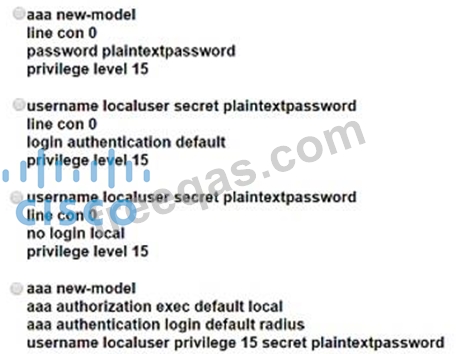

Correct Answer: C
insert code
  • ««
  • «
  • …
  • 27
  • 28
  • 29
  • 30
  • 31
  • 32
  • 33
  • 34
  • 35
  • 36
  • …
  • »
  • »»
[×]

Download PDF File

Enter your email address to download Cisco.200-301.v2024-06-03.q594 Dumps

Email:

FreeQAs

Our website provides the Largest and the most Latest vendors Certification Exam materials around the world.

Using dumps we provide to Pass the Exam, we has the Valid Dumps with passing guranteed just which you need.

  • DMCA
  • About
  • Contact Us
  • Privacy Policy
  • Terms & Conditions
©2026 FreeQAs

www.freeqas.com materials do not contain actual questions and answers from Cisco's certification exams.