FreeQAs
 Request Exam  Contact
  • Home
  • View All Exams
  • New QA's
  • Upload
PRACTICE EXAMS:
  • Oracle
  • Fortinet
  • Juniper
  • Microsoft
  • Cisco
  • Citrix
  • CompTIA
  • VMware
  • ISC
  • SAP
  • EMC
  • PMI
  • HP
  • Salesforce
  • Other
  • Oracle
    Oracle
  • Fortinet
    Fortinet
  • Juniper
    Juniper
  • Microsoft
    Microsoft
  • Cisco
    Cisco
  • Citrix
    Citrix
  • CompTIA
    CompTIA
  • VMware
    VMware
  • ISC
    ISC
  • SAP
    SAP
  • EMC
    EMC
  • PMI
    PMI
  • HP
    HP
  • Salesforce
    Salesforce
  1. Home
  2. Cisco Certification
  3. 300-420 Exam
  4. Cisco.300-420.v2026-06-15.q443 Dumps
  • ««
  • «
  • …
  • 14
  • 15
  • 16
  • 17
  • 18
  • 19
  • 20
  • 21
  • 22
  • 23
  • …
  • »
  • »»
Download Now

Question 86

An engineer uses Postman and YANG to configure a router with:
* OSPF process ID 400
* network 192.168.128.128/25 enabled for Area 0
Which get-config reply verifies that the model set was designed correctly?

Correct Answer: B
The valid get-config reply must show OSPF process ID 400 with network 192.168.128.128/25 enabled for Area 0. A /25 prefix has a block size of 128 addresses, so 192.168.128.128/25 is a valid network boundary and covers addresses from 192.168.128.128 through 192.168.128.255. Any reply that shows the wrong OSPF process, an incorrect network boundary, the wrong prefix length or wildcard equivalent, or a nonzero area does not verify the requested model set. In Cisco IOS XE model-driven configuration, the readback has to match the schema path and values used by the model, not simply produce an approximate CLI interpretation.
Option B is the reply that confirms the intended OSPF object. This verification method is important because YANG automation can fail silently in operational workflows when the payload is syntactically valid but targets the wrong container or key. A get-config verification step confirms the running datastore contains the exact OSPF process and area membership required by the design. Reference topics: YANG OSPF configuration, NETCONF get-config, prefix validation, IOS XE native models.
insert code

Question 87

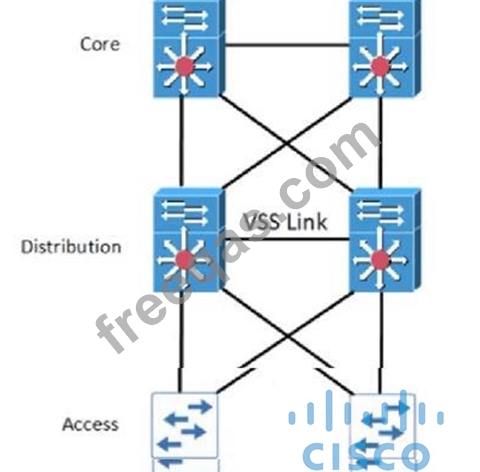
Refer to the exhibit. An engineer is designing a Layer 2 campus network. The design must support fast convergence and leverage as much bandwidth as possible between layers.
Distribution switches do support VSS; unfortunately, not all routing protocols are available for use due to license limitations. Which solution must the engineer choose?

Correct Answer: B
Configure StackWise Virtual on distribution layer and then configure MEC.
https://www.cisco.com/c/en/us/products/collateral/switches/catalyst-9000/nb-06-cat-9k-stack-wp- cte-en.html
insert code

Question 88

What is the function of the multicast Reverse Path Forwarding check?

Correct Answer: A
The multicast Reverse Path Forwarding check is a loop-prevention mechanism. Cisco multicast forwarding does not forward traffic merely because the packet arrived on any multicast-enabled interface. Instead, the router checks whether the packet arrived on the interface that would be used to route traffic back toward the multicast source or, in shared-tree cases, back toward the rendezvous point. If the packet arrives on the expected reverse path, it passes the RPF check and can be replicated to the outgoing interface list. If it arrives on the wrong interface, it is dropped to prevent loops and duplicate packets. This supports a loop-free multicast distribution tree from sources to receivers. Auto-RP mapping agents, bootstrap messages, and RP- set discovery are separate rendezvous point distribution mechanisms; they are not the function of the RPF check. In enterprise designs with redundant links, asymmetric routing, or multiple equal paths, multicast RPF behavior must be reviewed carefully because unicast routing choices directly influence whether multicast packets are accepted or discarded. Reference topics: multicast RPF, PIM forwarding, loop prevention, outgoing interface list.
insert code

Question 89

A company plans to transition to IPv6. They will link their IPv4 addresses to the lowest significant bits of the new Ipv6 addresses. A network administrator with an employee id: 4264:42:116 is preparing a mapping schema for the new IPv6 addresses. Which address does the 172.16.10.0/24 network translate to?
Correct Answer: B
insert code

Question 90


Refer to the exhibit. Which two technologies must an engineer include in the design to prevent Layer 2 loops in this topology? Choose two.


Correct Answer: A,B
The correct technologies are loop guard on uplinks and root guard on downlinks. Cisco campus Layer 2 design guidance recommends protecting the intended spanning-tree topology by placing root guard on ports where the root bridge should never appear and loop guard on non-designated ports that depend on receiving BPDUs. In a hierarchical topology, downlinks toward access switches should not be allowed to become a path to a new STP root; root guard enforces that design by moving a port to root-inconsistent state if a superior BPDU is received. Uplinks are vulnerable to failures where expected BPDUs stop arriving, which can cause an alternate or root port to incorrectly transition to forwarding. Loop guard prevents that by placing the port into loop-inconsistent blocking state. BPDU guard is not appropriate on normal interswitch uplinks or trunk downlinks because those links are expected to exchange BPDUs; it belongs mainly on PortFast edge ports.
Reference topics: STP protection, loop guard, root guard, campus Layer 2 design, Rapid PVST+.
insert code
  • ««
  • «
  • …
  • 14
  • 15
  • 16
  • 17
  • 18
  • 19
  • 20
  • 21
  • 22
  • 23
  • …
  • »
  • »»
[×]

Download PDF File

Enter your email address to download Cisco.300-420.v2026-06-15.q443 Dumps

Email:

FreeQAs

Our website provides the Largest and the most Latest vendors Certification Exam materials around the world.

Using dumps we provide to Pass the Exam, we has the Valid Dumps with passing guranteed just which you need.

  • DMCA
  • About
  • Contact Us
  • Privacy Policy
  • Terms & Conditions
©2026 FreeQAs

www.freeqas.com materials do not contain actual questions and answers from Cisco's certification exams.