FreeQAs
 Request Exam  Contact
  • Home
  • View All Exams
  • New QA's
  • Upload
PRACTICE EXAMS:
  • Oracle
  • Fortinet
  • Juniper
  • Microsoft
  • Cisco
  • Citrix
  • CompTIA
  • VMware
  • ISC
  • SAP
  • EMC
  • PMI
  • HP
  • Salesforce
  • Other
  • Oracle
    Oracle
  • Fortinet
    Fortinet
  • Juniper
    Juniper
  • Microsoft
    Microsoft
  • Cisco
    Cisco
  • Citrix
    Citrix
  • CompTIA
    CompTIA
  • VMware
    VMware
  • ISC
    ISC
  • SAP
    SAP
  • EMC
    EMC
  • PMI
    PMI
  • HP
    HP
  • Salesforce
    Salesforce
  1. Home
  2. Cisco Certification
  3. 300-420 Exam
  4. Cisco.300-420.v2026-06-15.q443 Dumps
  • ««
  • «
  • …
  • 12
  • 13
  • 14
  • 15
  • 16
  • 17
  • 18
  • 19
  • 20
  • 21
  • …
  • »
  • »»
Download Now

Question 76

Which two considerations must be made regarding the overlay network for a Cisco SD-Access architecture?
(Choose two.)

Correct Answer: C,E
The correct overlay considerations are that virtual networks provide data-plane isolation and that overlapping IP addresses should be avoided for operational simplicity. In Cisco SD-Access, virtual networks are used for macro segmentation and are commonly mapped to VRFs. This separates routing and forwarding tables between major groups such as corporate users, guests, IoT, and shared services. Security Group Tags provide finer policy control and microsegmentation, but they are not the primary mechanism for data-plane isolation between virtual networks. The phrase "virtual networks should be used for microsegmentation" is therefore inaccurate; microsegmentation is SGT and SGACL driven. Although overlapping IP addresses can technically exist in separate VRF-like contexts, Cisco design practice discourages unnecessary overlap because it complicates troubleshooting, service insertion, external connectivity, and inter-VN communication. A clean overlay address plan improves operations and reduces policy ambiguity. Reference topics: SD-Access overlay design, virtual networks, macro segmentation, SGTs, microsegmentation, overlapping IP avoidance. This also simplifies day-two operations.
insert code

Question 77

An engineer must propose a QoS architecture model that allows an application to inform the network of its traffic profile and to request a particular type of service to support its bandwidth and delay requirements.
The application requires consistent and dedicated bandwidth end to end. Which QoS architecture model meets these requirements?
Correct Answer: A
insert code

Question 78


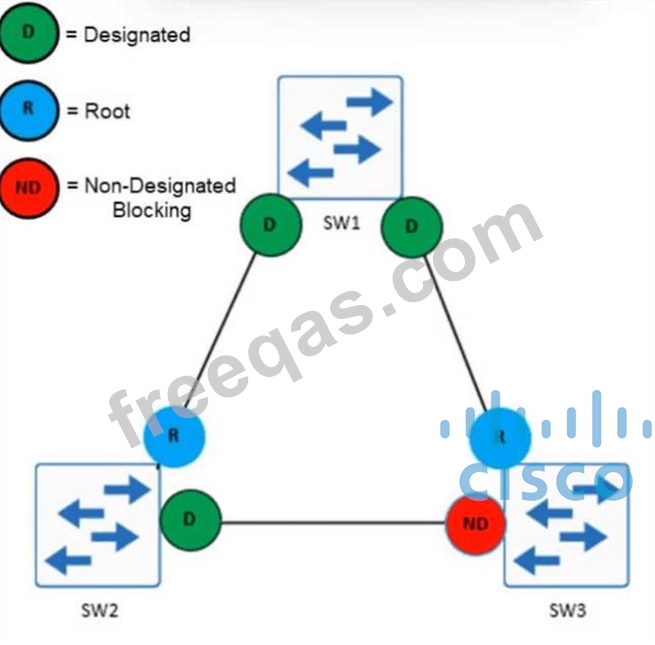
Refer to the exhibit. An architect is designing a Layer 2 network for a customer. The network will use the spanning-tree protocol. During a link failure between SW1 and SW2, the fastest possible convergence time is desired. Which solution must the architect select?

Correct Answer: B
UplinkFast is the correct spanning-tree feature for faster convergence after an uplink failure in a classic STP access-layer design. UplinkFast is designed for access switches that have redundant uplinks toward the distribution layer. When the primary root port fails, UplinkFast allows an alternate blocked uplink to transition rapidly to forwarding, reducing the outage compared with standard 802.1D timer-based convergence. PortFast is used on edge ports connected to end hosts, not on switch-to-switch uplinks. Loop Guard protects against unidirectional failures or missing BPDUs on non-designated ports, but it does not accelerate recovery from an access uplink failure. BackboneFast helps when an indirect link failure is detected elsewhere in the topology, but the described failure is directly between SW1 and SW2. The design objective is the fastest possible convergence during that direct uplink loss, which matches UplinkFast in a traditional STP environment. Reference topics: Spanning Tree Protocol, UplinkFast, access-layer redundancy, root port failover, Layer 2 convergence.
insert code

Question 79

Since installing a cisco TelePresence system, the company is experiencing other application having response issues when the system in use. As a result, the company asked an architect to recommend a QoS solution. The customer is currently using a CBWFQ policy to manage traffic on an internet connection with a speed of 100 Mbps. Which link-capacity limit must the architect choose for strict-priority for the real-time traffic?

Correct Answer: C
https://www.cisco.com/c/en/us/td/docs/ios-xml/ios/qos_conmgt/configuration/xe-3s/qos-conmgt-xe-3s-book
/qos-conmgt-oview.html#GUID-48F6AF58-5CCC-44A0-B868-125AE453FF2A%20%20%20%20%20%20 (75%20Mbps) The sum of all bandwidth allocation on an interface cannot exceed 75 percent of the total available interface bandwidth. The remaining 25 percent is used for other overhead, including Layer 2 overhead, routing traffic, and best-effort traffic. Bandwidth for the CBWFQ class-default class, for instance, is taken from the remaining 25 percent.
insert code

Question 80

An engineer is working with NETCONF and Cisco NX-OS based devices. The engineer needs a YANG model that supports a specific feature relevant only to Cisco NX-OS. Which model must the engineer choose?


Correct Answer: A
Explanation
https://github.com/YangModels/yang/tree/master/vendor/cisco
https://blogs.cisco.com/developer/which-yang-model-to-use
insert code
  • ««
  • «
  • …
  • 12
  • 13
  • 14
  • 15
  • 16
  • 17
  • 18
  • 19
  • 20
  • 21
  • …
  • »
  • »»
[×]

Download PDF File

Enter your email address to download Cisco.300-420.v2026-06-15.q443 Dumps

Email:

FreeQAs

Our website provides the Largest and the most Latest vendors Certification Exam materials around the world.

Using dumps we provide to Pass the Exam, we has the Valid Dumps with passing guranteed just which you need.

  • DMCA
  • About
  • Contact Us
  • Privacy Policy
  • Terms & Conditions
©2026 FreeQAs

www.freeqas.com materials do not contain actual questions and answers from Cisco's certification exams.